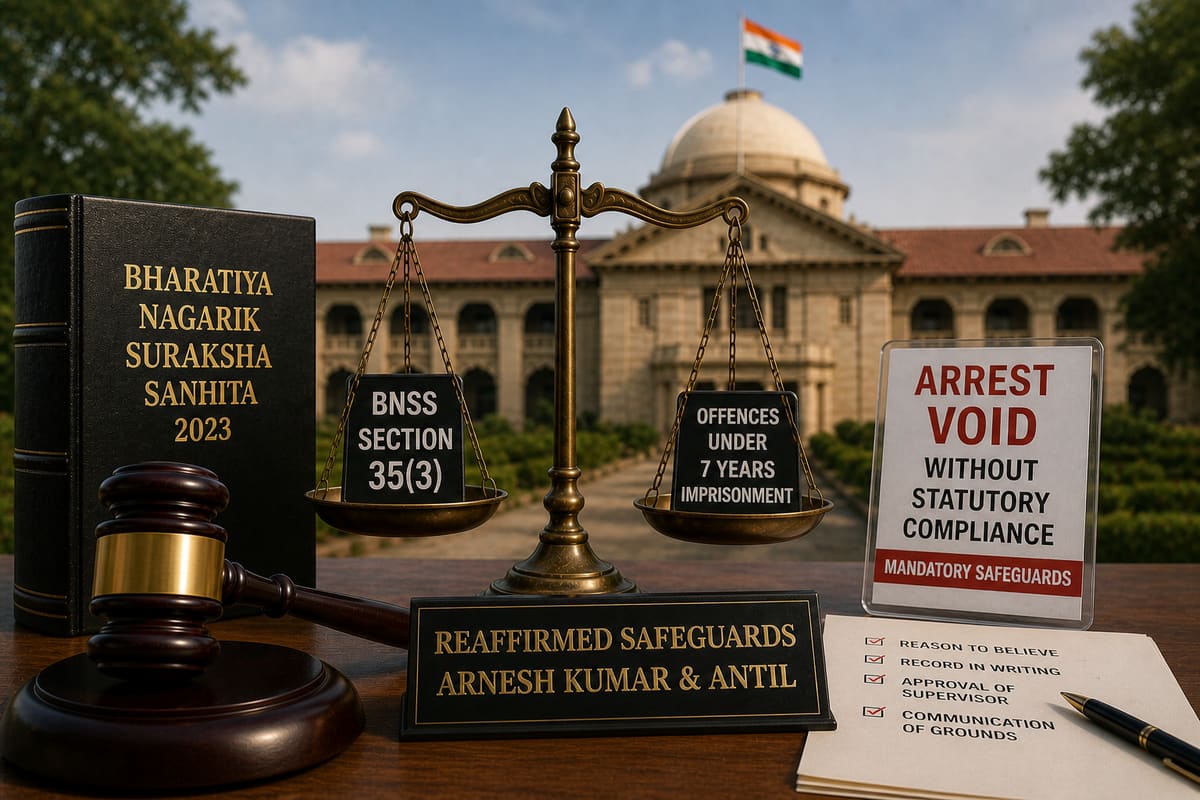
The Allahabad High Court has reiterated the necessity of adhering to procedural safeguards under Section 35 of the Bharatiya Nyaya Sanhita (BNSS), aligning it with the principles laid down in Arnesh Kumar v. State of Bihar. The judgment underscores that police cannot arrest accused persons without first issuing a notice and following the prescribed procedure, even in cases involving serious offences under the Scheduled Castes and Scheduled Tribes (Prevention of Atrocities) Act, 1989 and the Bharatiya Nyaya Sanhita (BNS).
Background & Facts
The Dispute
The petitioners, Munnavvar and others, sought quashing of an FIR (Case Crime No. 0183/2026) registered on 21.05.2026 at Police Station Gosainganj, District Sultanpur. The FIR invoked multiple provisions, including:
- Sections 110, 115(2), 3(5), 333, 351(3), and 352 of the Bharatiya Nyaya Sanhita (BNS)
- Sections 3(1)(r), 3(1)(d), and 3(2)(va) of the Scheduled Castes and Scheduled Tribes (Prevention of Atrocities) Act, 1989 (as amended in 2015)
The petitioners also sought a mandamus restraining the police from arresting them in connection with the FIR.
Key Facts
- The FIR was registered on 21.05.2026 under serious offences, some of which entail a sentence of up to seven years.
- The petitioners approached the High Court seeking quashing of the FIR and protection from arrest.
- The State, represented by the Additional Government Advocate (AGA), submitted that the police would comply with Section 35 of the BNSS, which prescribes the procedure for arrest.
Procedural History
- 21.05.2026: FIR registered under the aforementioned provisions.
- Date not specified: Petitioners filed Criminal Misc. Writ Petition No. 5512 of 2026 before the Allahabad High Court, Lucknow Bench.
- 19.06.2026: The High Court disposed of the petition with directions to the police to comply with Section 35 of the BNSS.
Relief Sought
The petitioners sought:
- Quashing of the FIR registered as Case Crime No. 0183/2026.
- A direction to the police not to arrest them in connection with the FIR.
- Compliance with procedural safeguards under Section 35 of the BNSS, akin to Section 41A of the CrPC.
The Legal Issue
The central question before the Court was whether Section 35 of the BNSS mandates the issuance of a notice and adherence to procedural safeguards before arresting an accused, even in cases involving serious offences under the SC/ST Act and BNS.
Arguments Presented
For the Petitioners
The petitioners relied on the judgment in Arnesh Kumar v. State of Bihar, arguing that:
- Section 35 of the BNSS (akin to Section 41A of the CrPC) requires the police to issue a notice before arresting an accused.
- The procedure prescribed under Section 35 must be followed, failing which any arrest would be illegal.
- The gravity of the offence alone cannot justify bypassing procedural safeguards.
For the Respondent
The Additional Government Advocate (AGA) for the State submitted that:
- The offences alleged entail a sentence of up to seven years, justifying potential arrest.
- The police would comply with the provisions of Section 35 of the BNSS, including sub-sections 35(3) to 35(6), which prescribe the mode, manner, and procedure for arrest.
- The State would ensure that no arbitrary arrest would be made without following the due process.
The Court's Analysis
The Court examined the provisions of Section 35 of the BNSS, which are analogous to Section 41A of the CrPC, and reiterated the principles laid down in Arnesh Kumar v. State of Bihar. The Court observed:
"Petitioners are entitled for the benefit of provisions embodied under Section 35 of BNSS, which are akin to Section 41A Cr.P.C."
The Court further noted the submission of the AGA that the police would follow the procedure prescribed under Section 35 of the BNSS, including sub-sections 35(3) to 35(6). The Court relied on the following extract from Arnesh Kumar:
"9. Another provision i.e. Section 41A Cr.PC aimed to avoid unnecessary arrest or threat of arrest looming large on accused requires to be vitalised. Section 41A as inserted by Section 6 of the Code of Criminal Procedure (Amendment) Act, 2008(Act 5 of 2009), which is relevant in the context reads as follows:
'41A. Notice of appearance before police officer.- (1) The police officer shall, in all cases where the arrest of a person is not required under the provisions of sub-section (1) of Section 41, issue a notice directing the person against whom a reasonable complaint has been made, or credible information has been received, or a reasonable suspicion exists that he has committed a cognizable offence, to appear before him or at such other place as may be specified in the notice.'"
The Court emphasized that Section 35 of the BNSS mandates the issuance of a notice to the accused before arrest, unless the arrest is necessary under Section 35(1). The Court held that:
- The police must issue a notice to the accused, directing them to appear before the police officer.
- If the accused complies with the notice, they shall not be arrested unless the police, for reasons to be recorded, form the opinion that arrest is necessary.
- The condition precedent for arrest under Section 35(1) of the BNSS must be strictly complied with, and the Magistrate must scrutinize the reasons for arrest.
The Court disposed of the petition with directions to the police to strictly comply with the provisions of Section 35 of the BNSS, ensuring that the mode, manner, and procedure prescribed therein are followed.
The Verdict
The Allahabad High Court disposed of the petition with the following directions:
- The police authorities are directed to proceed strictly in terms of Section 35 of the BNSS, ensuring compliance with the procedural safeguards akin to Section 41A of the CrPC.
- The Investigating Officer shall ensure compliance with sub-sections 35(3) to 35(6) of the BNSS, which prescribe the procedure for arrest.
- The petitioners shall not be arrested without following the due process, including the issuance of a notice under Section 35 of the BNSS.
What This Means For Similar Cases
Procedural Safeguards Are Non-Negotiable
This judgment reinforces that procedural safeguards under Section 35 of the BNSS (akin to Section 41A of the CrPC) must be strictly followed, even in cases involving serious offences. Practitioners should note:
- Notice before arrest: The police must issue a notice to the accused before effecting an arrest, unless the arrest is justified under Section 35(1) of the BNSS.
- Magistrate’s scrutiny: The reasons for arrest must be recorded and scrutinized by the Magistrate to prevent arbitrary detention.
- Compliance with sub-sections: Sub-sections 35(3) to 35(6) of the BNSS must be adhered to, ensuring transparency and fairness in the arrest procedure.
Gravity of Offence Does Not Justify Arbitrary Arrest
The Court has clarified that the gravity of the offence alone cannot justify bypassing procedural safeguards. This has significant implications for:
- Defence lawyers: Can argue for quashing of FIRs or protection from arrest where procedural safeguards are not followed.
- Prosecution: Must ensure that due process is followed to avoid challenges to the legality of arrests.
- Judicial officers: Must scrutinize the reasons for arrest to prevent misuse of power by investigating agencies.
SC/ST Act Cases Must Adhere to Due Process
Even in cases registered under the Scheduled Castes and Scheduled Tribes (Prevention of Atrocities) Act, 1989, the police cannot arrest accused persons without following the procedure under Section 35 of the BNSS. This judgment serves as a precedent for ensuring fair investigation in sensitive cases, balancing the rights of the accused with the interests of justice.