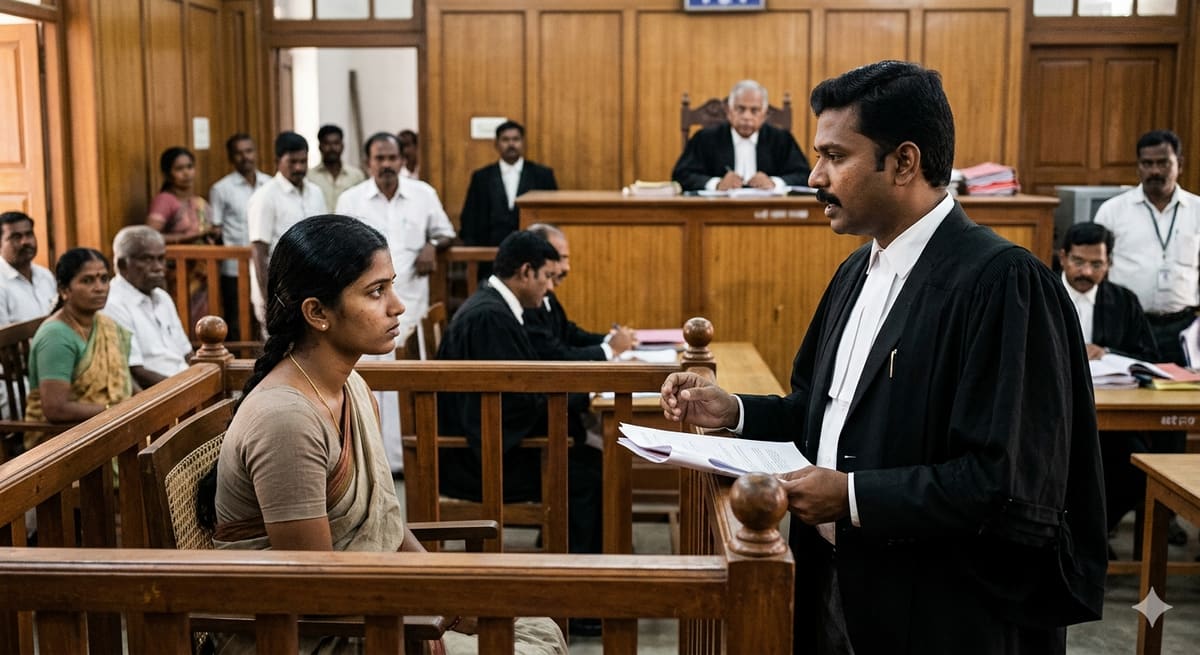
The Madras High Court has affirmed that an accused’s right to cross-examine witnesses under Section 311 of the CrPC cannot be extinguished by administrative circulars, particularly when legal aid counsel fails to exercise that right. This ruling reinforces procedural fairness in POCSO cases, ensuring that technical barriers do not override the fundamental right to a fair trial.
Background & Facts
The Dispute
The petitioner, accused No.3 in Special Criminal Case No.87 of 2025 before the Special Court for POCSO Act cases in Srivilliputtur, faces charges under the Protection of Children from Sexual Offences Act, 2012. The prosecution examined P.W.1 and P.W.2, the alleged victims, on 08.01.2026. At that time, the petitioner was represented by a Legal Aid Counsel, who chose not to cross-examine either witness. The petitioner engaged private counsel only on 30.01.2026. On 18.02.2026, she filed an application under Section 311 of the CrPC seeking recall of P.W.1 and P.W.2 for cross-examination. The trial court dismissed the application on 11.03.2026, relying on a High Court circular prohibiting the recall of victims for cross-examination.
Key Facts
The petitioner was charged under the POCSO Act in Crime No.06 of 2025
P.W.1 and P.W.2 were examined-in-chief on 08.01.2026
The petitioner was represented by Legal Aid Counsel on the date of examination-in-chief
Legal Aid Counsel did not cross-examine either victim
The petitioner engaged private counsel on 30.01.2026
Application under Section 311 CrPC filed on 18.02.2026
Trial Court dismissed the application on 11.03.2026 citing a High Court circular
No prior opportunity for cross-examination was afforded to the petitioner
Procedural History
08.01.2026: Examination-in-chief of P.W.1 and P.W.2 conducted; no cross-examination by Legal Aid Counsel
30.01.2026: Petitioner engaged private counsel
18.02.2026: Application under Section 311 CrPC filed for recall of witnesses
11.03.2026: Trial Court dismissed application relying on High Court circular
28.04.2026: Criminal Original Petition filed under Section 528 of BNSS, 2023, before Madurai Bench of Madras High Court
Relief Sought
The petitioner sought setting aside of the order dated 11.03.2026 dismissing her application under Section 311 CrPC, and permission to cross-examine P.W.1 and P.W.2.
The Legal Issue
The central question was whether a trial court may deny an accused’s application under Section 311 CrPC to recall victims for cross-examination solely on the basis of a High Court circular, when the accused was initially represented by Legal Aid Counsel who failed to cross-examine.
Arguments Presented
For the Petitioner
The learned counsel argued that Section 311 CrPC is a discretionary provision designed to secure the ends of justice, and its purpose is defeated when an accused is deprived of cross-examination due to the inaction of Legal Aid Counsel. The circular, being an administrative directive, cannot override statutory rights. Reliance was placed on State of U.P. v. Krishna Gopal and Rajendra Prasad v. State of U.P., which hold that the right to cross-examine is a vital component of fair trial under Article 21 of the Constitution.
For the Respondent
The Additional Public Prosecutor contended that the circular issued by the High Court was intended to prevent harassment of child victims and ensure expeditious trial. The prosecution argued that allowing recall of victims would defeat the spirit of the POCSO Act and subject children to repeated trauma. The circular, it was submitted, was a legitimate exercise of supervisory jurisdiction under Article 227 of the Constitution.
The Court's Analysis
The Court examined the nature and scope of Section 311 CrPC, which empowers the court to summon any person as a witness or examine any person in attendance, even if not summoned, if their evidence appears essential to the just decision of the case. The Court emphasized that this provision is not a mere procedural formality but a substantive safeguard for the accused’s right to a fair trial.
"The right to cross-examine is not a privilege but a constitutional imperative under Article 21. Denial of this right on the basis of a circular, especially when the accused was initially represented by Legal Aid Counsel who did not cross-examine, amounts to a denial of justice."
The Court held that administrative circulars cannot override statutory rights conferred by the CrPC. While the intent behind the circular - to protect child victims from repeated trauma - is commendable, it cannot operate as a blanket bar to cross-examination. The Court noted that the petitioner had no opportunity to cross-examine because her counsel at the time did not exercise that right, and she was not at fault. The trial court’s refusal to permit cross-examination under these circumstances was arbitrary and violative of natural justice.
The Court further clarified that the remedy under Section 311 CrPC is not an invitation to delay or abuse process, and therefore, the petitioner was granted a single opportunity to complete cross-examination on the day of appearance.
The Verdict
The petition was allowed. The order dated 11.03.2026 dismissing the application under Section 311 CrPC was set aside. The petitioner is directed to pay batta within three days and complete the cross-examination of P.W.1 and P.W.2 on the same day of their appearance. No further opportunity shall be granted. The connected miscellaneous petition is closed.
What This Means For Similar Cases
Cross-Examination Cannot Be Barred by Circulars
Practitioners must challenge any administrative directive that restricts the use of Section 311 CrPC where the accused’s right to cross-examine is compromised due to counsel’s inaction
Courts must prioritize statutory rights over procedural guidelines that lack legislative backing
Legal Aid Representation Does Not Waive Rights
The failure of a Legal Aid Counsel to cross-examine does not constitute waiver by the accused
Accused must be given a fair opportunity to exercise their rights once they secure private counsel
This applies equally in POCSO, rape, and other sensitive cases where victims are witnesses
Procedural Fairness Trumps Expediency
Speedy trial cannot justify denial of fundamental rights
Courts must balance victim protection with the accused’s right to a fair hearing
Any restriction on cross-examination must be case-specific, not blanket
Always file an application under Section 311 CrPC if cross-examination was missed due to counsel’s lapse
Cite State of U.P. v. Krishna Gopal and Rajendra Prasad v. State of U.P. to reinforce constitutional rights
Argue that circulars are not binding if they conflict with statutory provisions