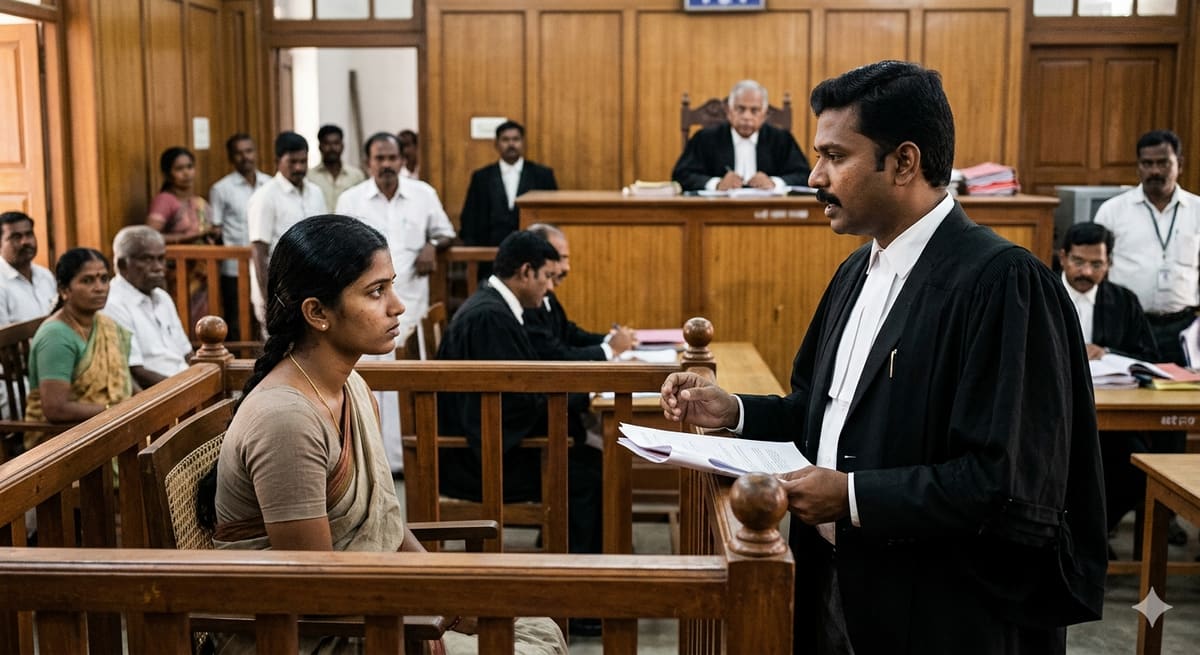
The Uttarakhand High Court has affirmed that the right to cross-examine prosecution witnesses is not a procedural formality but a foundational element of fair trial under Article 21 of the Constitution. In a POCSO case where the accused had been in judicial custody since 2005, the Court set aside the trial court’s refusal to recall key witnesses, emphasizing that denial of this right risks a miscarriage of justice.
Background & Facts
The Dispute
The applicant, accused in a POCSO case, was arrested on 01.05.2005 and has remained in judicial custody since then. The prosecution recorded statements of five witnesses - P.W.1, P.W.2, P.W.3 on 26.08.2025; P.W.4 on 02.09.2025; and P.W.5 on 09.09.2025. During this period, the applicant’s counsel failed to appear for cross-examination. The applicant, upon learning of this omission, immediately changed counsel and filed an application under Section 311 CrPC on 16.09.2025 seeking recall of these witnesses for cross-examination.
Key Facts
- The applicant has been in continuous judicial custody since 01.05.2005
- Prosecution witnesses P.W.1 to P.W.5 were examined between 26.08.2025 and 09.09.2025
- The applicant’s counsel did not cross-examine any of these five witnesses
- The applicant filed an application under Section 311 CrPC on 16.09.2025
- The Additional Sessions Judge/F.T.S.C. (POCSO), Roorkee, dismissed the application on the same day
- P.W.6 and P.W.7 have since been examined and cross-examined by the defence
- The trial is still at the stage of recording prosecution evidence
Procedural History
- 01.05.2005: Applicant arrested and placed in judicial custody
- 26.08.2025: Prosecution examination of P.W.1, P.W.2, P.W.3
- 02.09.2025: Prosecution examination of P.W.4
- 09.09.2025: Prosecution examination of P.W.5
- 16.09.2025: Applicant files application under Section 311 CrPC for recall of witnesses
- 16.09.2025: Trial Court dismisses application without hearing
- 30.04.2026: Uttarakhand High Court hears criminal miscellaneous application
The Parties' Positions
Relief Sought
The applicant sought recall of P.W.1 to P.W.5 for cross-examination, arguing that failure to do so would violate his right to a fair trial under Article 21 and Section 311 CrPC.
The Legal Issue
The central question was whether Section 311 CrPC permits recall of prosecution witnesses for cross-examination when the accused, despite being in custody, was denied a meaningful opportunity to challenge their testimony, and whether such denial constitutes a violation of natural justice and the right to a fair trial.
Arguments Presented
For the Appellant/Petitioner
Counsel argued that the right to cross-examine is a substantive right, not a mere formality, and is integral to the principles of natural justice. Reliance was placed on Zahira Habibullah H. Sheikh v. State of Gujarat and Natasha Singh v. CBI to establish that denial of cross-examination, particularly when the accused is in custody and unable to effectively instruct counsel, amounts to a denial of fair trial. It was submitted that the applicant acted promptly upon discovering the lapse and that no prejudice would accrue to the prosecution if the witnesses were recalled.
For the Respondent/State
The State counsel did not dispute that cross-examination of the five witnesses had not been conducted. No counter-arguments were advanced to justify the trial court’s summary dismissal of the application.
The Court's Analysis
The Court held that the right to cross-examine prosecution witnesses is a cornerstone of adversarial justice and a non-negotiable component of fair trial under Article 21. The Court observed that the applicant, despite being in custody since 2005, was not in a position to effectively instruct his counsel during the recording of the prosecution’s evidence. The failure to cross-examine P.W.1 to P.W.5 strikes at the heart of the defence’s ability to challenge the prosecution’s case.
"Denial of fair opportunity to cross-examine witnesses would amount to denial of fair trial."
The Court cited Zahira Habibullah H. Sheikh v. State of Gujarat to underscore that procedural lapses affecting the accused’s ability to defend himself cannot be condoned. It further relied on Natasha Singh v. CBI to affirm that recall of witnesses under Section 311 CrPC is permissible when essential for a just decision and where no serious prejudice is caused to the prosecution.
The Court rejected the trial court’s summary dismissal, noting that the order was passed without appreciating the circumstances of custody, the timing of the application, or the settled legal principles. It emphasized that the prosecution’s case remains untested on critical points, and allowing cross-examination would not delay the trial unduly, as the trial is still at the evidence-recording stage.
The Verdict
The applicant succeeded. The Uttarakhand High Court set aside the order dated 16.09.2025 dismissing the Section 311 CrPC application. The Court directed the trial court to recall P.W.1, P.W.2, P.W.3, P.W.4 and P.W.5 for cross-examination. The applicant was directed not to seek any adjournment, and the cross-examination of these five witnesses must be concluded expeditiously.
What This Means For Similar Cases
Cross-Examination Is Not a Formality
- Practitioners must immediately move under Section 311 CrPC if prosecution witnesses are examined without defence cross-examination, especially when the accused is in custody
- Trial courts cannot summarily dismiss such applications without considering custody constraints and the right to fair trial
Custody Does Not Waive Procedural Rights
- Judicial custody does not negate the accused’s right to effective legal representation or to challenge prosecution evidence
- Courts must actively ensure that custody does not become a barrier to procedural fairness
Section 311 CrPC Is a Tool for Justice, Not a Burden
- Recall of witnesses under Section 311 CrPC is not an abuse of process but a corrective mechanism to prevent miscarriage of justice
- Courts should prioritize substance over technicality when the accused’s defence is compromised