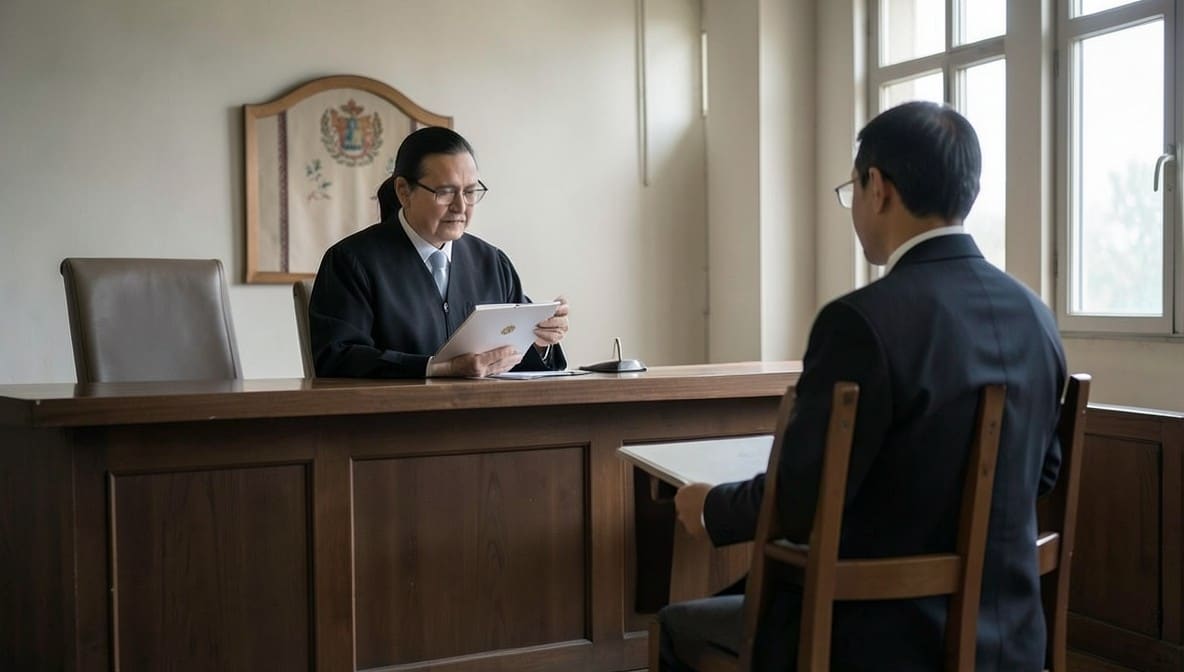
The Madhya Pradesh High Court has affirmed that the right to a fair trial under Section 311 of the CrPC includes the power to recall a witness for re-cross-examination when new contradictions emerge from subsequent testimony. This ruling ensures that procedural fairness is not sacrificed due to the sequential nature of witness examination.
Background & Facts
The Dispute
The petitioners, accused in a criminal trial, sought to re-cross-examine the Investigating Officer (IO), Kashiram Jhariya (PW-9), after the prosecutrix (PW-6) was re-examined. The trial court had rejected their application under Section 348 of the BNSS, holding that the IO had already been fully examined and no further opportunity was warranted.
Key Facts
- The IO, Kashiram Jhariya (PW-9), was examined on 06.02.2026
- The prosecutrix (PW-6) was originally examined prior to the IO
- On 05.05.2026, the prosecutrix was re-examined following an order by a coordinate Bench in M.Cr.C. No. 13186/2026
- During this re-examination, material contradictions and omissions emerged in her testimony that were not apparent during the initial cross-examination of the IO
- The petitioners sought to put these newly revealed contradictions to the IO, as they directly impacted the credibility of the prosecution’s case and the defence’s ability to rebut it
- The trial court denied the application, citing that the IO had already been cross-examined and Section 311 CrPC should not be used to fill lacunae in the defence
Procedural History
- 06.02.2026: Investigating Officer (PW-9) examined and cross-examined
- 05.05.2026: Prosecutrix (PW-6) re-examined after coordinate Bench order in M.Cr.C. No. 13186/2026
- 14.05.2026: Trial court rejects application under Section 348 BNSS to recall IO for re-cross-examination
- 17.05.2026: Petitioners file M.Cr.C. No. 24690/2026 under Section 482 CrPC / Section 528 BNSS before the High Court
- 01.07.2026: High Court hears arguments and delivers judgment
Relief Sought
The petitioners sought a direction to the trial court to recall PW-9, Kashiram Jhariya, for limited re-cross-examination on specific points arising from the re-examination of the prosecutrix.
The Legal Issue
Can a court permit re-cross-examination of a witness under Section 311 of the CrPC when new contradictions emerge from the re-examination of another witness, even if the first witness has already been examined?
Arguments Presented
For the Petitioner
Learned counsel argued that the re-examination of the prosecutrix on 05.05.2026 revealed contradictions and omissions that were not known at the time of the IO’s initial cross-examination on 06.02.2026. These contradictions directly affected the reliability of the investigation and the veracity of the prosecution’s narrative. The petitioners contended that Section 311 CrPC empowers the court to recall any witness at any stage if it is necessary for a just decision. They emphasized that the request was limited, specific, and aimed at ensuring a fair trial, not at delaying proceedings.
For the Respondent
The State opposed the prayer, asserting that the petitioners had already been given a full opportunity to cross-examine the IO. The Deputy Government Advocate relied on the principle that Section 311 CrPC cannot be invoked to remedy a defence’s own failure to ask relevant questions during the initial examination. The State argued that allowing re-cross-examination would set a precedent for endless adjournments and undermine the finality of evidence recording.
The Court's Analysis
The Court examined the purpose of Section 311 CrPC, which is not merely procedural but substantive - designed to ensure that justice is not defeated by technicalities. The Court noted that the prosecution’s case evolved after the IO’s examination, due to the re-examination of the prosecutrix. The contradictions revealed during that re-examination were material to the defence’s case and could not have been anticipated or raised during the initial cross-examination of the IO.
"At the time of cross-examination of the I.O., the question regarding omission and contradictions which came in the statement of prosecutrix could not be put up before him which are necessary for defence of the petitioners."
The Court rejected the State’s argument that this was an attempt to "fill lacunae" in the defence, distinguishing between a failure to prepare and a genuine emergence of new facts. It held that the right to cross-examine is a fundamental component of natural justice and that the court’s duty under Section 311 CrPC is to ensure that all relevant evidence is brought before it, even if it requires recalling a witness.
The Court further clarified that this was not an invitation to reopen evidence routinely, but a one-time, narrowly tailored opportunity to address a specific and unforeseen development in the trial.
The Verdict
The petition succeeded. The High Court set aside the trial court’s order dated 14.05.2026 and directed the trial court to grant the petitioners one opportunity to re-cross-examine the Investigating Officer, Kashiram Jhariya (PW-9), on the limited points arising from the re-examination of the prosecutrix on 05.05.2026. The trial court was directed to fix a date for this re-cross-examination, and if the petitioners’ counsel failed to appear or proceed on that date, the trial was to continue without further delay. No costs were awarded.
What This Means For Similar Cases
Re-cross-examination Is Permissible When New Evidence Emerges
- Practitioners may now invoke Section 311 CrPC to recall witnesses when subsequent testimony reveals contradictions or omissions that materially affect the defence
- The burden is on the applicant to demonstrate that the new points were genuinely unforeseeable at the time of the original cross-examination
- Courts must evaluate whether the request is specific, limited, and necessary for a just outcome - not a fishing expedition
Fair Trial Trumps Procedural Finality
-
The judgment reinforces that procedural finality cannot override the right to a fair trial under Article 21 of the Constitution
-
The court’s discretion under Section 311 CrPC is not a mere formality but a substantive safeguard
-
Defence counsel should document and preserve all prior testimony to identify contradictions that emerge later
-
Always file applications under Section 311 CrPC with a clear affidavit detailing the new points and their relevance
-
Avoid broad requests; specify exact questions to be asked to avoid dismissal as "fishing"
-
Cite State of U.P. v. Krishna Murari and Rajesh Kumar v. State of Haryana to support the principle that justice must prevail over technicalities