The Karnataka High Court has reaffirmed that in fatal road accidents involving multiple parties, the prosecution need not prove the accused’s guilt beyond all possible doubt - but must establish it beyond reasonable doubt, and the accused bears the burden of substantiating affirmative defenses with credible evidence. This judgment clarifies how injury patterns and unverified documentary claims are weighed in determining driver identity under Section 304A IPC.
Background & Facts
The Dispute
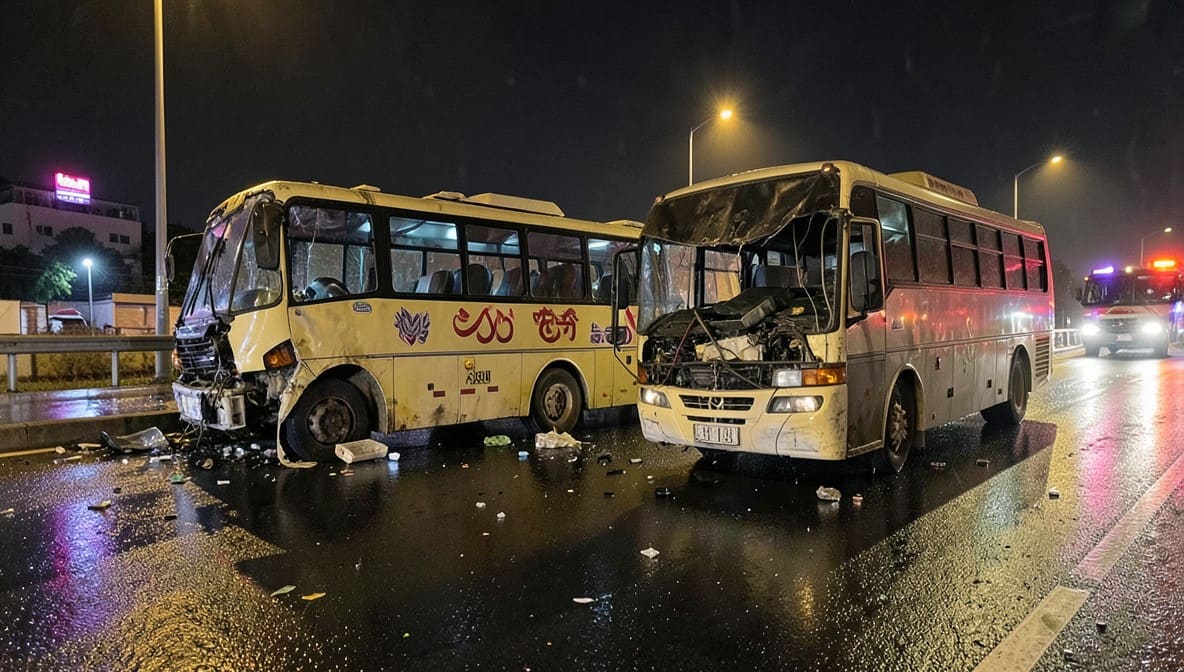
On 13.10.2008 at approximately 1:35 a.m., a head-on collision occurred between two KSRTC buses on National Highway near Mallapanahalli Gate, Kolar District. The bus bearing registration No. KA-07/F-1177, traveling from Tirupathi to Bengaluru, collided with the Volvo bus KA-01/F-7383, traveling from Bengaluru to Chennai. The impact resulted in the death of ten passengers and injuries to several others.
Key Facts
- The complainant, Venkataramu, was a passenger in the Volvo bus and sustained injuries to his left leg.
- Ten deceased passengers were identified, all traveling in the Volvo bus (KA-01/F-7383), including software engineers, a major in the army, and minors.
- The petitioner, Sri K. Nagaraja, aged 43, was identified by the prosecution as the driver of the offending bus (KA-07/F-1177).
- The petitioner claimed he was not the driver but the conductor, and that Anjaneya Prasad was the actual driver.
- The petitioner sustained injuries to his right hand, head, nose, and fingers of the legs.
- Anjaneya Prasad, examined as PW-5, denied being the driver and denied that the petitioner was the conductor.
- The petitioner produced two documents - Exhibit D-1 (log sheet) and Exhibit D-2 (route copy) - to support his claim of being conductor.
- Neither author of D-1 or D-2 was examined.
- Custody of D-1 and D-2 was not established.
- No official records or higher authority attestations were produced to corroborate the petitioner’s role.
Procedural History
- 13.10.2008: Fatal road accident occurred at 1:35 a.m.
- 14.10.2008: FIR registered as Crime No. 339/2008 under Sections 279, 337, 338, and 304A IPC.
- 2009: Charge sheet filed by Mulabagilu Police.
- 02.04.2014: Additional Civil Judge and JMFC, Mulabagal, convicted the petitioner under Sections 279, 337, 338, and 304A IPC and sentenced him to cumulative imprisonment and fines.
- 26.09.2018: Additional Sessions Judge, Kolar, dismissed the appeal (Crl.A. No. 33/2014), upholding conviction.
- 29.04.2026: Criminal Revision Petition No. 1290/2018 decided by the Karnataka High Court.
The Parties' Positions
Prosecution: Argued that the petitioner was the driver of the offending bus, evidenced by eyewitness testimony, injury pattern, and absence of credible defense documentation. No motive to falsely implicate the petitioner was established.
Petitioner: Claimed he was the conductor, not the driver, and that Anjaneya Prasad was driving. Relied on unexamined documents (D-1 and D-2) and the fact that he sustained injuries while Prasad did not.
Relief Sought
The petitioner sought quashing of the conviction and sentence dated 02.04.2014 and 26.09.2018, and acquittal on all charges under Sections 279, 337, 338, and 304A IPC.
The Legal Issue
The central question was whether the burden of proving driver identity in a fatal road accident shifts to the accused when they raise a specific defense of non-identity, and whether unverified documentary evidence coupled with inconsistent injury patterns can create reasonable doubt sufficient to overturn a conviction.
Arguments Presented
For the Appellant/Petitioner
The petitioner’s counsel argued that the prosecution failed to prove beyond reasonable doubt that the petitioner was the driver. He emphasized that the prosecution did not produce official logbooks or employment records to confirm his role. He contended that the trial and appellate courts erred in disregarding Exhibits D-1 and D-2, which purportedly showed his role as conductor. He further argued that the prosecution’s failure to examine the authors of these documents or establish their custody rendered them inadmissible, and that expecting the accused to prove innocence is contrary to the presumption of innocence under Section 101 of the Indian Evidence Act.
For the Respondent/State
The State, through the High Court Government Pleader, contended that the petitioner’s defense was speculative and unsupported by credible evidence. The prosecution highlighted that Anjaneya Prasad, the alleged actual driver, denied both being the driver and confirming the petitioner’s role as conductor. The State emphasized that the petitioner’s injuries - consistent with being at the steering wheel during a right-side collision - contradicted his claim of being a conductor seated near the rear. The absence of any corroborating official records or testimony from higher authorities further undermined the defense.
The Court's Analysis
The Court undertook a meticulous review of the evidence, focusing on the probative value of physical injuries and documentary reliability. It noted that in a head-on collision where the right side of the offending bus struck the Volvo bus, the driver - positioned on the left side of the vehicle - would be expected to sustain injuries on the right side of the body due to impact with the steering wheel or dashboard. The petitioner sustained injuries precisely to his right hand, head, nose, and legs, consistent with being the driver.
"If Anjaneya Prasad was to be the driver of the offending bus, when there is a head-on collision where the right side of the offending bus dashed the Volvo bus on its right side, it is the driver who has to sustain the injury and not the conductor."
The Court further held that the petitioner’s reliance on Exhibits D-1 and D-2 was legally unsustainable. These documents were neither authenticated nor their custody established. No witness from the KSRTC depot or administrative authority was examined to verify their authenticity. The Court observed that the petitioner’s admission that the original log sheet was with the Divisional Office, without producing it, amounted to failure to discharge the burden of proof on his affirmative defense.
The Court also noted that none of the witnesses, including Anjaneya Prasad, had any motive to falsely implicate the petitioner. The absence of animosity or enmity strengthened the credibility of the prosecution’s case.
The Court concluded that the trial court and appellate court correctly appreciated the evidence. The petitioner’s defense was not merely unproven - it was inherently implausible given the physical evidence and the absence of corroborative documentation.
The Verdict
The revision petition was dismissed. The conviction and sentence under Sections 279, 337, 338, and 304A IPC passed by the Additional Civil Judge and JMFC, Mulabagal, on 02.04.2014, and confirmed by the Additional Sessions Judge on 26.09.2018, were upheld. The petitioner was sentenced to: (1) one year simple imprisonment and a fine of Rs. 5,000 under Section 304A IPC; (2) three months simple imprisonment and a fine of Rs. 5,000 each under Sections 337 and 338 IPC; and (3) one year simple imprisonment and a fine of Rs. 5,000 under Section 279 IPC. In default of fine payment, additional imprisonment terms were imposed as specified in the original order.
What This Means For Similar Cases
Driver Identity Must Be Proven Through Physical and Documentary Corroboration
- Practitioners must now treat injury patterns as critical evidence in determining driver identity in road accident cases.
- A defendant claiming non-driver status must produce authenticated, contemporaneous records (e.g., duty rosters, logbooks, depot records) to rebut prosecution evidence.
- Unverified documents, even if seemingly supportive, are insufficient without authentication or custodial chain.
Burden of Proof Shifts to Accused When Raising Affirmative Defense
- When an accused raises a specific defense (e.g., "I was not the driver"), the burden shifts to them to substantiate it with credible evidence.
- Mere assertion or reliance on unexamined documents does not create reasonable doubt.
- Courts will weigh the plausibility of the defense against physical evidence and witness credibility.
Prosecution Need Not Disprove Every Alternative Theory
- The prosecution is not obligated to prove who the driver was not - it must prove beyond reasonable doubt who the driver was.
- The absence of motive to falsely implicate the accused strengthens the prosecution’s case.
- In cases involving mass casualties, courts will be less inclined to grant acquittal on speculative defenses lacking evidentiary foundation.