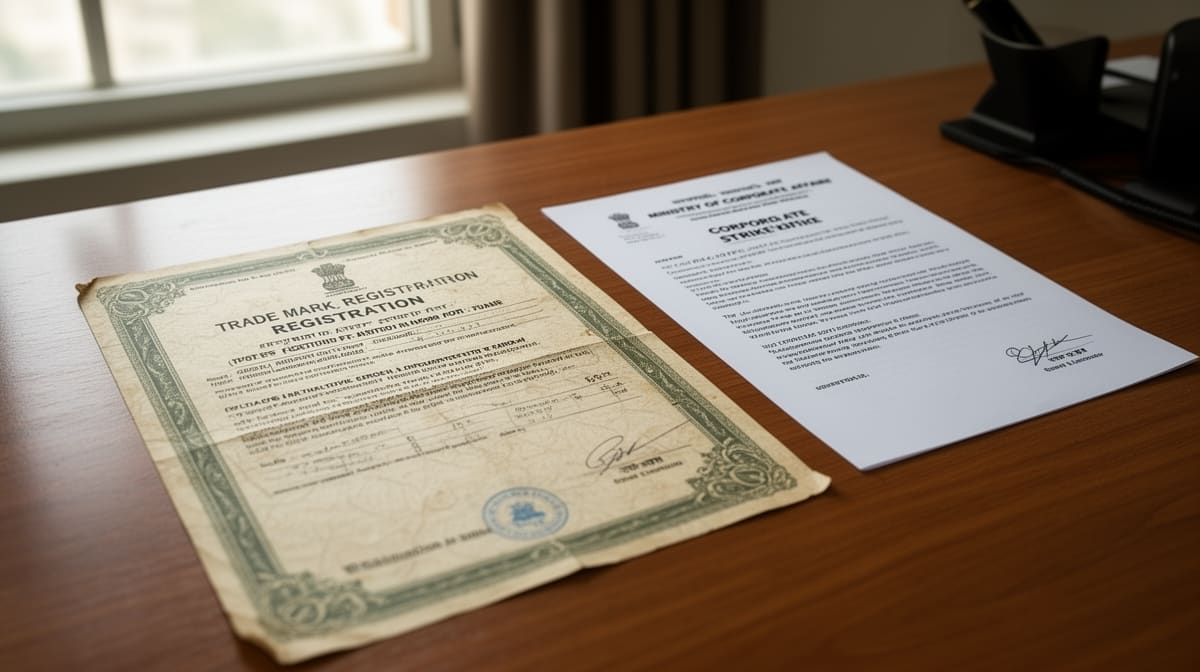
A landmark ruling by the Madras High Court has clarified that a trade mark registered in the name of a company struck off by the Registrar of Companies ceases to exist in law, regardless of private assignments. The judgment underscores the primacy of statutory registration over contractual transfers in trade mark law, with profound implications for brand owners and practitioners handling IP enforcement.
Background & Facts
The Dispute
The petitioner sought removal of Trade Mark Application No.2001235 in Class 30 for the mark "D-Lite Frankies and Foods Private Limited" under Sections 47, 57 and 125 of the Trade Marks Act, 1999, alleging non-use and fraudulent registration. The respondent company, originally named "D-Lite Frankie Food Private Limited", had changed its name to "D-Lite Frankies and Foods Private Limited" via Form TM-33 in November 2016, a change reflected in the Trade Mark Registry.
Procedural History
- 2010: Original trade mark application filed by D-Lite Frankie Food Private Limited
- 2015: Mark registered in name of D-Lite Frankie Food Private Limited
- 2016: Company name changed to D-Lite Frankies and Foods Private Limited; registry updated
- 2018: Company struck off by Registrar of Companies on 15.12.2019; assignment deed executed on 20.12.2018 in favor of Director Mr. Khaja Moinuddin Mohammed
- 2019: Trade mark renewed in name of the struck-off company, despite assignment
- 2024: Counter affidavit filed by the struck-off company through its Director
- 2025: Director applied to be impleaded as proprietor; petitioner filed rectification against wrong entity
- 2026: Madras High Court examined the legal status of the mark
Relief Sought
The petitioner sought cancellation of the trade mark registration on grounds of non-use and fraudulent representation, arguing that the registered proprietor no longer existed under law.
The Legal Issue
The central question was whether a trade mark registered in the name of a company that has been struck off by the Registrar of Companies remains a valid legal entity for purposes of registered proprietorship, and whether an unregistered assignment to an individual can sustain the mark’s validity against a rectification petition.
Arguments Presented
For the Petitioner
The petitioner contended that since the registered proprietor (D-Lite Frankies and Foods Private Limited) was struck off in 2019, it ceased to exist as a legal person under the Companies Act, 2013. Any renewal or representation by the company after strike-off was legally void. The petitioner relied on Section 47 of the Trade Marks Act, which permits removal of a mark if the registered proprietor no longer exists. It further argued that the Director’s private assignment did not confer legal standing as proprietor without formal registration under Section 45.
For the Respondent
The first respondent, through its Director, argued that the assignment deed of 20.12.2018 transferred all rights to Mr. Khaja Moinuddin Mohammed, and that the renewal in the company’s name was a clerical oversight. The second respondent (Registrar of Trade Marks) acknowledged the discrepancy but claimed no authority to act without a formal application for change of proprietor.
The Court's Analysis
The Court undertook a rigorous analysis of the interplay between corporate existence under the Companies Act and proprietary rights under the Trade Marks Act. It held that registered proprietorship is a statutory status, not a contractual one. The Court emphasized that while assignment transfers beneficial interest, only registration under Section 45 confers legal enforceability.
"The trade mark registration is not a private contract between parties; it is a public record that creates rights enforceable against the world. When the registered proprietor ceases to exist, the registration becomes non-est in the eye of law."
The Court rejected the notion that the Director’s silent ownership, even with an assignment, could preserve the mark’s validity. The renewal in 2019 by a non-existent entity was deemed a legal nullity. The Court further noted that the Director had ample opportunity - over six years - to register himself as proprietor but chose not to, thereby forfeiting any equitable claim.
The Court distinguished between beneficial ownership and legal proprietorship, holding that only the latter triggers the statutory remedies under the Trade Marks Act. The petitioner’s rectification petition, though misdirected against the wrong entity, was ultimately vindicated because the registered proprietor no longer existed.
The Verdict
The petitioner succeeded. The Court held that trade mark registration in the name of a struck-off company becomes non-est in law, and directed the Registrar of Trade Marks to remove the mark from the register. The Court clarified that the assignee, Mr. Khaja Moinuddin Mohammed, must pursue independent remedies to claim rights, but cannot rely on the invalid registration to oppose rectification.
What This Means For Similar Cases
Registration Trumps Assignment
- Practitioners must verify the registered proprietor’s corporate status before filing rectification or infringement suits
- An assignment deed alone is insufficient to establish standing; Section 45 registration is mandatory for enforceability
- Failure to update registration after assignment exposes assignees to loss of rights
Strike-Off Automatically Voids Trade Mark Registration
- When a company is struck off, its trade mark registration is deemed non-est - no separate application for removal is required
- The Registrar of Trade Marks must act suo motu upon receiving notice of strike-off
- Courts will not entertain claims against defunct entities, even if the real owner is identifiable
Procedural Due Diligence Is Non-Negotiable
- Always cross-check the Trade Mark Registry records against the Ministry of Corporate Affairs database before initiating proceedings
- If a company is struck off, the correct respondent is no one - proceedings must be discontinued or redirected to the actual owner via fresh application
- Delay in updating registration after assignment is fatal to claims of equitable relief