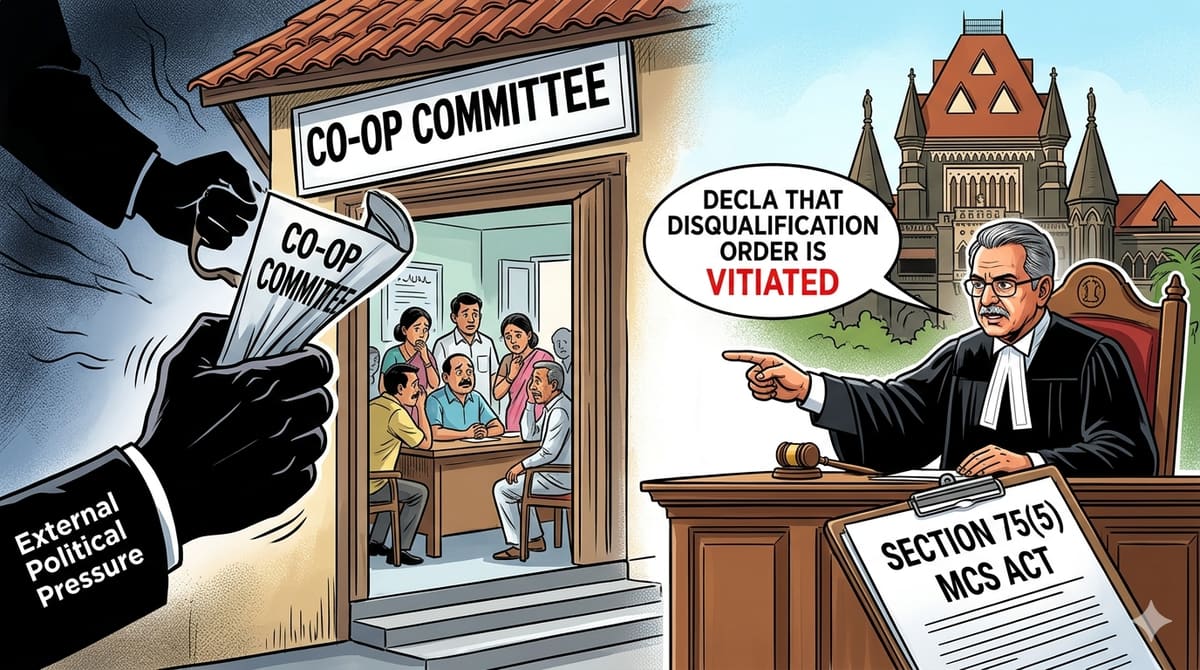
The Bombay High Court has reaffirmed that statutory disqualification of elected office bearers in co-operative societies cannot proceed without a show cause notice that explicitly discloses the potential consequence of removal from office. This judgment underscores that procedural fairness is not a formality but a substantive safeguard for democratic representation.
Background & Facts
The Dispute
The petitioners, Shabnoor Nigam Vohra and others, were elected members of the managing committee of a co-operative society registered under the Maharashtra Co-operative Societies Act, 1960 ("MCS Act"). Proceedings were initiated against them under Section 154B-8 and 147P-2 of the MCS Act, alleging financial irregularities and non-compliance with statutory obligations. The Registrar, acting under Section 154B-23, ultimately disqualified them for five years. This disqualification triggered a further order under Section 77A of the MCS Act, which declared the managing committee’s composition invalid due to falling below the statutory minimum strength.
Key Facts
- The petitioners were elected members of the managing committee of a registered co-operative society in Mumbai
- On 15.12.2022, the Registrar issued a show cause notice calling upon them to explain why action under Sections 154B-8 and 147P-2 should not be taken and why a monetary penalty of Rs. 5,000/- should not be imposed
- The notice made no mention of disqualification under Section 154B-23
- The petitioners submitted their reply on 20.01.2023, addressing only the allegations of financial default and the proposed fine
- On 01.03.2023, the Registrar passed an order disqualifying the petitioners under Section 154B-23 for five years
- On 02.05.2023, the Registrar passed a consequential order under Section 77A, declaring the managing committee invalid due to insufficient members
- The petitioners challenged both orders before the High Court via Writ Petition No. 1747 of 2026
Procedural History
- 15.12.2022: Show cause notice issued by Registrar under Sections 154B-8 and 147P-2, seeking explanation for monetary penalty only
- 20.01.2023: Petitioners submitted reply addressing only financial allegations and proposed fine
- 01.03.2023: Registrar passed order disqualifying petitioners under Section 154B-23 for five years
- 02.05.2023: Registrar passed order under Section 77A, invalidating committee composition
- 10.05.2023: Petitioners filed Writ Petition No. 1747 of 2026 before the Bombay High Court
- 06.05.2026: Judgment delivered by Justice Amit Borkar
Relief Sought
The petitioners sought quashing of the disqualification order dated 01.03.2023 and the consequential order dated 02.05.2023, on grounds of violation of natural justice and procedural unfairness.
The Legal Issue
The central question was whether a show cause notice under the Maharashtra Co-operative Societies Act, 1960, which only mentions the possibility of a monetary penalty, satisfies the requirements of natural justice when the ultimate order imposes disqualification - a far more severe statutory consequence.
Arguments Presented
For the Petitioners
The petitioners’ counsel argued that the show cause notice failed to disclose the possibility of disqualification under Section 154B-23, rendering the hearing meaningless. They relied on Sadashiv H. Patil v. Vithal D. Teke (2000) 8 SCC 82 to assert that disqualification affects democratic representation and must be preceded by explicit notice. They contended that the petitioners could not reasonably be expected to defend against a consequence never mentioned, and that their reply was necessarily confined to the scope of the notice.
For the Respondent
The State’s counsel, represented by the Additional Government Pleader, conceded that the notice was defective but argued that the defect was procedural and did not nullify the Registrar’s statutory power. They requested liberty to initiate fresh proceedings with a proper notice, emphasizing that the underlying allegations of misconduct remained valid and required adjudication.
The Court's Analysis
The Court held that the issuance of a show cause notice is not a mere formality but a foundational element of procedural fairness. It emphasized that the notice must communicate not only the allegations but also the full range of potential consequences. The Court observed:
"A reasonable person receiving such notice would understand proceedings only in manner reflected from language employed therein. The Petitioners were informed about possibility of fine and penal action of monetary nature. However, nowhere does notice indicate that authority was contemplating action of disqualification under Section 154B-23 of the Act."
The Court distinguished between financial penalties and disqualification, noting that the latter results in removal from an elected office, disruption of democratic representation, and loss of legal rights to manage the society. It held that such a consequence cannot be inferred from a notice that speaks only of fines.
The Court further relied on Sadashiv H. Patil v. Vithal D. Teke, where the Supreme Court held that disqualification provisions must be construed strictly because they affect not only the individual but the electorate’s right to representation. The Court stated:
"Compliance with statutory requirements must be affirmatively demonstrated before authority can sustain order of disqualification. Such insistence upon compliance arises because consequences flowing from disqualification are grave."
The Court rejected the notion that the petitioners’ silence in their reply could be construed as acquiescence or implied awareness. It held that the absence of a defence on disqualification was not due to negligence but because the notice gave no reason to anticipate it.
The Court also held that the order under Section 77A, which declared the committee invalid, was entirely consequential upon the disqualification. Since the foundation was legally defective, the superstructure could not survive.
The Verdict
The petitioners succeeded. The Court quashed the disqualification order dated 01.03.2023 and the consequential order under Section 77A dated 02.05.2023. The Registrar is directed to issue a fresh show cause notice clearly indicating the proposed action of disqualification under Section 154B-23. All proceedings following such notice must be concluded within eight weeks of its issuance. There shall be no order as to costs.
What This Means For Similar Cases
Notice Must Explicitly State Disqualification
- Practitioners must ensure that show cause notices under co-operative laws explicitly mention disqualification as a possible consequence
- Vague references to "action under Section X" without specifying disqualification will be deemed defective
- Any reply confined to lesser penalties cannot be treated as a defence against disqualification
Disqualification Triggers Strict Procedural Scrutiny
- Courts will apply heightened scrutiny to disqualification proceedings under statutes like the MCS Act
- The principle from Sadashiv H. Patil now applies uniformly: disqualification affects democratic rights and demands rigorous compliance
- Procedural defects in notice are not curable by subsequent conduct or alleged awareness
Consequential Orders Are Not Independent
- Orders under Section 77A or similar provisions, triggered solely by disqualification, are void if the foundational order is set aside
- Practitioners must challenge both the primary and consequential orders together
- The "foundation and superstructure" doctrine is now firmly established in co-operative law