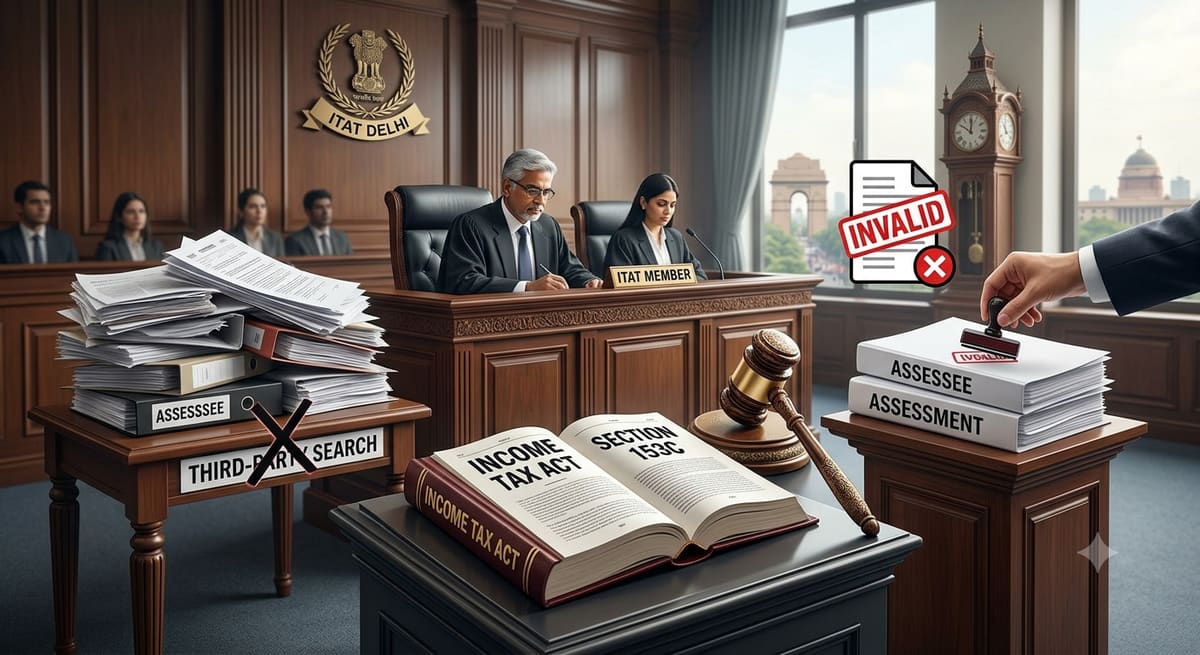
The Income Tax Appellate Tribunal, Delhi, has delivered a decisive ruling affirming that assessment proceedings under Section 153C of the Income Tax Act cannot be initiated against a non-searched person without incriminating material directly linking them to the alleged undisclosed income. The Tribunal quashed all assessments for four assessment years, holding that reliance on uncorroborated statements and unverified Excel sheets violates fundamental principles of evidence and natural justice.
Background & Facts
The Dispute
The Revenue initiated assessment proceedings under Section 153C of the Income Tax Act, 1961, against the respondent, Shri Vivek Gahlaut, for Assessment Years (AY) 2014-15 to 2017-18. These proceedings were triggered by information allegedly seized during searches conducted on Shri Rajiv Saxena, a Chartered Accountant based in Dubai, and Shri Sanjay Jain, a business associate. The Revenue alleged that undisclosed commissions were paid by Uralkali Trading Gibraltar (purportedly linked to Russia) to entities controlled by Saxena, which were then routed to entities beneficially owned by Vivek Gahlaut and his father, Shri Parvinder Singh Gahlaut, in connection with imports of Muriate of Potash (MOP) by India Potash Ltd (IPL).
Key Facts
- Shri Rajiv Saxena was brought to India by the Enforcement Directorate (ED) in January 2019.
- Searches were conducted on Saxena on 30.06.2019 in Mumbai, and on Sanjay Jain and other entities on the same date.
- A search was conducted on Vivek Gahlaut on 02.07.2019.
- The assessment proceedings under Section 153A were dropped by the Assessing Officer (AO) on 23.09.2021, as satisfaction under Section 153C was recorded later on 29.09.2021.
- Notices under Section 153C were issued on 29.09.2021, directing the assessee to file returns for AYs 2014-15 to 2020-21.
- The assessee filed returns on 08.10.2021.
- No additions were made for AYs 2018-19 to 2020-21 under Section 153C.
- The sole basis for the additions against Vivek Gahlaut was an Excel sheet (Exhibit 4) allegedly prepared by Saxena, containing entries linking payments to entities controlled by the assessee.
- The Excel sheet was never verified forensically, nor were bank accounts or entities identified.
- Uralkali Russia issued a written statement on 23.06.2023, categorically denying any payment of commission outside India to any person or entity related to exports to India.
- Shri A.D. Singh retracted his statement dated 03.07.2019 on 29.07.2019, a fact ignored by the AO.
- The assessee was never named in any seized documents, nor was any material found during his search linking him to the alleged transactions.
- The Delhi High Court, in Ishita Varshney Jain v. UOI (22.11.2024), had previously quashed Section 153C proceedings where no documents pertaining to the assessee were found.
Procedural History
- 30.06.2019: Search conducted on Shri Rajiv Saxena and Shri Sanjay Jain.
- 02.07.2019: Search conducted on Vivek Gahlaut.
- 02.07.2019 & 03.07.2019: Statements recorded from Shri Rajiv Saxena under Section 132(4).
- 23.09.2021: Satisfaction note under Section 153C recorded by AO of Shri Rajiv Saxena.
- 29.09.2021: Consolidated satisfaction note recorded by AO of Vivek Gahlaut to initiate Section 153C proceedings for seven AYs.
- 08.10.2021: Assessee filed returns for AYs 2014-15 to 2020-21.
- 27.05.2023: Assessment orders passed under Section 153C r.w.s. 143(3) and 144C for AYs 2014-15 to 2017-18.
- 14.10.2025: CIT(A) quashed the assessments for all four AYs, holding no incriminating material existed.
- 27.05.2026: ITAT Delhi dismissed the Revenue’s appeals.
The Parties' Positions
For the Revenue (Appellant):
- Argued that the Excel sheet, WhatsApp chats, fund-flow records, and FT&TR responses constituted incriminating material.
- Contended that the statements of Saxena were corroborated by seized ledgers and that the assessee was a beneficiary.
- Asserted that the CIT(A) erred in relying on Amol Awasthi and Ojjus Medicare, claiming the present case had independent evidence.
- Claimed that protective additions were valid even if substantive additions were deleted.
For the Assessee (Respondent):
- Argued that no document, ledger, or communication found during search named or linked him to the alleged transactions.
- Highlighted that the Excel sheet was never authenticated, not prepared in regular course, and contradicted by Uralkali’s denial.
- Pointed out that retraction of statements by Shri A.D. Singh was ignored.
- Relied on Ishita Varshney Jain, Dhirajlal Girdharilal, and Common Cause to argue that assumptions and hearsay cannot form the basis of assessment.
- Emphasized that cross-examination of Saxena was denied, despite being granted to other similarly situated assessees.
Relief Sought
The Revenue sought to set aside the CIT(A)’s order and restore the assessment orders for AYs 2014-15 to 2017-18, with the following additions:
- AY 2014-15: Rs. 27,14,50,000
- AY 2015-16: Rs. 103,54,35,074
- AY 2016-17: Rs. 17,42,00,000
- AY 2017-18: Rs. 13,00,00,000
The assessee sought confirmation of the CIT(A)’s order quashing the assessments and deletion of all additions.
The Legal Issue
The central question was whether Section 153C of the Income Tax Act permits initiation of assessment proceedings against a non-searched person solely on the basis of uncorroborated, hearsay statements and unverified documents, without any incriminating material directly linking the assessee to the alleged undisclosed income.
Arguments Presented
For the Appellant
The Revenue contended that the Excel sheet, WhatsApp chats, and fund-flow records constituted incriminating material under Section 153C. It argued that the statements of Shri Rajiv Saxena were corroborated by seized ledgers and that the assessee’s father, Shri P.S. Gahlaut, was the real beneficiary, making the protective additions valid. It relied on Dhirajlal Girdharilal to argue that inferences from circumstantial evidence are permissible. The Revenue further claimed that the CIT(A) erred in applying Amol Awasthi and Ojjus Medicare, asserting that the present case involved independent evidence not present in those decisions.
For the Respondent
The assessee argued that Section 153C requires incriminating material that directly connects the assessee to undisclosed income. He emphasized that no document, ledger, or communication seized during the search named him. He highlighted that Uralkali’s denial, retraction of statements, absence of forensic verification, and lack of bank account details rendered the Excel sheet inadmissible. He relied on Common Cause, Sunil Kumar Sharma, and Ishita Varshney Jain to establish that assumptions and unverified statements cannot sustain an assessment. He further argued that protective additions are inherently unsustainable once substantive additions are quashed.
The Court's Analysis
The Tribunal conducted a meticulous review of the evidentiary foundation for the assessments. It observed that the entire case against the assessee rested on the statement of Shri Rajiv Saxena, recorded under Section 132(4), and an unauthenticated Excel sheet (Exhibit 4). The Tribunal noted that the Excel sheet was never verified for origin, authenticity, or digital forensics, and no bank accounts or entities receiving the alleged funds were identified.
"The said Excel Sheet was never prepared in the regular course nor has any reference to the actual transactions. The assessee has pointed several infirmities challenging the authenticity of the said sheet... Such loose sheets have no credence for the purpose of assessment of income unless complete corroborative evidence is on record."
The Tribunal emphasized that the Hon’ble Delhi High Court in Ishita Varshney Jain had held that Section 153C proceedings are invalid where no documents belonging to or pertaining to the assessee are found. It further noted that Uralkali’s written denial directly contradicted the Revenue’s allegations, and the retraction of Shri A.D. Singh’s statement was ignored by the AO.
The Tribunal also held that the protective additions made in the hands of the assessee were legally unsustainable once the substantive additions in the hands of his father, Shri P.S. Gahlaut, were quashed by a coordinate bench in ITA No. 8971/Del/2025. It relied on ITA No. 6526/Mum/2025 to affirm that protective additions cannot survive when the underlying substantive liability is extinguished.
The Tribunal concluded that the initiation of proceedings under Section 153C was void ab initio, as there was no incriminating material linking the assessee to the alleged income. It reiterated that assessments cannot be based on suspicion, conjecture, or hearsay, citing Dhirajlal Girdharilal v. CIT and Omar Salay Mohamed Sait v. CIT.
The Verdict
The appeals of the Revenue were dismissed. The Tribunal quashed the assessment orders for AYs 2014-15 to 2017-18, striking off the following protective additions:
- AY 2014-15: Rs. 27,14,50,000
- AY 2015-16: Rs. 103,54,35,074
- AY 2016-17: Rs. 17,42,00,000
- AY 2017-18: Rs. 13,00,00,000
The Tribunal held that the initiation of proceedings under Section 153C was invalid ab initio due to absence of incriminating material, and all additions were deleted on merits. The order was pronounced on 27.05.2026.
What This Means For Similar Cases
Incriminating Material Must Be Direct and Verifiable
- Practitioners must now insist that any Section 153C proceeding be supported by documents or evidence directly linking the assessee to the undisclosed income.
- Hearsay statements, unverified Excel sheets, or third-party allegations without corroboration are insufficient.
- The burden shifts to the Revenue to prove the existence of incriminating material, not the assessee to disprove allegations.
Protective Additions Are Not a Legal Workaround
- Protective additions under Section 69A cannot be sustained if the substantive liability is quashed.
- Where the real beneficiary’s assessment is set aside, protective additions against associates or family members are legally untenable.
- Practitioners should challenge protective additions as a matter of course when the primary assessment is under attack.
Cross-Examination Is a Right, Not a Discretion
- When statements of third parties (like Saxena) form the basis of assessment, the assessee has a right to cross-examine.
- Denial of cross-examination, especially when granted to similarly situated assessees, violates principles of natural justice.
- Failure to record retracted statements or ignore contradictory evidence renders the assessment vulnerable to quashing.
Jurisdictional Precedents Are Binding
- Decisions of coordinate benches and the jurisdictional High Court on identical facts are binding.
- The ITAT’s reliance on Amol Awasthi and Ojjus Medicare was upheld, reinforcing that consistent legal interpretation must prevail.
- Practitioners should cite jurisdictional precedents early and often in Section 153C cases.