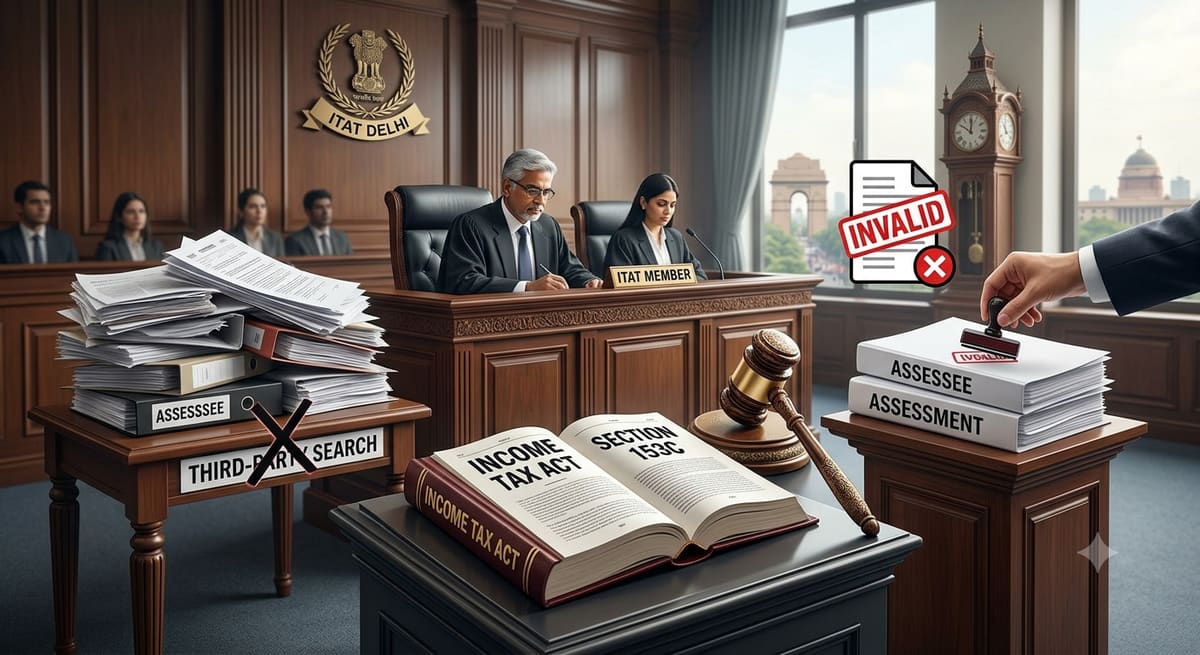
The Income Tax Appellate Tribunal, Ahmedabad, has delivered a significant ruling clarifying the limits of reassessment powers under Section 147 of the Income Tax Act, 1961. The Tribunal held that reopening beyond four years requires proof of failure by the assessee to disclose material facts, and that reliance on unverified investigation reports without independent application of mind renders the reassessment void. The decision reinforces the principle that suspicion cannot substitute evidence.
Background & Facts
The Dispute
The appellant, M R Patel And Sons, a business entity engaged in loading and supervision services, faced reassessment proceedings for Assessment Years (A.Y.) 2013-14 and 2015-16. The Assessing Officer (AO) reopened the assessments and made additions of Rs.64,17,000 and Rs.38,61,500 respectively under Section 69C of the Income Tax Act, treating payments made to Dishman Carbogen Amcis Ltd. as unexplained expenditure. The AO relied on search proceedings conducted against Dishman group, which revealed that the entity was engaged in providing accommodation entries.
Key Facts
- The appellant paid Rs.64,17,000 to Dishman Carbogen Amcis Ltd. during A.Y. 2013-14 and Rs.38,61,500 during A.Y. 2015-16 as loading and supervision charges.
- These payments were supported by invoices, ledger accounts, bank payment records, and TDS deduction certificates.
- The appellant had disclosed these payments in full during the original assessment proceedings under Section 143(3).
- The original assessment for A.Y. 2013-14 was completed on 28.03.2015 and for A.Y. 2015-16 on 25.03.2017.
- Search proceedings under Section 132 were conducted against Dishman Carbogen Amcis Ltd. in 2017.
- The AO issued notice under Section 148 on 15.03.2021 for A.Y. 2013-14 (beyond four years from end of A.Y. 2013-14) and on 18.03.2021 for A.Y. 2015-16 (within four years).
- The AO’s reasons for reopening stated that the appellant had received fictitious loans and accommodation entries from Dishman, despite the actual transaction being payment for services.
- The appellant submitted audited financial statements of Dishman Carbogen Amcis Ltd., showing it as a listed company with turnover, assets, and employees.
- The appellant earned substantial loading income from Gujarat Electricity Board and other clients, establishing commercial rationale for the payments.
Procedural History
- 28.03.2015: Original assessment completed for A.Y. 2013-14 under Section 143(3)
- 25.03.2017: Original assessment completed for A.Y. 2015-16 under Section 143(3)
- 2017: Search conducted under Section 132 against Dishman Carbogen Amcis Ltd.
- 15.03.2021: Notice under Section 148 issued for A.Y. 2013-14
- 18.03.2021: Notice under Section 148 issued for A.Y. 2015-16
- 21.08.2025: Order passed by Ld. CIT(A), NFAC, Delhi, upholding reassessment and additions
- 25.02.2026: Hearing before ITAT Ahmedabad
- 23.04.2026: Judgment pronounced by ITAT
The Parties' Positions
For the Appellant
- The payments were genuine business expenses, fully disclosed during original assessment.
- No failure to disclose material facts occurred; hence, reopening beyond four years for A.Y. 2013-14 was invalid.
- The AO’s reasons were internally inconsistent, referring to the payments as loans, expenses, and accommodation entries.
- The AO relied solely on statements from third-party search proceedings without independent verification.
- No notice under Sections 131 or 133(6) was issued to Dishman Carbogen Amcis Ltd. to verify its operations.
- The Coordinate Bench of ITAT had already accepted the genuineness of similar transactions in A.Y. 2014-15.
- The financial statements of Dishman proved it was a legitimate entity.
For the Respondent
- The search proceedings revealed Dishman Carbogen Amcis Ltd. as a shell company providing accommodation entries.
- The payments made by the appellant were part of a broader pattern of bogus transactions.
- The AO had sufficient material to form a belief that income had escaped assessment.
- The appellant’s documentary evidence was insufficient to rebut the adverse inference from search findings.
- The CIT(A) had correctly applied the test of preponderance of probabilities.
Relief Sought
The appellant sought:
- Quashing of the reassessment orders for both A.Y. 2013-14 and 2015-16
- Deletion of the additions of Rs.64,17,000 and Rs.38,61,500 under Section 69C
- Restoration of the original assessment orders
- Costs of litigation
The Legal Issue
The central questions were: (1) Whether the reopening of assessment under Section 147 beyond four years was valid in the absence of any failure by the assessee to disclose material facts; and (2) Whether an addition under Section 69C can be sustained solely on the basis of uncorroborated statements from third-party search proceedings, without independent verification or corroborative evidence.
Arguments Presented
For the Appellant
The appellant relied on ITO v. Lakhmani Mewal Das [1976] 103 ITR 437 (SC), which held that reasons for reopening must be based on specific, tangible material, not vague or general information. It cited Ashish Jashwantbhai Desai (HUF) v. ITO [2025] 171 taxmann.com 220 (Guj.), Surani Steel Tubes Ltd. v. ITO [2022] 136 taxmann.com 139 (Guj.), and Harikishan Sundarlal Virmani v. DCIT [2017] 394 ITR 146 (Guj.) to establish that reopening based on borrowed satisfaction without independent application of mind is invalid. It further relied on 03 Developers Pvt. Ltd. v. ITO [2025] 174 taxmann.com 1028 (Guj.) to argue that reopening for fishing inquiries is impermissible. The appellant also cited Kolahai Infotech Pvt. Ltd. v. ITO (2018) 409 ITR 595 (Delhi) and Siddhi Corporation v. DCIT [2025] 180 taxmann.com 552 (Guj.) to show that if the jurisdictional premise is factually incorrect, the reassessment fails. The appellant emphasized that the AO had mischaracterized the transaction as a loan when it was clearly a service payment, rendering the basis of belief erroneous.
For the Respondent
The Revenue contended that the search proceedings provided credible information indicating escapement of income. It relied on the CIT(A)’s finding that the entity receiving payments was a paper company and that the appellant’s business model lacked commercial rationale. It argued that the burden shifted to the assessee to prove genuineness, and that the documentary evidence submitted was insufficient to overcome the adverse inference from search findings. The Revenue did not dispute the absence of independent verification but maintained that the totality of circumstances justified the addition.
The Court's Analysis
The Tribunal conducted a rigorous analysis of both jurisdictional and substantive grounds. On the issue of reopening under Section 147, it held that the proviso to Section 147 mandates a failure by the assessee to disclose fully and truly all material facts as a sine qua non for reopening beyond four years. In this case, the appellant had disclosed the payments during the original assessment, and the AO had examined them. No new failure was established in the reasons recorded. The Tribunal emphasized that the AO’s reasons were internally contradictory - sometimes referring to the payments as loans, sometimes as expenses - indicating non-application of mind.
"The reasons recorded do not refer to any tangible material linking the assessee with any alleged bogus transaction except general information, which is not sufficient to form a valid belief of escapement of income."
The Tribunal further held that the AO’s reliance on search proceedings against a third party, without issuing notices under Sections 131 or 133(6) to verify the recipient’s operations, amounted to "borrowed satisfaction." It cited multiple judgments of the Gujarat High Court to affirm that suspicion, however strong, cannot replace evidence. The Tribunal noted that the appellant had submitted audited financials of Dishman Carbogen Amcis Ltd., proving it was a listed company with substantial turnover and employees - directly rebutting the allegation of it being a paper entity.
Regarding the addition under Section 69C, the Tribunal held that once the assessee produced primary evidence - invoices, bank records, TDS certificates - the burden shifted to the Revenue to disprove genuineness. The Revenue failed to produce any independent evidence, cash trail, or corroborative material. The Tribunal also noted a critical procedural flaw: the reopening was initiated on the premise of a fictitious loan, yet the addition was made on account of loading charges - a fundamental mismatch. It relied on CIT v. Mohmed Juned Dadani [2014] 355 ITR 172 (Guj.) and Ranbaxy Laboratories Ltd. v. CIT [2011] 336 ITR 136 (Del.) to hold that no addition can be sustained on a ground different from the one for which the case was reopened.
The Tribunal also found persuasive the prior decision of its own Coordinate Bench in ITA No. 523/Ahd/2024, which had accepted the genuineness of identical transactions with the same party in A.Y. 2014-15.
The Verdict
The appellant succeeded on both appeals. The Tribunal set aside the reassessment orders dated 21.08.2025 for A.Y. 2013-14 and 2015-16. The additions of Rs.64,17,000 and Rs.38,61,500 under Section 69C were deleted. The original assessments were restored. The Tribunal directed the Assessing Officer to compute the tax liability based on the original returns, without any adjustment for the impugned expenditures. No costs were awarded.
What This Means For Similar Cases
Reopening Beyond Four Years Requires Concrete Disclosure Failure
- Practitioners must challenge reassessments initiated beyond four years where the assessee disclosed all transactions in the original assessment.
- The Revenue must prove a specific, material omission - not merely rely on third-party search findings.
- Vague or general information from investigation wings is insufficient to satisfy the proviso to Section 147.
Documentary Evidence + Business Rationale Trumps Suspicion
- In cases involving third-party payments, submission of invoices, bank records, TDS certificates, and audited financials of the recipient creates a strong prima facie case of genuineness.
- The burden shifts to the Revenue to disprove the transaction through independent verification - not through uncorroborated statements.
- Commercial rationale (e.g., earning substantial income from similar services) strengthens the case for legitimacy.
Reopening Cannot Be Used to Introduce New Grounds
- If a case is reopened on the basis of one alleged escapement (e.g., fictitious loan), no addition can be made on a different ground (e.g., unexplained expenditure) unless the notice is amended.
- Courts will strike down additions that diverge from the stated reason for reopening.
- Practitioners should immediately flag such procedural misalignment in appeals.