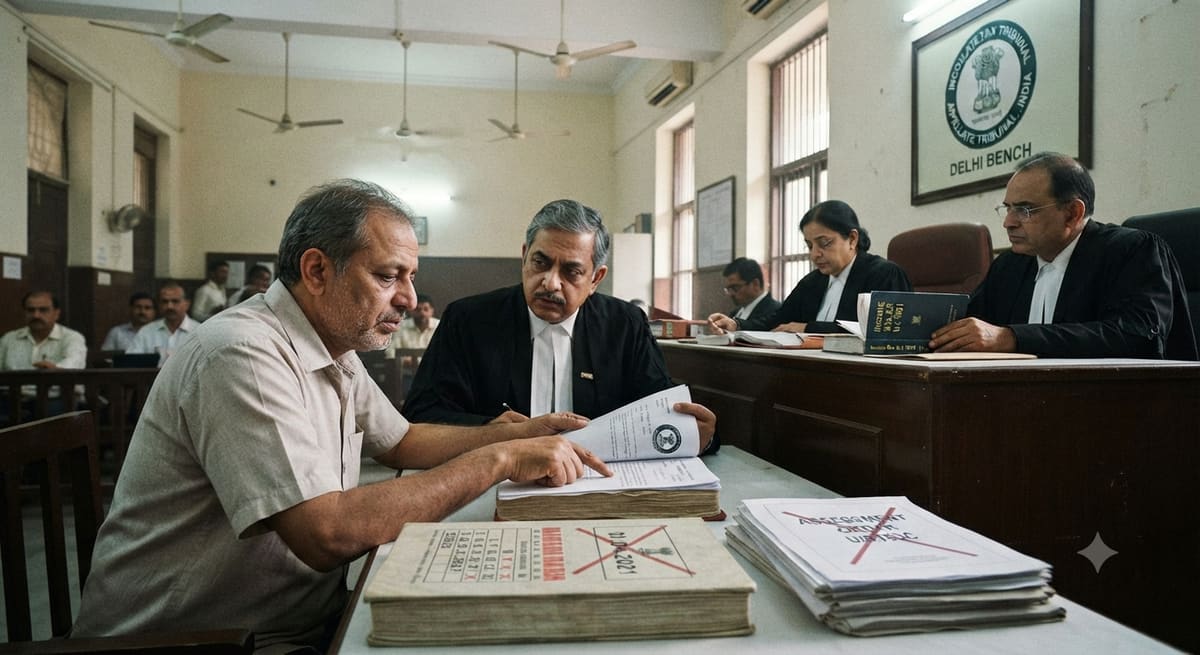
The Income Tax Appellate Tribunal, Delhi, has clarified a critical jurisdictional boundary in reassessment proceedings: when income escapement is discovered through evidence recovered during a search under Section 132, the tax authorities must invoke Section 153C, not Section 147. This ruling reinforces procedural integrity and prevents misuse of general reopening powers.
Background & Facts
The Dispute
The appellant, Smt. Sudesh Devi, proprietor of M/s SD Trading, Ghaziabad, was assessed for Assessment Years 2008-09 and 2009-10. The Income Tax Department initiated reassessment proceedings under Section 147 after a search and seizure operation under Section 132 was conducted on 19.02.2014 at the premises of M/s Uflex Group of Companies. During the search, substantial cash deposits were found in Uflex’s bank accounts, which were explained as cash sale proceeds from various persons, including the appellant. The Department alleged that the appellant had made cash purchases from Uflex to the tune of Rs. 1,12,27,857 during FY 2007-08 (AY 2008-09), which were not disclosed in the return, thereby escaping tax under Section 40A(3).
Key Facts
- The search under Section 132 was conducted on 19.02.2014 at the premises of M/s Uflex Ltd.
- Information from the search was transmitted to the Assessing Officer (AO) of the appellant on 27.03.2015, triggering the issuance of a notice under Section 148.
- The appellant filed her return on 03.11.2015, declaring taxable income of Rs. 5,09,311.
- Despite multiple notices and opportunities, the appellant failed to produce books of account or substantiate the cash purchases.
- The AO made an addition of Rs. 1,12,27,857 under Section 40A(3), disallowing 20% of the amount (Rs. 22,45,571) as unexplained expenditure.
- The appellant did not dispute the fact of cash purchases but challenged the legal basis of the reassessment.
Procedural History
- 19.02.2014: Search and seizure conducted under Section 132 at M/s Uflex Ltd.
- 27.03.2015: Notice under Section 148 issued to the appellant.
- 03.11.2015: Return filed by the appellant.
- 01.03.2016: Show cause notice under Section 144 issued.
- 28.03.2016: AO passed assessment order under Section 143(3)/147, making the addition.
- 25.08.2017: CIT(A) dismissed the appeal, upholding the reassessment.
- 22.01.2026: Hearing before ITAT Delhi.
- 25.03.2026: Judgment pronounced.
The Parties' Positions
For the Appellant
The appellant contended that the reassessment was invalid because the information used to initiate proceedings originated from a search under Section 132. She argued that Section 153C, which governs assessment in cases where incriminating material is found during a search in the case of another person, is the exclusive and mandatory provision applicable here. Relying on multiple precedents including Rajat Shubra Chatterji v. ACIT and ACIT v. Arun Kapur, she asserted that invoking Section 147 in such circumstances is a jurisdictional error.
For the Respondent
The Department relied on the CIT(A)’s order, arguing that the AO had sufficient reasons to believe income had escaped assessment and that the procedural requirements under Sections 147 to 151 were satisfied. No specific counter-arguments were advanced against the applicability of Section 153C.
Relief Sought
The appellant sought quashing of the reassessment orders dated 28.03.2016 for both AY 2008-09 and 2009-10, on the ground that they were issued without jurisdiction under Section 147 and in violation of Section 153C.
The Legal Issue
The central question was whether the Income Tax Department could lawfully initiate reassessment under Section 147 of the Income Tax Act, 1961, when the basis for reopening was information obtained from a search and seizure operation conducted under Section 132 in the case of another person, or whether Section 153C was the exclusive and mandatory provision applicable in such circumstances.
Arguments Presented
For the Appellant
The appellant’s counsel relied on a series of binding precedents from the Delhi High Court and ITAT, including Rajat Shubra Chatterji v. ACIT, ACIT v. Arun Kapur, and PCIT v. RMG Polyvinyl (I) Ltd., which uniformly held that when incriminating material is recovered during a search in the case of a third party and used to reopen the assessment of another person, the legal framework under Section 153C applies. She argued that Section 147 is a general provision for escapement of income, while Section 153C is a special provision designed specifically for cases arising from search operations. The invocation of Section 147 in such cases, she submitted, is a jurisdictional nullity. Further, she contended that the approval under Section 151 was invalid as no independent judicial mind was applied to the satisfaction of reopening.
For the Respondent
The Department’s representative merely relied on the CIT(A)’s order and did not contest the applicability of Section 153C or distinguish the cited precedents. No independent legal argument was advanced to refute the appellant’s position.
The Court's Analysis
The Tribunal examined the nature of the information used to initiate reassessment. The reasons recorded by the AO explicitly stated that the reopening was based on "information received" from the Directorate of Income Tax (Investigation) concerning the search conducted on 19.02.2014 at Uflex Ltd. The Tribunal noted that this was not a case of independent discovery of escapement by the AO, but one where the trigger was material unearthed during a search in another person’s case.
"In the present case before us, it is an admitted fact, as also evident from the reasons recorded and the assessment order that the initiation of reopening proceedings was made by the assessing officer on the basis of information received from the Directorate of Income Tax (Inv.) on the basis of search & seizure operation conducted at the premises of Rock Land Group of cases and the documents related to the assessee found during the course of search were made available to the assessing officer of the present assessee."
The Tribunal then applied the ratio in Rajat Shubra Chatterji v. ACIT, which held that when the basis of reassessment is material recovered during a search under Section 132 in the case of another person, Section 153C is the only applicable provision. The Tribunal emphasized that Section 147 cannot be used as a substitute for Section 153C, as the latter provides a specific procedural framework, including time limits and jurisdictional safeguards, tailored to search-based assessments.
The Tribunal further observed that the Department’s reliance on Section 147 in this context amounted to a failure to follow the special law, rendering the reassessment proceedings void ab initio. The Court noted that the approval under Section 151 was not independently examined because the jurisdictional defect under Section 153C rendered it irrelevant. The Tribunal concluded that the reassessment orders were legally unsustainable and must be set aside.
The Verdict
The appellant succeeded. The ITAT Delhi allowed both appeals, quashing the reassessment orders dated 28.03.2016 for Assessment Years 2008-09 and 2009-10. The Tribunal held that the reopening under Section 147 was void ab initio as the correct provision applicable was Section 153C. The additions of Rs. 1,12,27,857 under Section 40A(3) were set aside. No further directions were issued as the reassessment itself was invalidated.
What This Means For Similar Cases
Section 153C Is Exclusive for Search-Based Reassessments
- Practitioners must now challenge any reassessment initiated under Section 147 where the basis is material recovered during a search under Section 132 in the case of a third party.
- The burden shifts to the Department to prove that the information was not derived from a search, or else the reassessment is void.
- Any assessment framed under Section 147 in such circumstances is a jurisdictional nullity and can be quashed at any stage.
Procedural Compliance Cannot Be Ignored
- Even if the Department believes the assessee has concealed income, it cannot bypass Section 153C’s procedural safeguards.
- Appeals under Section 250 or revision under Section 264 cannot cure a jurisdictional defect arising from improper invocation of Section 147.
- Practitioners should routinely verify whether the notice under Section 148 cites search-related material; if so, Section 153C is the only valid route.
Precedents Are Binding and Must Be Cited
- The ITAT reaffirmed that decisions from coordinate benches, including Rajat Shubra Chatterji and ACIT v. Arun Kapur, are binding unless overruled by a larger bench.
- Counsel must cite these precedents at the first opportunity to prevent wasteful litigation.
- The Department’s failure to distinguish or oppose these precedents will be viewed as acquiescence.