The Bombay High Court has reaffirmed a foundational principle in motor insurance law: the rights of third-party victims under a motor vehicle insurance policy cannot be defeated by alleged breaches of policy terms between the insurer and the insured. This judgment ensures that innocent claimants are not left without recourse due to technical or procedural failures on the part of the insurer or its policyholder.
Background & Facts
The Dispute
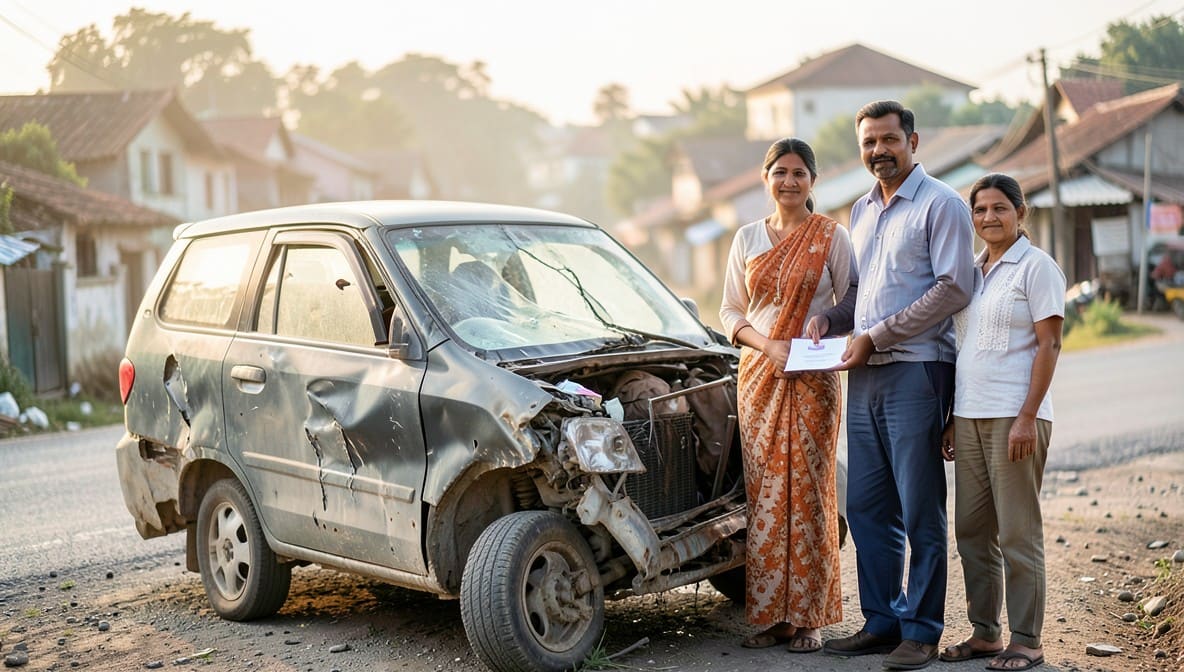
The dispute arose from a fatal road accident on 19th February 2011, in which Mr. Navsa Tumda, a passenger in a Wagon R, lost his life when the vehicle lost control due to rash and negligent driving and collided with a tree, overturning. Several other passengers sustained injuries. The dependents of Mr. Tumda filed a claim petition before the Motor Accident Claims Tribunal seeking compensation for wrongful death.
Key Facts
- The accident occurred on 19.02.2011 in Maharashtra
- The driver of the Wagon R was alleged by the insurer to be driving without a valid driving license
- The vehicle was insured with Iffco Tokio General Insurance Co. Ltd.
- The claimants submitted evidence of the accident, death certificate, and dependency documents
- The insurer raised a defense based on alleged breach of policy conditions due to the driver’s purported lack of a valid license
- The insurer’s witness admitted during cross-examination that no notice was issued to the vehicle owner requesting production of the driver’s license prior to the hearing
- The police did not register any offence against the driver for driving without a license, although he was prosecuted for other offences related to the accident
Procedural History
- 19.02.2011: Fatal accident involving Wagon R, resulting in death of Mr. Navsa Tumda
- 2011: Claim petition filed before Motor Accident Claims Tribunal
- 10.05.2012: Tribunal awarded compensation of Rs. 6,84,000/- to the dependents, along with interest
- 2013: Iffco Tokio filed Civil Application No. 424 of 2013 seeking stay of the award
- 2016: First Appeal No. 196 of 2016 filed before the Bombay High Court challenging the Tribunal’s award
- 09.06.2026: Judgment delivered by the Bombay High Court
Relief Sought
The appellant-insurer sought to set aside the Tribunal’s award of Rs. 6,84,000/- on the ground that the driver was not holding a valid license, thereby voiding the insurer’s liability under the policy terms. The respondents sought confirmation of the award, interest, and costs.
The Legal Issue
The central question was whether an insurer can deny liability to a third-party claimant under a motor insurance policy on the ground that the driver at the time of the accident was not holding a valid driving license, where such breach has not been established by the insurer and the third party is innocent.
Arguments Presented
For the Appellant
The learned counsel for Iffco Tokio contended that the driver’s lack of a valid license constituted a clear breach of the policy conditions, particularly under the standard terms of motor insurance policies which require the driver to be duly licensed. Relying on policy clauses and General Insurance Corporation v. Smt. Sushila Devi, the insurer argued that such a breach absolves it of liability to pay compensation, even to third parties.
For the Respondent
The counsel for the respondents, including Respondent No. 4, argued that the insurer failed to discharge its burden of proving the driver’s lack of a valid license. The insurer’s witness admitted that no notice was issued to the vehicle owner to produce the license, and the police did not charge the driver with driving without a license. The respondents relied on National Insurance Co. Ltd. v. Laxmi Narain Dhut and New India Assurance Co. Ltd. v. Ashok Kumar, emphasizing that third-party rights are statutory and cannot be defeated by policy defenses not proven in the claim proceedings.
The Court's Analysis
The Court examined the Tribunal’s findings, which were based on a careful appreciation of evidence. The Tribunal noted that the insurer’s own witness conceded that no pre-hearing notice was issued to the vehicle owner to produce the driver’s license. The Court emphasized that the burden of proving a breach of policy conditions lies squarely on the insurer, and mere allegation is insufficient.
"The Insurance Company has failed to prove that the driver was not holding a valid license. Such a request was made after the evidence of the claimants."
The Court further held that even if a breach of policy terms were established, the insurer’s remedy lies against the insured (the policyholder), not against the innocent third party who suffered loss. The statutory framework under the Motor Vehicles Act, 1988 mandates that insurance policies must provide for third-party liability, and this protection is not contingent on the insurer’s internal compliance with policy conditions.
The Court rejected the insurer’s attempt to shift the burden of proof to the claimants and underscored that the Tribunal’s factual findings, supported by evidence and unchallenged on appeal, must be upheld. The Court also noted the absence of any police charge against the driver for driving without a license, further weakening the insurer’s claim.
The Verdict
The appeal was dismissed. The Court upheld the Tribunal’s award of Rs. 6,84,000/- to the dependents of Mr. Navsa Tumda, along with interest. The Tribunal was directed to disburse the awarded amount to the original claimants within eight weeks from the date of judgment. A statutory deposit of Rs. 25,000/- made by the insurer was ordered to be transferred to the Tribunal, and the parties were permitted to withdraw it. The civil application seeking stay was disposed of as infructuous.
What This Means For Similar Cases
Third-Party Rights Are Statutory and Absolute
- Practitioners must argue that third-party claimants under the Motor Vehicles Act are protected by statute, irrespective of policy breaches by the insured
- Insurers cannot raise unproven policy defenses to defeat claims by victims or their dependents
- The burden of proving breach of policy terms rests entirely on the insurer, and must be established with documentary or credible evidence
Procedural Lapses by Insurers Are Fatal
- Failure to issue a pre-hearing notice to the insured for production of the driver’s license renders the insurer’s defense untenable
- Delayed objections, raised only after claimants have adduced evidence, are not admissible as valid grounds for denial
- Courts will not permit insurers to use technicalities to evade statutory obligations to victims
Police Records Carry Weight in Insurance Disputes
- Absence of a police charge for driving without a license, despite investigation, undermines the insurer’s allegation
- Courts treat official records as corroborative evidence; insurers cannot rely on speculative or unsubstantiated claims
- Practitioners should always request police reports and challan records in motor accident claims to counter insurer defenses