The Bombay High Court has clarified that a Competent Authority under the Maharashtra Ownership Flats Act (MOFA) cannot use a corrigendum to substantially increase an area previously granted, as such an action amounts to a substantive review beyond statutory powers. This ruling reinforces the principle that final orders under MOFA attain legal finality unless set aside through prescribed appellate mechanisms.
Background & Facts
The Dispute
The dispute arises from a challenge to an order issued by the Competent Authority under Section 11(3) of the Maharashtra Ownership Flats Act, 1963 (MOFA). The petitioner, Harshada A Villa Coop. Housing Society Limited, contests an order dated 18 January 2024 that increased the built-up area granted to respondent Nos. 3 to 5 - individual flat purchasers - from 3,397.80 sq. mtrs to 5,014.54 sq. mtrs. The petitioner, as an adjoining housing society, contends that this increase was unlawful and prejudicial to its rights.
Key Facts
- On 11 April 2023, the Competent Authority passed an order granting respondent Nos. 3 to 5 a built-up area of 3,397.80 sq. mtrs out of a total land area of 5,460 sq. mtrs, following an application under Section 11(3) of MOFA.
- This order was a final determination based on material submitted and was not appealed or set aside.
- On 17 July 2023, respondent Nos. 3 to 5 filed a second application seeking an increase in the granted area.
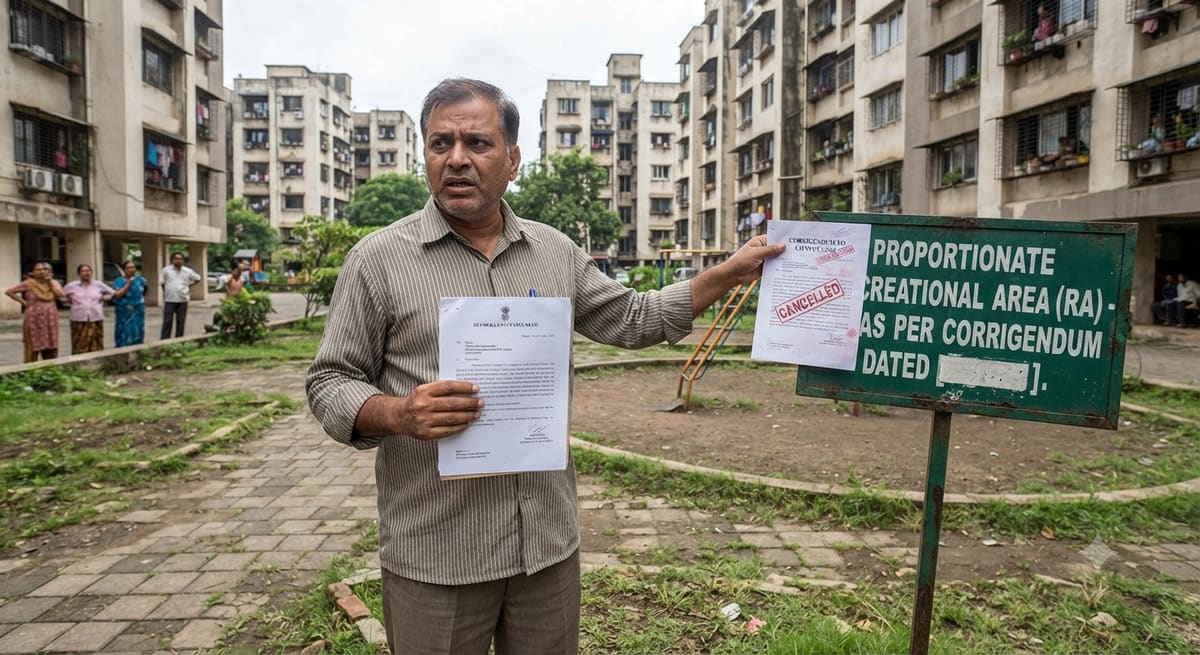
- On 18 January 2024, the Competent Authority issued a "corrigendum" granting 5,014.54 sq. mtrs, effectively increasing the area by 1,616.74 sq. mtrs.
- The petitioner challenged this order as a substantive alteration of a final decision, not a mere correction.
- The respondents claim the corrigendum was intended to rectify a clerical or arithmetical error.
Procedural History
- 11 April 2023: Competent Authority grants 3,397.80 sq. mtrs built-up area under Section 11(3) of MOFA.
- 17 July 2023: Respondent Nos. 3 to 5 file second application seeking increased area.
- 18 January 2024: Competent Authority issues corrigendum granting 5,014.54 sq. mtrs.
- 2025: Petitioner files Writ Petition No. 8600 of 2025 before the Bombay High Court.
- 24 March 2026: Judgment delivered by Justice Amit Borkar.
- Concurrently, on 16 January 2025, a conveyance deed was executed based on the impugned order.
- 2025: Petitioner files Regular Civil Suit No. 16 of 2025 challenging the conveyance deed under Section 31 of the Specific Relief Act, 1963.
The Parties' Positions
Petitioner: Argues that the corrigendum is not a correction but a substantive revision of a final order. Relies on Kashish Park Reality Pvt. Ltd. v. State of Maharashtra (2021) 3 Mah LJ 778, which holds that Competent Authorities lack power to review their own final orders. Asserts that the increase is arbitrary and violates the principle of finality.
Respondent Nos. 3 to 5: Contend that the corrigendum is a procedural correction of a clerical or arithmetical error. Argue that the original order mistakenly understated the area to which they were entitled. Also assert that the petitioner has already sought relief in a civil suit, making the writ petition redundant.
Respondent Nos. 1 and 2 (State of Maharashtra): Support the Competent Authority’s action, arguing that the corrigendum is within inherent powers to correct inadvertent errors.
Relief Sought
The petitioner seeks:
- Quashing of the order dated 18 January 2024 issued under Section 11(3) of MOFA.
- Declaration that the Competent Authority has no power to increase a previously granted area via corrigendum.
- Direction to restore the original order dated 11 April 2023.
The Legal Issue
The central question is whether the Competent Authority under Section 11(3) of the Maharashtra Ownership Flats Act has the power to issue a corrigendum that substantially increases the area previously granted, or whether such an action constitutes an impermissible substantive review beyond statutory authority.
Arguments Presented
For the Petitioner
The petitioner relied on Kashish Park Reality Pvt. Ltd. v. State of Maharashtra to argue that a Competent Authority under MOFA cannot reopen a concluded decision merely by issuing a corrigendum. The petitioner emphasized that the original order dated 11 April 2023 was a final adjudication, and any subsequent alteration must follow statutory appeal mechanisms. The increase of over 1,600 sq. mtrs was not a correction of a clerical mistake but a re-adjudication on the merits, which the statute does not permit. The petitioner further argued that the corrigendum was issued without notice or opportunity of hearing, violating principles of natural justice.
For the Respondent/State
Respondent Nos. 3 to 5 contended that the corrigendum merely corrected an arithmetical or clerical error in the original order, which inadvertently understated the area they were entitled to. They argued that such corrections are universally permissible under the doctrine of curative jurisdiction and do not require express statutory authorization. They also submitted that the petitioner had already filed a civil suit challenging the conveyance deed, and therefore, the writ petition was an abuse of process and should be dismissed on grounds of alternative remedy.
The Court's Analysis
The Court examined the nature of the impugned order and distinguished between procedural correction and substantive review. It held that a corrigendum is permissible only to rectify clerical or arithmetical errors apparent on the face of the record, not to grant additional relief.
"If there was already a finding granting larger area, but due to mistake it was not reflected in the operative part, then it could be treated as clerical error. But here, there is no such prior adjudication. The second application has led to a fresh consideration and a fresh grant."
The Court noted that the original order dated 11 April 2023 contained no indication that the Competent Authority had intended to grant 5,014.54 sq. mtrs. The increase was not a correction of an oversight in recording but a new decision based on a fresh application. This amounted to a substantive review, which the Court held was not contemplated under Section 11(3) of MOFA.
The Court further rejected the argument that the filing of a civil suit ousted its writ jurisdiction. It observed that the civil suit challenged the conveyance deed executed under Section 11(5), while the writ petition questioned the legality of the order under Section 11(3). The two remedies addressed distinct legal issues: one concerned the validity of a registered document, the other the jurisdictional validity of an administrative order.
The Court reaffirmed the principle from Kashish Park Reality that the Competent Authority under MOFA acts as a quasi-judicial body, and its final orders must be treated with finality. Allowing unilateral enlargement of rights through corrigenda would undermine the statutory scheme and invite arbitrariness.
The Verdict
The writ petition succeeded. The Court set aside the order dated 18 January 2024 granting 5,014.54 sq. mtrs of built-up area. The original order dated 11 April 2023 granting 3,397.80 sq. mtrs was restored. The Court directed the Competent Authority to communicate this restoration to all concerned parties within four weeks. There was no order as to costs.
What This Means For Similar Cases
Final Orders Under MOFA Cannot Be Unilaterally Expanded
- Practitioners must treat orders under Section 11(3) of MOFA as final unless set aside through appeal or judicial review.
- Any attempt to increase granted area via corrigendum, even if labeled "clerical," will be struck down if it involves substantive re-adjudication.
Corrigenda Are Limited to Typographical or Arithmetic Errors
- A corrigendum is valid only if it corrects an error apparent on the face of the record, such as misstated figures, wrong unit, or transcription mistake.
- If the original order lacks any basis for the corrected figure, the corrigendum is invalid.
- Practitioners should scrutinize whether the alleged "error" was ever adjudicated upon in the original order.
Civil Suit Does Not Bar Writ Jurisdiction on Administrative Legality
- Challenges to the legality of an administrative order under MOFA remain maintainable in writ jurisdiction even if a civil suit is pending regarding the resulting conveyance.
- The two remedies address different causes of action: one challenges the authority’s order, the other the validity of a registered document.
Statutory Finality Trumps Administrative Convenience
- Authorities cannot use procedural mechanisms to circumvent statutory appeal timelines.
- This judgment reinforces that quasi-judicial bodies must act within the four corners of their statutory mandate, and cannot assume powers of review absent express provision.