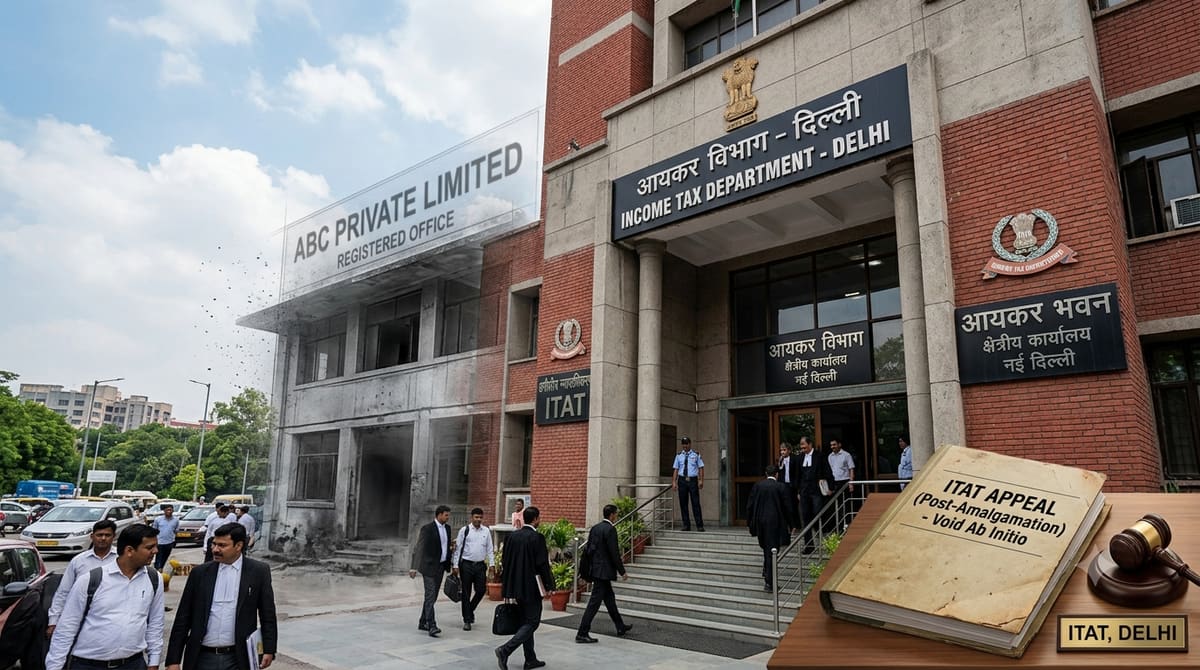
The ITAT Delhi has delivered a decisive ruling affirming that an income tax assessment issued against a legal entity that no longer exists due to statutory amalgamation is void ab initio. This judgment reinforces the foundational principle that tax proceedings must be initiated against a legally recognized assessee, and any deviation renders the entire assessment invalid.
Background & Facts
The Dispute
The appeal arises from an assessment order issued under Section 147 read with Section 144 of the Income-tax Act, 1961, for the assessment year 2017-18. The Assessing Officer initiated proceedings and passed the final assessment order in the name of M/s. Ultimate Hospitality Services Pvt. Ltd., a company that had been merged with M/s. Compass India Food Services Pvt. Ltd. (the present appellant) effective 01.04.2012. The merger was sanctioned by the Hon’ble Madras High Court under Sections 351 and 354 of the Companies Act, 1956, via its order dated 22.07.2013.
Key Facts
M/s. Ultimate Hospitality Services Pvt. Ltd. was a distinct legal entity prior to amalgamation
The amalgamation scheme was approved by the Madras High Court on 22.07.2013
The merger took effect w.e.f. 01.04.2012, as per the sanctioned scheme
Post-merger, Ultimate Hospitality Services Pvt. Ltd. ceased to exist as a separate legal entity
Despite this, the Assessing Officer initiated proceedings under Section 148 on 15.03.2024 and issued the assessment order dated 29.09.2025 in the name of the defunct entity
The appellant, M/s. Compass India Food Services Pvt. Ltd., is the successor-in-interest to the merged entity
The Revenue did not dispute the fact of amalgamation or the non-existence of the original entity
Procedural History
01.04.2012: Merger of M/s. Ultimate Hospitality Services Pvt. Ltd. into M/s. Compass India Food Services Pvt. Ltd. effective
22.07.2013: Madras High Court approves amalgamation scheme under Sections 351 & 354 of the Companies Act, 1956
15.03.2024: Notice under Section 148 issued by Assessing Officer to M/s. Ultimate Hospitality Services Pvt. Ltd. (non-existent entity)
29.09.2025: CIT(A)/NFAC passes order upholding assessment against the defunct entity
13.05.2026: Appeal heard before ITAT Delhi
Relief Sought
The appellant sought quashing of the assessment order dated 29.09.2025 on the ground that it was issued against a non-existent legal entity, and requested that the proceedings be directed against the successor entity, if warranted.
The Legal Issue
The central question was whether an assessment order issued under Section 147 read with Section 144 of the Income-tax Act, 1961, against a legal entity that has been extinguished by a court-approved amalgamation, is valid in law.
Arguments Presented
For the Appellant
The appellant contended that the Assessing Officer had no jurisdiction to initiate or complete proceedings against M/s. Ultimate Hospitality Services Pvt. Ltd., as it ceased to exist as a legal person upon the effective date of amalgamation (01.04.2012). The appellant relied on the binding precedent in PCIT v. Maruti Suzuki (2019) 416 ITR 613 (SC), which held that an assessment against a non-existent entity is a nullity. The appellant further argued that the Revenue’s failure to substitute the successor entity at any stage rendered the entire proceeding void.
For the Respondent
The Revenue did not contest the factual position of amalgamation or the non-existence of the original entity. No substantive counter-arguments were advanced on the legal validity of the assessment against the defunct entity. The Department’s position, as articulated by the Sr. DR, was effectively limited to procedural compliance without challenging the core legal proposition.
The Court's Analysis
The Tribunal observed that the Assessing Officer initiated proceedings under Section 148 and passed the assessment order in the name of M/s. Ultimate Hospitality Services Pvt. Ltd., a company that had been legally dissolved over a decade prior. The Revenue conceded the amalgamation and the extinction of the original entity. The Tribunal emphasized that the legal personality of a company is not a mere formality but a substantive condition for the validity of any tax proceeding.
"Such an assessment framed in a non-existent entity's hands is not sustainable in law."
The Tribunal relied squarely on the Supreme Court’s ruling in PCIT v. Maruti Suzuki (2019) 416 ITR 613, which held that an assessment order issued against a non-existent entity is a nullity and cannot be validated by subsequent substitution or rectification. The Court noted that the principle is not one of technicality but of jurisdictional competence: a tax authority cannot assess a person who does not exist. The Tribunal further held that the Revenue’s failure to identify the correct legal person - the successor entity - at any stage of the proceedings rendered the assessment void ab initio.
All other contentions raised by the parties on the merits of income, disallowances, or additions were rendered academic, as the foundation of the assessment itself was legally defective.
The Verdict
The appeal is allowed. The assessment order dated 29.09.2025 issued against M/s. Ultimate Hospitality Services Pvt. Ltd. is quashed as void ab initio. The Revenue is directed to initiate fresh proceedings, if warranted, against the successor entity, M/s. Compass India Food Services Pvt. Ltd., in accordance with law.
What This Means For Similar Cases
Assessment Against Defunct Entities Is a Nullity
Practitioners must verify the legal status of the assessee before responding to any notice under Section 148 or 147
Any assessment issued against a merged, dissolved, or de-registered entity is void and can be challenged at any stage
The burden is on the Revenue to identify the correct legal person; failure to do so invalidates the entire proceeding
Successor Entities Must Be Properly Substituted
If an entity has undergone amalgamation, the Revenue must substitute the successor entity before passing any order
Merely issuing notices to the old entity and later claiming it was a clerical error is not legally acceptable
Applications for substitution under Section 297(2)(b) or Rule 122 of the Income-tax Rules must be filed before assessment, not after
Procedural Compliance Is Non-Negotiable
Tax authorities cannot rely on substantive merits to validate a procedurally invalid assessment
Courts and tribunals will not entertain arguments on income computation if the assessee’s identity is legally flawed
This judgment reinforces that jurisdictional defects cannot be cured by subsequent action