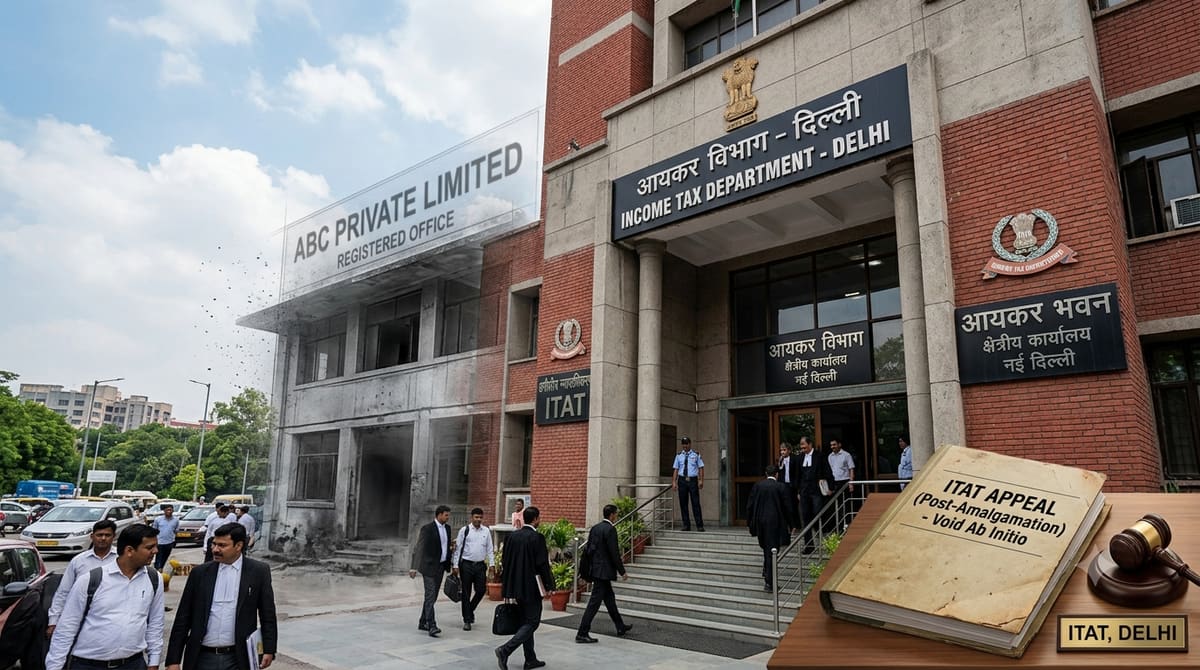
The Bombay High Court has delivered a significant judgment on the validity of GST proceedings initiated against a non-existent entity post-amalgamation. The Court held that any show cause notice or subsequent order issued under Section 74 of the Central Goods and Services Tax Act, 2017 (CGST Act) against an amalgamated company that has ceased to exist is void ab initio, setting aside a demand of Rs. 42.65 crore.
Background & Facts
The Dispute
The petitioner, Kanakia Spaces Realty Private Limited (KSRPL), is a company incorporated under the Companies Act, 1956. It was formed following the amalgamation of Kanakia Supremo Construction Private Limited (KSCPL) with KSRPL, as approved by the Bombay High Court on 29th November, 2016. The appointed date of the merger was 1st April, 2015, resulting in the dissolution of KSCPL and its striking off from the Registrar of Companies (RoC) records.
KSCPL was registered under the Finance Act, 1994, with Service Tax Code (STC) No. AAECA2207JSD001. It had filed its last ST-3 return for the period October 2016 to March 2017 and paid service tax of Rs. 62,78,041 during April 2016 to March 2017. On 22nd February, 2017, KSCPL informed the Superintendent of Central Excise about its amalgamation with KSRPL and the transfer of unutilized CENVAT credit under Rule 10 of the CENVAT Credit Rules, 2004.
Key Facts
- 29.11.2016: Bombay High Court approved the amalgamation of KSCPL with KSRPL, with the appointed date of 01.04.2015.
- 22.02.2017: KSCPL informed the Central Excise Department about its amalgamation and transfer of CENVAT credit.
- 20.06.2019: Deputy Commissioner issued a notice to KSCPL for non-filing of GSTR-3B returns for the previous twelve months.
- 18.07.2019: KSRPL replied, informing the Department that KSCPL had ceased to exist post-amalgamation.
- 17.02.2020: GST registration of KSCPL was cancelled with NIL liability.
- 28.10.2022: KSRPL submitted details of service tax paid by KSCPL and the cancellation order dated 17.02.2020.
- 21.05.2025: Respondent No. 4 issued DRC-01A form under Section 74 of the CGST Act in the name of KSCPL, demanding GST liability with interest.
- 28.05.2025: KSRPL replied, denying liability and asserting that proceedings against a non-existent entity were invalid.
- 25.06.2025: Show cause notice issued under Section 74 of the CGST Act in the name of KSCPL, demanding Rs. 44,78,61,113 along with interest and penalty.
- 31.12.2025: Respondent No. 3 issued the impugned Order-in-Original, confirming a GST demand of Rs. 42,65,34,393, interest under Section 50, and penalty under Section 74 of the CGST Act, while dropping the demand of Rs. 2,13,26,720 towards land value.
Procedural History
- 25.06.2025: Show cause notice issued to KSCPL under Section 74 of the CGST Act.
- 28.05.2025: KSRPL filed a reply, denying liability and asserting the invalidity of proceedings against a non-existent entity.
- 2025: KSRPL filed Writ Petition (L) No. 25819 of 2025 before the Bombay High Court, but no interim relief was granted.
- 31.12.2025: Impugned Order-in-Original issued by Respondent No. 3.
- 2026: Present writ petition (WP No. 2586 of 2026) filed before the Bombay High Court.
Relief Sought
The petitioner sought the quashing of the impugned Order-in-Original dated 31st December, 2025, on the ground that it was issued against a non-existent entity, KSCPL, which had ceased to exist post-amalgamation.
The Legal Issue
The central question before the Court was whether a show cause notice and subsequent order issued under Section 74 of the CGST Act against a non-existent entity, which had ceased to exist pursuant to a court-approved amalgamation scheme, is sustainable in law.
Arguments Presented
For the Petitioner
The petitioner relied on the decisions in Reliance Industries Limited v. P. L. Roongta and Vodafone Idea Ltd. v. Union of India and Ors. to argue that the show cause notice and impugned order were void ab initio. The petitioner contended that since KSCPL had ceased to exist post-amalgamation, any proceedings initiated against it were without jurisdiction.
For the Respondents
The respondents argued that under Section 85 of the CGST Act, the Department was entitled to recover unpaid GST dues from the transferee entity, i.e., KSRPL, even after the amalgamation. They contended that the liability of KSCPL pertained to the GST regime introduced from 1st July, 2017, and thus, KSRPL was liable for the dues.
The Court's Analysis
The Court examined the rival submissions and the material on record. It observed that the core issue was not whether the dues of KSCPL were recoverable but whether proceedings initiated against a non-existent entity were maintainable in law.
The Court relied on the Supreme Court's decision in Principal Commissioner of Income Tax, New Delhi v. Maruti Suzuki India Ltd., which held that proceedings initiated against a non-existent amalgamating company, despite the Department's knowledge of the amalgamation, were void ab initio. This principle was reiterated by the Bombay High Court in Reliance Industries Limited v. P. L. Roongta and Vodafone Idea Ltd. v. Union of India and Ors.
The Court analyzed Section 87 of the CGST Act, which deals with the liability of amalgamated companies. It noted that Section 87 applies only to the intervening period from the date on which the amalgamation order takes effect until the date of the order. The provision does not empower the Department to initiate proceedings against a non-existent entity post-amalgamation.
"These conditions, to our mind, are only in respect of the intervening period from the date on which the order takes effect till the date of the order, and in no way affect or give the Department the authority to issue a show-cause notice on a non-existent entity post merger/amalgamation. This in view of the fact that post merger/amalgamation the merged entity has no status in the eyes of law, and therefore no proceedings can be initiated against it."
The Court rejected the respondents' contention that Maruti Suzuki India Ltd. was distinguishable as it pertained to the Income Tax Act, 1961. It held that the principle laid down in Maruti Suzuki was equally applicable to the CGST Act.
The Verdict
The writ petition was allowed. The Court set aside the impugned Order-in-Original dated 31st December, 2025, confirming a GST demand of Rs. 42,65,34,393, interest under Section 50, and penalty under Section 74 of the CGST Act. The Court clarified that its decision was based solely on the ground that the proceedings were initiated against a non-existent entity and did not express any opinion on the merits of the claims. The respondents were left free to initiate fresh proceedings against KSRPL, if permissible under law.
What This Means For Similar Cases
Proceedings Against Non-Existent Entities Are Void Ab Initio
- No Jurisdiction: Any show cause notice or order issued under the CGST Act against a non-existent entity, post-amalgamation, is without jurisdiction and void ab initio. Practitioners must challenge such notices on this ground alone.
- Precedential Value: The judgment reinforces the principle laid down in Maruti Suzuki India Ltd., Reliance Industries Limited v. P. L. Roongta, and Vodafone Idea Ltd., extending it to GST proceedings.
Section 87 CGST Act Does Not Empower Post-Amalgamation Proceedings
- Limited Scope of Section 87: Section 87 of the CGST Act applies only to the intervening period between the date of the amalgamation order and its effect. It does not authorize the Department to initiate proceedings against a non-existent entity post-amalgamation.
- No Carry Forward of Liability: The Department cannot rely on Section 87 to recover dues from the transferee entity if the proceedings were initiated against the non-existent transferor entity.
Fresh Proceedings Can Be Initiated Against the Transferee Entity
- No Bar on Fresh Proceedings: While the Court set aside the impugned order, it clarified that the respondents could initiate fresh proceedings against KSRPL for recovery of unpaid GST dues, if permissible under law.
- Due Diligence: The Department must ensure that proceedings are initiated against the correct legal entity, especially in cases involving amalgamations or mergers.