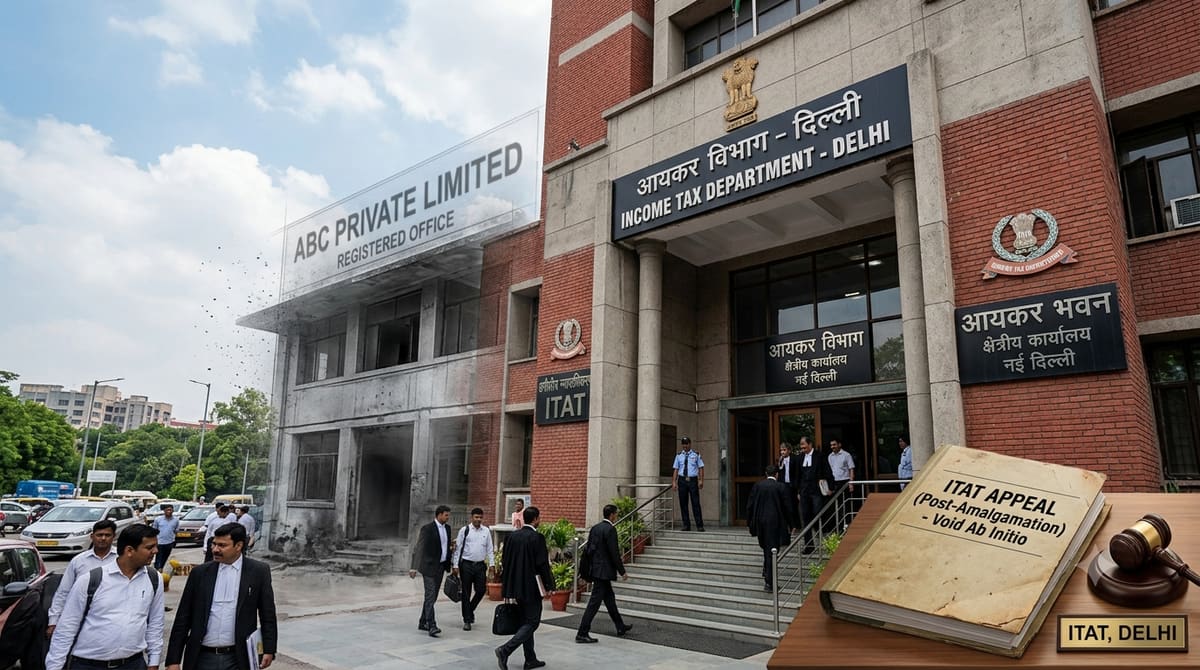
The Income Tax Appellate Tribunal, Patna Bench, held that an assessment framed in the name of a dissolved entity is a nullity and cannot be cured by the assessee’s participation in the proceedings. The Tribunal quashed a rectification order passed under Section 154 of the Income Tax Act, 1961, which had imposed a penalty of ₹29,23,94,340, relying on Supreme Court precedent that such orders are substantively illegal.
Background & Facts
The Dispute
The assessee, Prakash Bhawan, challenged the order of the National Faceless Appeal Centre (NFAC) dated 21.11.2022 which upheld a rectification order passed under Section 154 by the Assessing Officer (AO) in the name of Bihar State Electricity Board (BSEB). The assessee contended that BSEB had been dissolved w.e.f. 01.11.2012 and therefore any proceedings in its name were a nullity.
Key Facts
- Bihar State Electricity Board was dissolved vide notification bearing No. 17 dated 30.10.2012 (or 31.10.2012) issued by the Energy Department, Government of Bihar.
- The dissolution was effected with effect from 01.11.2012, and its business was taken over as a going concern by five successor companies.
- The AO issued a notice under Section 154 dated 28.06.2021 in the name of BSEB, Patna.
- In response, the assessee uploaded a written submission dated 28.06.2021 on 18.08.2021.
- The AO passed a rectification order under Section 154 dated 10.02.2022, computing a penalty of ₹29,23,94,340 (being 100% of the tax sought to be evaded) by rectifying an earlier penalty order dated 15.06.2018 passed under Section 271(1)(c).
- The NFAC (referred to as Ld. CIT(A)) passed an order dated 21.11.2022 upholding the AO’s rectification order for the assessment year 2012-13.
Procedural History
- 28.06.2021: Notice u/s 154 issued by AO in name of BSEB.
- 18.08.2021: Assessee’s written submission uploaded.
- 10.02.2022: AO passes rectification order u/s 154, penalty ₹29,23,94,340.
- 21.11.2022: NFAC (Ld. CIT(A)) upholds the AO’s order.
- 25.08.2026: Date of hearing before ITAT Patna Bench (virtual hearing at Kolkata).
- 24.09.2026: Date of pronouncement of the present order.
Relief Sought
The assessee sought quashing of the NFAC order dated 21.11.2022 and the AO’s rectification order dated 10.02.2022, declaration that the proceedings were a nullity, and consequential relief.
The Legal Issue
The central question was whether an assessment or rectification order passed under Section 154 of the Income Tax Act, 1961 in the name of a non-existent or dissolved entity is a mere procedural irregularity curable under Section 292B or a substantive illegality rendering the order a nullity, and whether the assessee’s participation in the proceedings creates an estoppel against challenging such nullity.
Arguments Presented
For the Appellant/Petitioner
The assessee, through AR A.K. Rastogi, contended that the AO lacked jurisdiction to initiate proceedings against a dissolved entity. Reliance was placed on the Supreme Court’s decision in Principal Commissioner of Income Tax, New Delhi vs. Maruti Suzuki India Ltd. [(2019) 416 ITR 613 (SC)] which held that an order passed in the name of a non-existent entity is a nullity and cannot be cured by participation. It was argued that the notice u/s 154 dated 28.06.2021, the rectification order u/s 154 dated 10.02.2022, and the NFAC order dated 21.11.2022 were all void ab initio. The assessee further submitted that the penalty of ₹29,23,94,340 was computed on a baseless premise and therefore illegal.
For the Respondent/State
The DR, representing the Revenue through Shri Bharat Bhusan Garg, relied on the orders of the authorities below and argued that the assessee’s participation in the assessment proceedings precluded it from raising the plea of nullity at a later stage. The DR emphasized that the AO had acted in good faith and that any defect was merely procedural, curable under Section 292B of the Act.
The Court's Analysis
The Tribunal first noted the undisputed fact that BSEB had ceased to exist w.e.f. 01.11.2012, a fact communicated to the AO. It then examined the nature of the defect. Citing PCIT vs. Maruti Suzuki India Ltd. (supra) and the coordinate bench decision in CIT vs. Spice Infotainment Ltd. [(2012) 247 CTR 500 (Delhi)], the Tribunal held that an assessment framed in the name of a non-existent company suffers from substantive illegality and is not a mere procedural mistake. The Tribunal observed:
"Considering the facts and circumstances of the instant case in the light of decisions of the Hon'ble Apex Court, we hold that the order passed by the AO in the name of non existent entity is nullity and bad in law and is hereby quashed."
The Tribunal further held that the assessee’s participation in the proceedings does not create an estoppel against challenging the nullity, as there is no estoppel against law. It concluded that the additional grounds raised by the assessee challenging the jurisdiction of the AO were maintainable for the first time before the appellate authority.
The Verdict
The appeal of the assessee was allowed. The order passed by the AO under Section 154 dated 10.02.2022, which had imposed a penalty of ₹29,23,94,340, was declared a nullity and quashed. The additional grounds of appeal were allowed, while other grounds were left open for future adjudication. The NFAC order dated 21.11.2022 upholding the AO’s order was consequently set aside.
What This Means For Similar Cases
Assessment on Dissolved Entity Is Void Ab Initio
Practitioners must verify the existence of the taxpayer entity at the time of issuing any notice or order under Section 154. If the entity has been dissolved or amalgamated, proceedings in its name are a nullity and cannot be cured by Section 292B.
Participation Does Not Create Estoppel
The assessee’s involvement in assessment proceedings, including filing responses, does not bar it from challenging the lack of jurisdiction. The principle of ‘no estoppel against law’ applies, allowing the plea of nullity to be raised at any stage.
Reliance on Supreme Court Precedent Is Binding
Lower tribunals and authorities are bound by the Supreme Court’s ratio in PCIT vs. Maruti Suzuki India Ltd. and CIT vs. Spice Infotainment Ltd. that orders passed in the name of non-existent entities are substantively illegal and must be set aside.