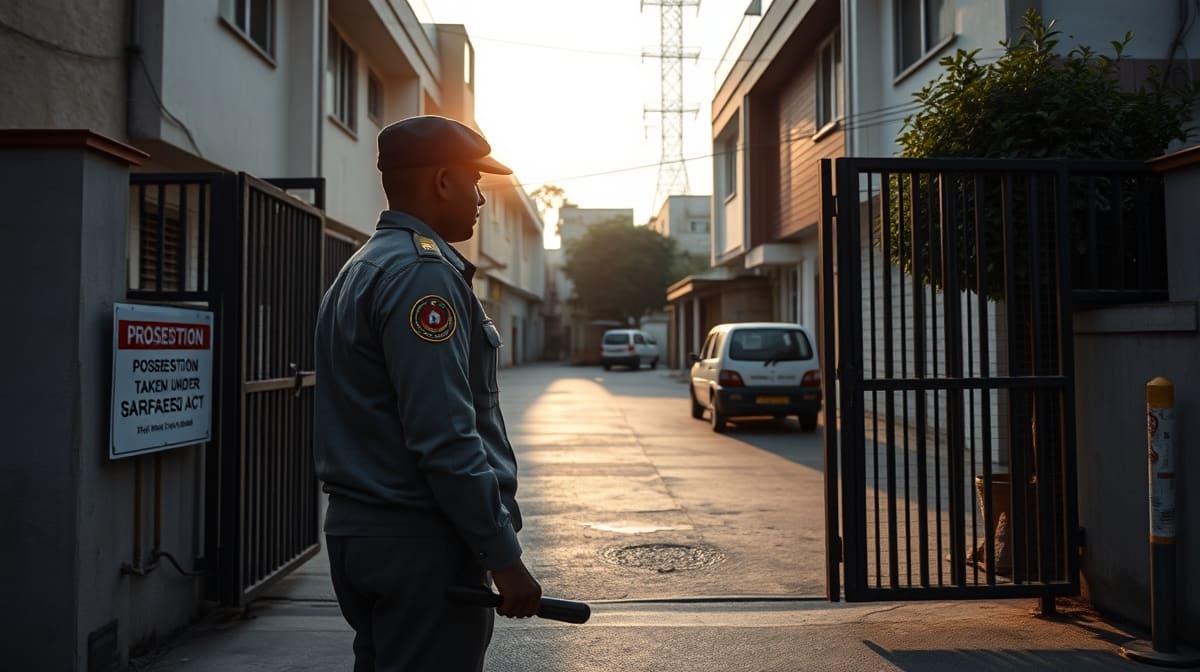
The Madhya Pradesh High Court has reaffirmed the rights of secured creditors under the SARFAESI Act, holding that financial institutions are entitled to restoration of possession if borrowers illegally re-enter secured assets after being dispossessed. The judgment clarifies the limited scope of writ jurisdiction in matters of police inaction, directing aggrieved parties to alternative remedies under the CrPC.
Background & Facts
The Dispute
The petitioner, Aavas Financiers Ltd, a financial institution, had initiated proceedings under Section 14 of the Securitisation and Reconstruction of Financial Assets and Enforcement of Security Interest Act, 2002 (SARFAESI Act) for recovery of possession of a secured asset. An order dated 22.02.2024 was passed by the Chief Judicial Magistrate (CJM) under Section 14, facilitating the petitioner's possession of the asset. However, the borrower subsequently re-entered the secured asset illegally, prompting the petitioner to approach the High Court under Article 226 of the Constitution of India.
Key Facts
- The petitioner is a secured creditor under the SARFAESI Act
- An order under Section 14 SARFAESI Act was passed on 22.02.2024 by the CJM, granting possession to the petitioner
- The borrower illegally re-entered the secured asset after dispossession
- The petitioner filed a complaint dated 07.05.2026 alleging criminal acts by the borrower
- No FIR was registered by the police despite the complaint
Procedural History
- 22.02.2024: Order passed under Section 14 SARFAESI Act by CJM
- 07.05.2026: Petitioner filed complaint with police alleging illegal re-entry and criminal acts
- 17328/2026: Writ petition filed before the Madhya Pradesh High Court seeking:
- Registration of FIR
- Fair and impartial investigation
- Restoration of possession of the secured asset
- Police protection during SARFAESI proceedings
Relief Sought
The petitioner sought the following reliefs:
- A writ of mandamus directing respondents to register an FIR based on the complaint dated 07.05.2026
- Direction for a fair, impartial, and time-bound investigation
- Restoration of peaceful and vacant possession of the secured asset
- Continuous police protection until completion of SARFAESI proceedings
The Legal Issue
The central questions before the Court were:
- Whether a secured creditor is entitled to restoration of possession under Section 14 SARFAESI Act if the borrower illegally re-enters the secured asset after dispossession?
- Whether the High Court can exercise its writ jurisdiction under Article 226 to direct registration of an FIR or investigation into alleged criminal acts?
Arguments Presented
For the Petitioner
- Relied on precedents such as W.P. No. 1681/2025 (Madhya Pradesh High Court), Kotak Mahindra Bank v. State of Maharashtra & Ors., and HDB Financial Services Limited v. State of Maharashtra & Ors. to argue that illegal re-entry by the borrower cannot defeat the statutory rights of the secured creditor
- Contended that the Court should direct restoration of possession and registration of FIR to protect the petitioner's rights under the SARFAESI Act
For the Respondent/State
- Argued that the appropriate remedy for non-registration of FIR or police inaction lies under Section 156(3) CrPC before the jurisdictional Magistrate, not under Article 226
- Cited Sakiri Vasu v. State of U.P. and Aleque Padamsee v. Union of India to support the contention that writ jurisdiction should not be invoked for such reliefs
The Court's Analysis
The Court examined the scope of Section 14 SARFAESI Act and the rights of secured creditors in cases of illegal re-entry by borrowers. It observed that the issue of restoration of possession was no longer res integra, as identical circumstances had been addressed in earlier judgments:
"In identical circumstances, the Division Bench of this Court in W.P. No. 1681/2025 has held that there exists no legal impediment in re-executing an order passed under Section 14 of the SARFAESI Act or in extending fresh assistance to the secured creditor where the borrower, after having been dispossessed, illegally re-enters the secured asset and resumes possession thereof. The Division Bench further observed that such illegal re-entry by the borrower cannot be permitted to defeat the statutory rights of the secured creditor or frustrate the object and purpose of the SARFAESI Act."
The Court relied on the Full Bench decision in W.P. No. 11500/2020, which held that the action of the District Magistrate or Chief Metropolitan Magistrate under Section 14 SARFAESI Act is ministerial in nature and undertaken for the benefit of the secured creditor. Thus, the petitioner was entitled to restoration of possession.
Regarding the reliefs for registration of FIR and investigation, the Court referred to the settled legal position in Sakiri Vasu v. State of U.P. and Aleque Padamsee v. Union of India, which held that the appropriate remedy for police inaction is to approach the jurisdictional Magistrate under Section 156(3) CrPC rather than invoking writ jurisdiction:
"In cases of non-registration of FIR or alleged police inaction, the appropriate remedy is to approach the jurisdictional Magistrate by filing an application under Section 156(3) of the Code of Criminal Procedure, 1973, corresponding to Section 175(3) of the Bharatiya Nagarik Suraksha Sanhita, 2023, rather than invoking the writ jurisdiction of this Court under Article 226 of the Constitution of India."
The Court emphasized that Section 156(3) CrPC empowers the Magistrate to direct registration of an FIR and ensure proper investigation, and that the High Court should discourage the practice of filing writ petitions for such reliefs.
The Verdict
The Court disposed of the writ petition with the following directions:
- Respondent No. 2 was directed to provide all necessary assistance and aid to the petitioner for dispossessing the borrower and restoring peaceful and vacant possession of the secured asset in terms of the order dated 22.02.2024 passed under Section 14 SARFAESI Act
- The petitioner was left at liberty to avail remedies under Section 156(3) CrPC or Section 175(3) Bharatiya Nagarik Suraksha Sanhita, 2023 for reliefs relating to registration of FIR and investigation
What This Means For Similar Cases
Restoration of Possession Under SARFAESI Act Is a Statutory Right
- Secured creditors can seek restoration of possession if borrowers illegally re-enter secured assets after dispossession
- Courts will not permit illegal re-entry to defeat the object of the SARFAESI Act
- Financial institutions should rely on orders under Section 14 SARFAESI Act and seek police assistance for re-execution if necessary
Writ Jurisdiction Is Not a Substitute for CrPC Remedies
- Aggrieved parties cannot bypass Section 156(3) CrPC by directly approaching the High Court under Article 226 for registration of FIR or investigation
- The appropriate remedy for police inaction is to file an application before the jurisdictional Magistrate
- Practitioners should advise clients to exhaust remedies under CrPC before invoking writ jurisdiction
Ministerial Nature of Section 14 SARFAESI Act
- The role of the Magistrate under Section 14 SARFAESI Act is ministerial, not adjudicatory
- Secured creditors are entitled to assistance for recovery of possession as a matter of right
- Courts will ensure compliance with orders passed under Section 14 to uphold the statutory framework