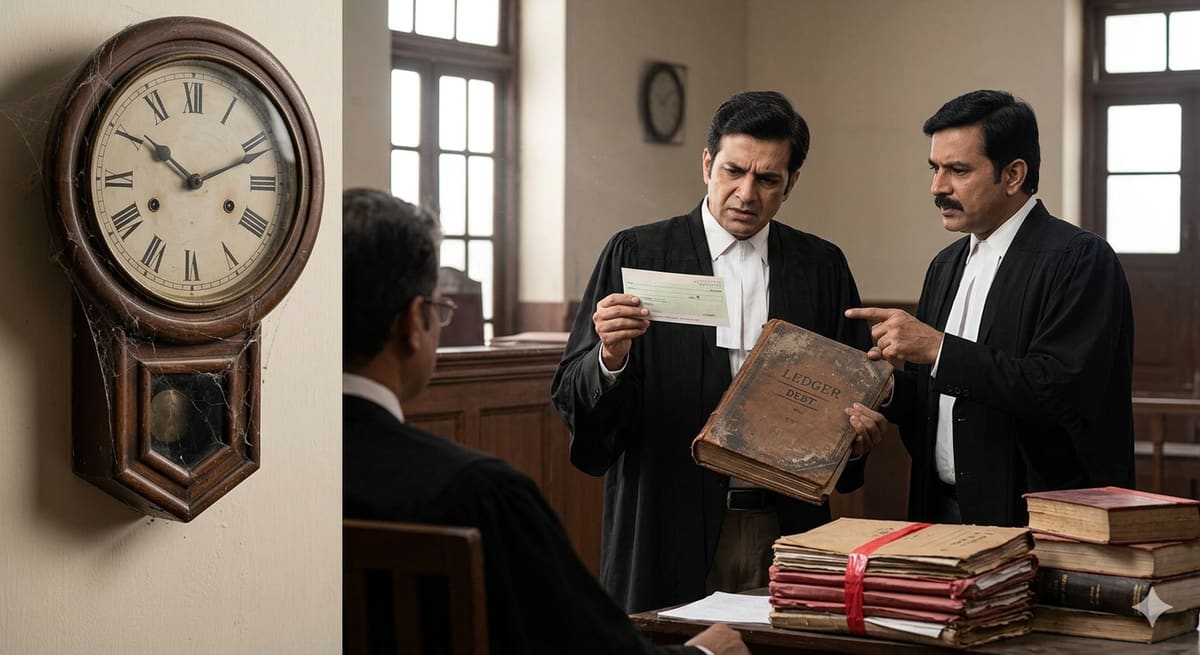
The Himachal Pradesh High Court has clarified a critical procedural aspect under Section 138 of the Negotiable Instruments Act, affirming that the 45-day limitation period for filing a complaint begins from the date stamped on the postal acknowledgment receipt, not from any assumed earlier date of service. This ruling resolves a recurring ambiguity in cheque dishonour cases and reinforces the primacy of documentary evidence over speculative inference in limitation calculations.
Background & Facts
The Dispute
The complainant, Ajay Kumar Sharma, filed a complaint under Section 138 of the Negotiable Instruments Act against the accused, Mehar Singh Thakur, alleging dishonour of a cheque issued to discharge a lawful liability. The cheque, bearing No. 080463 and dated 02.11.2019, for Rs. 10,00,000, drawn on Punjab National Bank, Rohru, was presented for payment and returned on 11.12.2019 with the remark "funds insufficient".
Key Facts
- Cheque issued on: 02.11.2019
- Cheque dishonoured on: 11.12.2019
- Legal notice sent via registered post on: 27.12.2019
- Acknowledgment receipt (AD) returned to complainant on: 15.01.2020
- No date of receipt by the accused was written on the acknowledgment
- Complaint filed before Judicial Magistrate, First Class, Arki: 28.02.2020
- Process issued by Magistrate: 06.03.2020
- Criminal revision dismissed by Additional Sessions Judge: 18.01.2024
- Writ petition filed before High Court: 2024
- Judgment date: 13.05.2026
Procedural History
- 27.12.2019: Legal notice sent by registered post to the accused
- 11.12.2019: Cheque dishonoured by bank
- 15.01.2020: Acknowledgment receipt returned to complainant with postal stamp date
- 28.02.2020: Complaint filed under Section 138 NI Act
- 06.03.2020: Judicial Magistrate, First Class, Arki, issued process against the accused
- 2023: Accused filed Criminal Revision Petition No. 48-S/10 of 2023/22 before Additional Sessions Judge-I, Solan
- 18.01.2024: Additional Sessions Judge dismissed the revision, upholding issuance of process
- 2024: Petitioner filed Cr.MMO No. 640 of 2024 under Section 482 CrPC before Himachal Pradesh High Court
- 13.05.2026: High Court delivered judgment
Relief Sought
The petitioner sought quashing of the order dated 18.01.2024 and the process issued on 06.03.2020, arguing that the complaint was time-barred because the legal notice must have been received before 15.01.2020, making the filing date of 28.02.2020 exceed the 45-day limitation period.
The Legal Issue
The central question was whether the 45-day limitation period under Section 138 of the Negotiable Instruments Act commences from the date stamped on the postal acknowledgment receipt, or whether it can be presumed to have commenced earlier based on speculative inference of actual service.
Arguments Presented
For the Petitioner
The petitioner’s counsel contended that since the acknowledgment receipt was returned on 15.01.2020, the notice must have been delivered to the accused several days prior, as postal delivery typically takes 3 - 5 days. Therefore, the 45-day limitation period should be calculated from an earlier date, rendering the complaint filed on 28.02.2020 time-barred. Reliance was placed on the principle that courts should infer actual service from circumstantial evidence when the acknowledgment does not record the date of receipt.
For the Respondent
The respondent’s counsel argued that the acknowledgment receipt, as a statutory document, is the only legally recognized proof of service. In the absence of any date written by the accused or his representative, the date stamped by the postal department on the acknowledgment must be deemed the date of service. The complaint was filed within 45 days of 15.01.2020, and therefore, was well within limitation.
The Court's Analysis
The Court examined the settled legal position regarding service of legal notice under Section 138 of the Negotiable Instruments Act. It noted that while the law presumes service if a notice is sent to the correct address and the acknowledgment is not returned, the presence of an acknowledgment receipt with a postal date changes the legal calculus.
"In case acknowledgment receipt is received and no date is mentioned with regard to receipt of registered letter by the accused, date reflected upon acknowledgment receipt with regard to its receipt at the sender’s address shall be deemed to be date of service of notice upon the accused."
The Court rejected the petitioner’s argument that actual service must have occurred earlier, emphasizing that such speculation undermines the certainty required in criminal proceedings. It cited Subodh S. Salaskar v. Jay Prakash M. Shah (2008) 13 SCC 689, which holds that the period for filing a complaint under Section 138 is 30 days from the date of receipt of notice, and the 45-day window includes the 15-day notice period. The Court clarified that the date on the acknowledgment receipt is the conclusive evidence of service unless rebutted by clear proof of earlier delivery - which was absent here.
The Court further observed that the trial court and the Sessions Judge had correctly appreciated the evidence and applied the law. There was no illegality, perversity, or abuse of process in issuing process based on the acknowledgment date of 15.01.2020.
The Verdict
The petition was dismissed. The High Court upheld the order dated 18.01.2024 of the Additional Sessions Judge and confirmed that the limitation period commenced from 15.01.2020. The complaint filed on 28.02.2020 was held to be within the 45-day limitation period. The Court directed the parties to appear before the Judicial Magistrate, First Class, Arki, on 28.05.2026 for further proceedings. All interim orders were vacated, and the record was directed to be sent back forthwith.
What This Means For Similar Cases
Documentary Proof of Service Is Conclusive
- Practitioners must treat the postal acknowledgment receipt’s stamped date as the definitive date of service under Section 138 NI Act unless the accused provides independent proof of earlier receipt
- Oral testimony or speculative timelines about postal delivery times are inadmissible to challenge the acknowledgment date
- Always ensure the legal notice is sent via registered post with proper address and retain the acknowledgment receipt
Limitation Calculations Must Be Precise
- The 45-day window begins from the date stamped on the acknowledgment, not from the date of posting or assumed delivery
- Even if the notice was delivered earlier, the law does not permit courts to infer an earlier service date without explicit acknowledgment by the accused
- Filing a complaint on the 45th day from the acknowledgment date is valid - no need to file earlier to avoid risk
Strategic Implications for Defense
- Accused parties who receive notice early should immediately write the date of receipt on the acknowledgment and return it to the sender to preserve evidence
- Failure to do so waives the right to challenge the limitation period based on actual service date
- Challenges to process issuance on limitation grounds will fail unless the accused can produce a signed acknowledgment with an earlier date