The Allahabad High Court has quashed a summoning order in a Section 138 Negotiable Instruments Act case, holding that a complaint filed before the expiry of the 15-day notice period under Section 138(c) is not maintainable in law. The court followed the Supreme Court's binding precedent in Yogendra Pratap Singh v. Savitri Pandey, which established that such a complaint is a nullity, not merely premature, and cannot be cured by the subsequent passage of time.
Background & Facts
The Dispute
The applicant, Arun Gautam, and the complainant-respondent, Amit Kumar Tripathi, were well acquainted and had cordial relations. In July 2014, the applicant approached the complainant for a loan of Rs. 2,50,000 for his business. The complainant allegedly advanced the amount in instalments: Rs. 1.25 lakhs on different dates and Rs. 1,25,000 on 31.07.2014 through NEFT from his ICICI Bank account. The loan was stated to be interest-free, repayable within three months. When the applicant failed to repay, the complainant demanded repayment on 15.10.2014.
Key Facts
- 15.10.2014: Applicant issued Cheque No. 001295 dated 15.10.2014 for Rs. 1,00,000 drawn on Axis Bank Limited, Kakadeo, Kanpur Nagar, but requested the complainant not to present it due to insufficient funds.
- The cheque was not presented within its validity period and became invalid.
- 23.02.2016: Applicant issued Cheque No. 462111 dated 23.02.2016 for Rs. 1,50,000 drawn on ING Vysya Bank Limited, Kanpur Branch, assuring sufficient funds and promising to repay the remaining Rs. 1,00,000 shortly.
- 26.02.2016: Cheque presented and returned unpaid with endorsement "kindly contact drawer".
- 11.03.2016: Cheque re-presented and again returned unpaid with same endorsement.
- 06.04.2016: Cheque presented again and returned unpaid with same endorsement.
- 20.04.2016: Complainant issued legal notice by registered post through counsel Sri Sudhir Kumar Awasthi; the notice was allegedly refused by the applicant and returned undelivered.
- 02.05.2016: Complainant filed Complaint Case No. 3621 of 2016 before the Additional Chief Metropolitan Magistrate, Kanpur Nagar.
- 10.05.2016: Magistrate passed summoning order, concluding a prima facie case under Section 138 NI Act was made out.
Procedural History
- 02.05.2016: Complaint instituted before Additional Chief Metropolitan Magistrate, Court No. 2, Kanpur Nagar.
- 10.05.2016: Summoning order passed by Additional Chief Metropolitan Magistrate, Court No. 1, Kanpur Nagar.
- 2017: Application under Section 482 CrPC (No. 39950 of 2017) filed before Allahabad High Court challenging the summoning order and consequential proceedings.
- 29.10.2026: Judgment reserved.
- 02.11.2026: Judgment delivered.
Relief Sought
The applicant prayed for quashing of the entire proceedings of Complaint Case No. 3621 of 2016, including the summoning order dated 10.05.2016, on the ground that the complaint was filed prematurely before the expiry of the statutory 15-day period under Section 138(c) of the NI Act.
The Legal Issue
Whether a complaint under Section 138 of the Negotiable Instruments Act, 1881, filed before the expiry of the 15-day period stipulated in Section 138(c) from the date of receipt of notice by the drawer, is maintainable in law.
Arguments Presented
For the Applicant
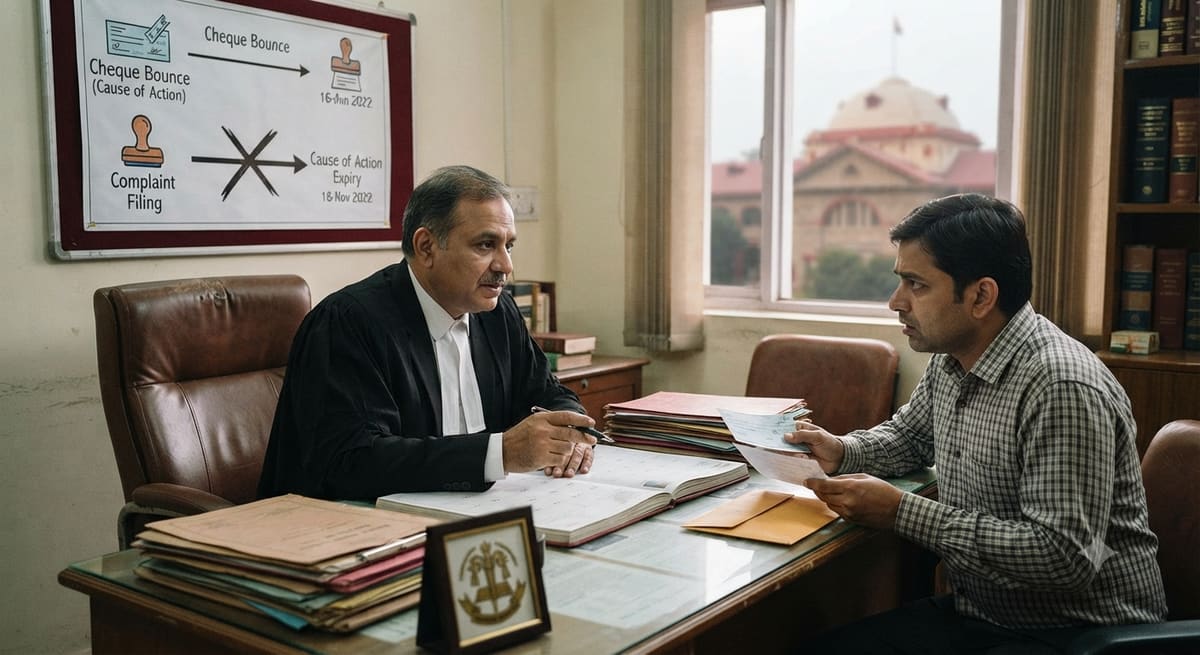
Learned counsel Sri P.K. Singh submitted that even accepting the allegations of dishonour, the complaint was filed prematurely and therefore not maintainable. The legal notice was issued on 20.04.2016 and allegedly refused on the same date; the 15-day period under Section 138(c) would expire only on 05.05.2016. However, the complaint was filed on 02.05.2016, before the expiry of this period. Reliance was placed on Yogendra Pratap Singh v. Savitri Pandey (2014) 10 SCC 713 and Gajanand Burange v. Laxmi Chand Goyal 2022 SCC OnLine SC 1711, where the Supreme Court held that a complaint filed before the expiry of 15 days is not a complaint in the eye of law and criminal proceedings initiated thereon are liable to be quashed.
For the Respondent
Learned counsel for the complainant-respondent submitted that even if the complaint was filed before the expiry of the 15-day period, nearly ten years have elapsed since institution and the trial has not concluded. At this belated stage, it would not be appropriate to quash the proceedings and leave the complainant to institute a fresh complaint on the same facts.
The Court's Analysis
The court examined Section 138 of the Negotiable Instruments Act, 1881, focusing on the proviso clauses (a), (b), and (c). It noted that clause (c) requires the drawer to fail to make payment within 15 days of receipt of notice. The court relied on the three-Judge Bench decision of the Supreme Court in Yogendra Pratap Singh v. Savitri Pandey, which authoritatively answered two questions: (i) whether a court can take cognizance on a complaint filed before the expiry of 15 days, and (ii) whether the complainant can be permitted to present the complaint again after the limitation period under Section 142(b) has expired.
"A bare reading of the provision contained in clause (c) of the proviso makes it clear that no complaint can be filed for an offence under Section 138 of the NI Act unless the period of 15 days has elapsed. Any complaint filed before the expiry of 15 days from the date on which the notice has been served on the drawer/accused is no complaint at all in the eye of the law. It is not the question of prematurity of the complaint where it is filed before the expiry of 15 days from the date on which notice has been served on him, it is no complaint at all under law."
The Supreme Court overruled Narsingh Das Tapadia v. Goverdhan Das Partani (2000) 7 SCC 183 and approved Sarav Investment & Financial Consultancy (P) Ltd. v. Llyods Register of Shipping Indian Office Staff Provident Fund (2007) 14 SCC 753, holding that service of notice under Section 138(b) is part of the cause of action and a complaint filed before 15 days cannot be maintained. The remedy is to file a fresh complaint, and if the limitation period under Section 142(b) has expired, the complainant may seek condonation of delay under the proviso by satisfying the court of sufficient cause.
Applying this law, the court found that in the instant case, the legal notice was issued on 20.04.2016 and allegedly refused the same day. Even presuming deemed service on 20.04.2016, the 15-day period would expire on 05.05.2016. The complaint was filed on 02.05.2016, which is before the expiry of the statutory period. Therefore, the complaint was not maintainable, and the trial court erred in taking cognizance and passing the summoning order dated 10.05.2016.
The Verdict
The Allahabad High Court allowed the Section 482 CrPC application. The impugned summoning order dated 10.05.2016 passed by the Additional Chief Metropolitan Magistrate, Court No. 1, Kanpur Nagar, is set aside. The complainant-respondent is at liberty to institute a fresh complaint. Since the earlier complaint could not be presented within the time prescribed by Section 142(b) of the NI Act, the complainant may seek the benefit of the proviso by satisfying the trial court of sufficient cause for the delay. In the event a fresh complaint is filed within two months from the date of this order (02.11.2026), the trial court is directed to dispose of the complaint within a period of six months.
What This Means For Similar Cases
Complaint Filed Before 15-Day Period Is a Nullity
A complaint under Section 138 NI Act filed before the expiry of the 15-day notice period under Section 138(c) is not merely premature but a legal nullity. It does not constitute a "complaint" in the eye of law, and no cognizance can be taken on it even if the 15-day period expires by the time the court considers the matter. Practitioners must ensure the notice period has fully elapsed before filing the complaint.
Fresh Complaint Permitted With Condonation of Delay
Where a premature complaint has been filed and the limitation period under Section 142(b) has expired, the complainant's remedy is to file a fresh complaint and seek condonation of delay under the proviso to Section 142(b) by demonstrating sufficient cause. The Supreme Court in Yogendra Pratap Singh directed that delay in filing the fresh complaint will be treated as condoned if filed within one month from the date of decision in the criminal case. The High Court here extended this to two months from its order.
Trial Court Bound by Timelines for Fresh Complaints
The court imposed a specific timeline: if a fresh complaint is filed within two months (by 02.01.2027), the trial court must dispose of it within six months. This underscores the judiciary's emphasis on expeditious resolution of NI Act cases and prevents indefinite pendency. Lawyers should calendar these deadlines and seek compliance if the trial court exceeds the prescribed period.
- Actionable takeaway: Before filing a Section 138 complaint, verify the date of service or deemed service of the legal notice and calculate the 15-day period accurately. File the complaint only after the 15th day.
- Actionable takeaway: If a premature complaint has been filed and summoning order passed, challenge it under Section 482 CrPC or Section 397/401 CrPC at the earliest, citing Yogendra Pratap Singh and Gajanand Burange.
- Actionable takeaway: In fresh complaints filed after limitation, prepare a detailed affidavit explaining sufficient cause for delay to invoke the proviso to Section 142(b).