The Punjab and Haryana High Court has clarified that a cheque issued for a debt that has become time-barred under the Limitation Act cannot form the basis of a criminal complaint under Section 138 of the Negotiable Instruments Act, even if the cheque is subsequently dishonoured. This ruling reinforces the foundational requirement that the underlying debt must be legally enforceable at the time of issuance.
Background & Facts
The Dispute
The petitioner, Sanjay Singh, was named as the accused in Complaint No. 907 dated 22.04.2019 filed by Devender Sharma before the Court of Judicial Magistrate 1st Class, Rewari, under Section 138 of the Negotiable Instruments Act. The complainant alleged that in the year 2010, he extended a friendly loan of ₹3,00,000 to the petitioner for a period of one year. No written agreement was produced, and no acknowledgment of liability was obtained during or after the loan period.
Key Facts
The alleged loan was advanced in the year 2010 for a term of one year, implying the due date was 2011
No demand, payment, or written acknowledgment of the debt occurred between 2011 and 2018
A cheque No. 387424 dated 26.12.2018, drawn on United Bank of India, Branch Dharuhera Chowk, Rewari, for ₹3,00,000 was issued by the petitioner
The cheque was presented and dishonoured on 01.02.2019 for insufficient funds
It was re-presented and dishonoured again on 26.02.2019 for the same reason
A legal notice dated 20.03.2019 was sent demanding payment; no reply or payment followed
The complaint was filed on 22.04.2019
The summoning order was issued on 26.11.2021
Procedural History
26.12.2018: Cheque issued by petitioner
01.02.2019: First dishonour of cheque
26.02.2019: Second dishonour of cheque
20.03.2019: Legal notice served on petitioner
22.04.2019: Complaint filed under Section 138 NI Act
26.11.2021: Summoning order issued by Magistrate
10.05.2022: Petition under Section 482 CrPC filed before Punjab and Haryana High Court
28.04.2026: Judgment reserved
04.05.2026: Judgment pronounced
Relief Sought
The petitioner sought quashing of the complaint dated 22.04.2019 and the summoning order dated 26.11.2021, on the ground that the underlying debt was time-barred and therefore not legally enforceable under Section 138 of the Negotiable Instruments Act.
The Legal Issue
The central question was whether the issuance of a cheque for a debt that had become time-barred under the Limitation Act, without any acknowledgment of liability within the limitation period, can satisfy the requirement of a "legally enforceable debt or liability" under Section 138 of the Negotiable Instruments Act.
Arguments Presented
For the Petitioner
Learned counsel argued that the loan was advanced in 2010 for one year, making the due date 2011. The limitation period of three years under Article 113 of the Limitation Act expired in 2014. No acknowledgment of liability was made within this period, as required under Section 18 of the Limitation Act. The cheque issued in 2018 was therefore not in discharge of a legally enforceable debt. The petitioner relied on Manjeet Kaur v. Vinita to contend that a time-barred debt cannot be revived merely by issuing a cheque.
For the Respondent
The respondent’s counsel contended that the issuance of the cheque in 2018 constituted a fresh acknowledgment of liability, thereby reviving the debt and making it enforceable. It was argued that the act of issuing a cheque for an old debt implies an admission of liability and thus satisfies the requirement of a legally enforceable debt under Section 138.
The Court's Analysis
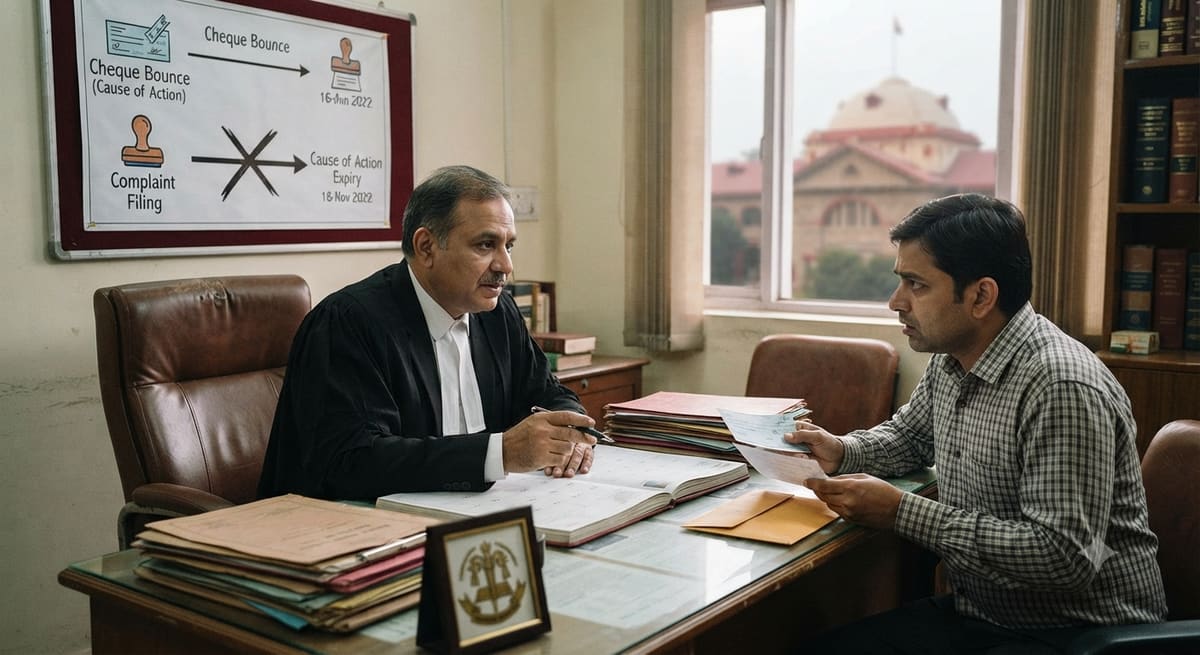
The Court examined the nature of a "legally enforceable debt or liability" under Section 138 of the Negotiable Instruments Act and held that the debt must be enforceable in law at the time the cheque is issued. The Court noted that the complainant’s own averments placed the loan in 2010 with a one-year term, making the limitation period expire in 2014. No document, letter, or admission was produced to show any acknowledgment of liability between 2011 and 2014.
"An acknowledgment under Section 18 of the Limitation Act must be made within the subsisting period of limitation. Once the limitation has already expired, a subsequent issuance of cheque would not revive the time-barred debt so as to make it legally enforceable for the purposes of Section 138 of the Negotiable Instruments Act."
The Court rejected the respondent’s argument that the cheque itself amounted to a valid acknowledgment under Section 18 of the Limitation Act, emphasizing that acknowledgment must occur during the subsisting limitation period to extend it. A post-limitation act, such as issuing a cheque, cannot resurrect a dead claim.
The Court affirmed the precedent set in Manjeet Kaur v. Vinita, which held that dishonour of a cheque issued for a time-barred debt does not attract criminal liability under Section 138. The Court found no distinction between the facts in that case and the present one. The debt was extinguished by limitation in 2014, and the 2018 cheque could not revive it.
The Verdict
The petition was allowed. The complaint dated 22.04.2019 and the summoning order dated 26.11.2021 are quashed. All pending applications are dismissed. The proceedings under Section 138 of the Negotiable Instruments Act are terminated.
What This Means For Similar Cases
Time-Barred Debts Cannot Be Revived by Cheque Issuance
Practitioners must verify the limitation period of the underlying debt before filing or defending a Section 138 complaint
A cheque issued after the limitation period expires, without prior acknowledgment, is legally insufficient to establish a "legally enforceable debt"
Courts will not infer acknowledgment from mere issuance of a cheque if no prior admission occurred within the limitation window
Documentary Evidence of Acknowledgment Is Essential
To extend limitation under Section 18 of the Limitation Act, there must be clear, written, or recorded acknowledgment before the expiry of the limitation period
Oral assertions or post-limitation conduct (like cheque issuance) are not sufficient to revive a time-barred debt
Practitioners should advise clients to obtain signed acknowledgments or partial payments before limitation expires
Procedural Safeguards Against Frivolous Complaints
Section 482 CrPC remains a viable remedy to quash complaints based on time-barred debts
Magistrates must scrutinize the date of loan and issuance of cheque at the summoning stage
This judgment empowers defence counsel to move for quashing at the earliest opportunity, avoiding prolonged litigation on legally untenable grounds