The Allahabad High Court has clarified a critical procedural requirement under Section 138 of the Negotiable Instruments Act (NI Act), holding that a complaint filed before the expiry of the 15-day period from the receipt of notice under clause (c) of the proviso to Section 138 is non-maintainable. This judgment reinforces the statutory timeline for initiating complaints in cheque bounce cases, emphasizing strict adherence to procedural mandates.
Background & Facts
The Dispute
The applicant, Ram Naresh Yadav, was involved in a complaint case under Section 138 of the NI Act filed by the opposite party, Sunil Kumar Yadav, before the Additional Chief Judicial Magistrate, Azamgarh. The complaint alleged dishonour of a cheque issued by the applicant, leading to criminal proceedings.
Key Facts
The complaint case (Complaint Case No. 6666 of 2019) was filed under Section 138 NI Act before the Additional Chief Judicial Magistrate, Court No. 10, Azamgarh.
The applicant challenged the proceedings, arguing that the complaint was premature as it was filed before the expiry of the 15-day period prescribed under clause (c) of the proviso to Section 138 for issuing a notice to the drawer of the cheque.
Procedural History
19.10.2019: The Additional Chief Judicial Magistrate, Azamgarh, passed an order in Complaint Case No. 6666 of 2019, proceeding with the complaint under Section 138 NI Act.
2021: The applicant filed a criminal revision (Criminal Revision No. 284/2019) before the Additional Sessions Judge, Court No. 1, Azamgarh, challenging the magistrate’s order.
24.08.2021: The Additional Sessions Judge dismissed the revision, upholding the magistrate’s order.
2021: The applicant filed the present application under Section 482 of the Code of Criminal Procedure (CrPC) before the Allahabad High Court, seeking quashing of the orders dated 19.10.2019 and 24.08.2021.
Relief Sought
The applicant prayed for the following reliefs:
Setting aside the order dated 24.08.2021 passed by the Additional Sessions Judge, Azamgarh.
Setting aside the order dated 19.10.2019 passed by the Additional Chief Judicial Magistrate, Azamgarh.
Allowing the application under Section 482 CrPC in light of the Supreme Court’s judgment in Yogendra Pratap Singh v. Savitri Pandey and Another.
The Legal Issue
The central question before the court was whether a complaint under Section 138 NI Act filed before the expiry of the 15-day period from the receipt of notice under clause (c) of the proviso to Section 138 is maintainable.
Arguments Presented
For the Applicant
Learned counsel for the applicant relied on the judgment of the Supreme Court in Yogendra Pratap Singh v. Savitri Pandey and Another, (2014) 10 SCC 713, which held that a complaint filed before the expiry of the 15-day period prescribed under Section 142(b) of the NI Act is non-maintainable. The counsel argued that the lower courts erred in proceeding with the complaint despite its premature filing.
For the State
The learned Additional Government Advocate (AGA) appeared for the State but did not advance any substantive arguments to counter the applicant’s reliance on the Supreme Court’s judgment.
The Court's Analysis
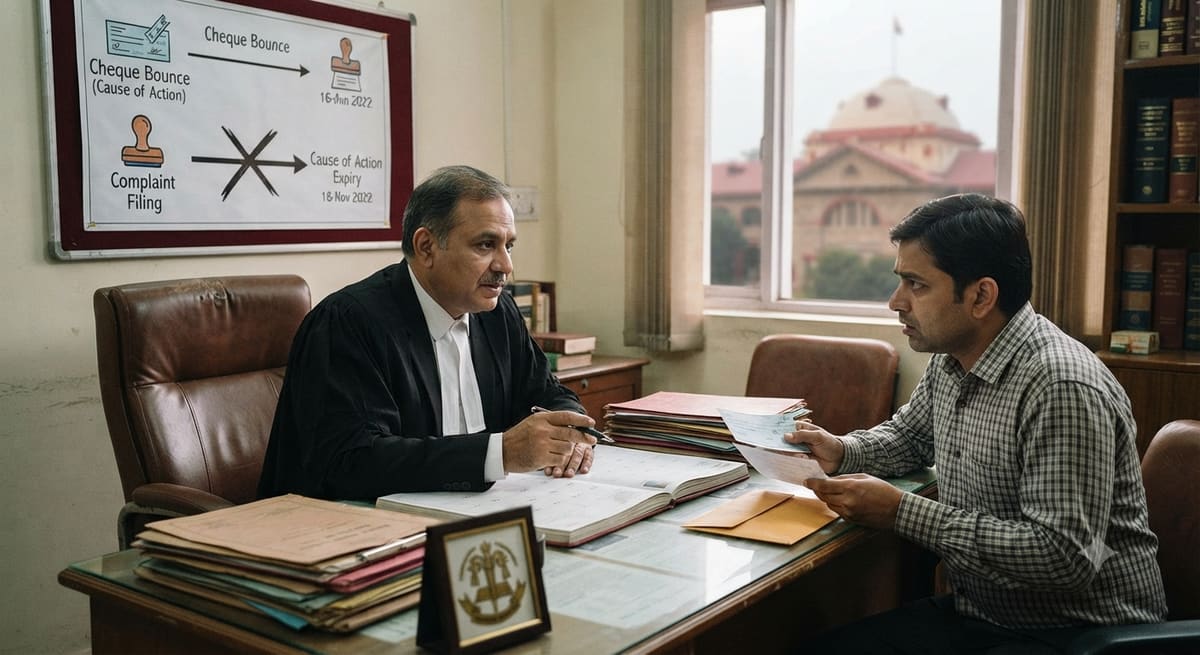
The High Court examined the statutory framework under Section 138 and Section 142 of the NI Act, particularly the timeline for filing a complaint. The court noted that Section 142(b) mandates that a complaint must be filed within one month from the date on which the cause of action arises under clause (c) of the proviso to Section 138. The cause of action, in this context, arises only after the expiry of the 15-day period from the receipt of the notice by the drawer of the cheque.
The court relied on the following passage from Yogendra Pratap Singh v. Savitri Pandey and Another:
"41. Section 142 of the NI Act prescribes the mode and so also the time within which a complaint for an offence under Section 138 of the NI Act can be filed. A complaint made under Section 138 by the payee or the holder in due course of the cheque has to be in writing and needs to be made within one month from the date on which the cause of action has arisen under clause (c) of the proviso to Section 138. The period of one month under Section 142(b) begins from the date on which the cause of action has arisen under clause (c) of the proviso to Section 138. However, if the complainant satisfies the court that he had sufficient cause for not making a complaint within the prescribed period of one month, a complaint may be taken by the court after the prescribed period. Now, since our answer to Question (i) is in the negative, we observe that the payee or the holder in due course of the cheque may file a fresh complaint within one month from the date of decision in the criminal case and, in that event, delay in filing the complaint will be treated as having been condoned under the proviso to clause (b) of Section 142 of the NI Act. This direction shall be deemed to be applicable to all such pending cases where the complaint does not proceed further in view of our answer to Question (i). As we have already held that a complaint filed before the expiry of 15 days from the date of receipt of notice issued under clause (c) of the proviso to Section 138 is not maintainable, the complainant cannot be permitted to present the very same complaint at any later stage. His remedy is only to file a fresh complaint; and if the same could not be filed within the time prescribed under Section 142(b), his recourse is to seek the benefit of the proviso, satisfying the court of sufficient cause."
The court held that the complaint in the present case was filed prematurely, i.e., before the expiry of the 15-day period from the receipt of the notice, and was therefore non-maintainable. The lower courts’ orders proceeding with the complaint were thus unsustainable in law.
The Verdict
The Allahabad High Court allowed the application under Section 482 CrPC, setting aside the orders dated 24.08.2021 and 19.10.2019 passed by the Additional Sessions Judge and the Additional Chief Judicial Magistrate, Azamgarh, respectively. The court directed that the complaint filed under Section 138 NI Act be dismissed as non-maintainable, in light of the Supreme Court’s judgment in Yogendra Pratap Singh v. Savitri Pandey and Another.
What This Means For Similar Cases
Strict Compliance with Statutory Timelines
This judgment underscores the importance of adhering to the statutory timelines prescribed under Section 142 of the NI Act. Practitioners must ensure that complaints under Section 138 are filed only after the expiry of the 15-day period from the receipt of the notice under clause (c) of the proviso to Section 138. Filing a complaint prematurely renders it non-maintainable, as held by the Supreme Court and reiterated by the Allahabad High Court.
Remedy for Premature Complaints
If a complaint is filed prematurely, the complainant cannot amend or revive the same complaint. The only remedy is to file a fresh complaint within one month from the date of the decision in the criminal case.
If the fresh complaint cannot be filed within the prescribed period, the complainant may seek condonation of delay under the proviso to Section 142(b), by satisfying the court of sufficient cause.
Implications for Lower Courts
Lower courts must scrutinize complaints under Section 138 NI Act to ensure compliance with the statutory timeline. Orders proceeding with premature complaints are liable to be set aside, as demonstrated in this case. This judgment serves as a precedent for dismissing non-maintainable complaints at the threshold, saving judicial time and resources.