The Customs, Excise & Service Tax Appellate Tribunal (CESTAT) Allahabad has clarified that the legal foundation for confiscating goods under the Customs Act requires a reasonable belief of smuggling to exist at the precise moment of seizure, not as a retrospective conclusion drawn after investigation. This judgment reinforces the procedural safeguards against arbitrary state action in customs enforcement.
Background & Facts
The Dispute
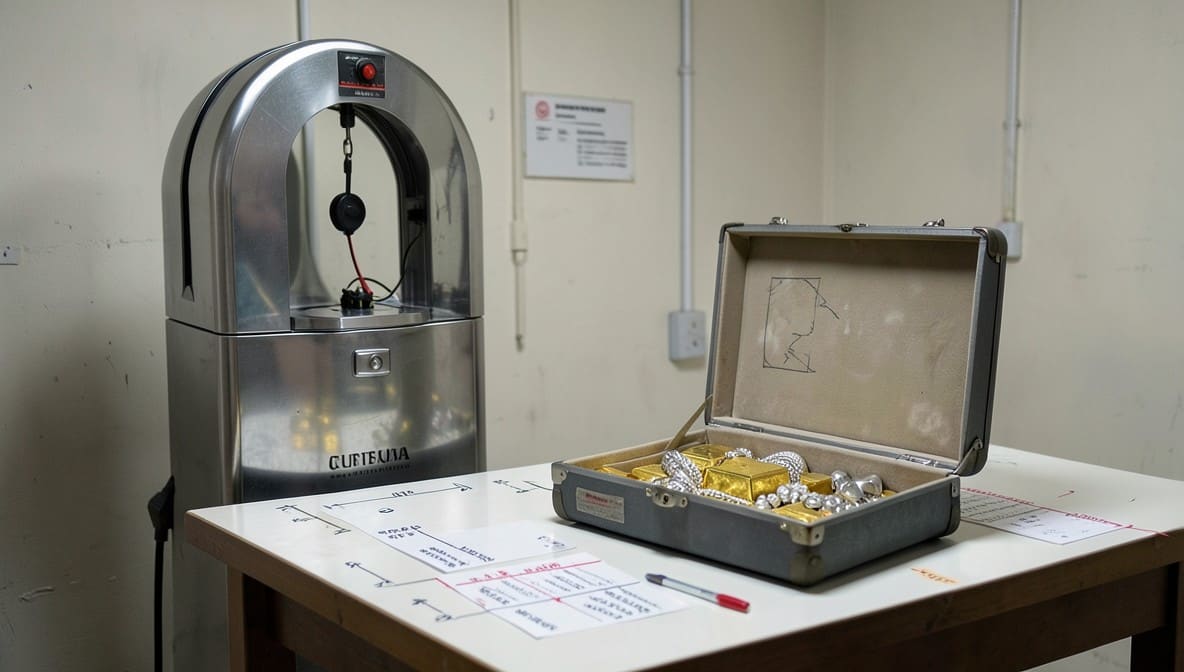
The dispute arose from the seizure of gold and silver bars from a vehicle on 23.11.2023 near a toll plaza in Uttar Pradesh, based on intelligence that smuggled foreign-origin gold was being transported from Delhi to Mathura. The vehicle, a Maruti Suzuki Swift bearing registration DL 5CQ 9162, was driven by Mr. Gaurav Tiwari, who was apprehended by the Directorate of Revenue Intelligence (DRI). Inside a concealed cavity, 10 pieces of yellow metal weighing 4253.96 grams and three silver pieces weighing 12736 grams were recovered. No foreign markings were found on the metal bars, and they did not conform to international standard sizes or purity levels (99.99%).
Key Facts
- The seizure occurred on 23.11.2023 at a toll plaza, not at a notified customs area such as an airport, land customs station, or international border.
- Mr. Gaurav Tiwari was arrested on 25.11.2023 and remanded to judicial custody by the CJM, Meerut.
- A search of his residence was conducted on 26.12.2023, yielding no incriminating evidence.
- Searches of the shops of Mr. Mukul Agarwal and Mr. Rakesh Chaudhary (respondents 2 and 3) were conducted but both were absent; no incriminating material was found.
- Call data records showed continuous communication between Mr. Tiwari and the other two respondents between 01.11.2023 and 23.11.2023.
- Mr. Tiwari submitted a written statement on 24.11.2023 claiming he was transporting silver on commission for the other two respondents, but later retracted this statement on 24.07.2023 through his brother.
- He produced invoices dated 2012 - 2015 from M/s Brijwasi Bullion & Jewellers Pvt. Ltd., showing purchase of gold and silver by his family members using proceeds from land sales and ancestral assets.
- The Adjudicating Authority issued a show cause notice on 22.01.2024, followed by a corrigendum on 23.07.2024.
- The Adjudicating Authority passed an order on 28.01.2025, confiscating the gold, silver, and vehicle, and imposing a penalty of Rs. 25 lakhs each on all three respondents.
- The Commissioner (Appeals) set aside the order on 04.07.2025, holding that the Revenue failed to establish reasonable belief at the time of seizure.
- The Commissioner (Appeals) order was appealed before CESTAT on 10.03.2026.
Procedural History
- 23.11.2023: Seizure of gold and silver from vehicle at toll plaza
- 24.11.2023: Statement recorded from Mr. Gaurav Tiwari
- 25.11.2023: Arrest and judicial remand
- 26.12.2023: Search of respondent’s residence
- 01.01.2024 to 23.07.2024: Investigation and follow-up
- 22.01.2024: Show cause notice issued
- 23.07.2024: Corrigendum issued
- 24.06.2024: Replies filed by all respondents
- 28.01.2025: Order-in-Original passed by Adjudicating Authority
- 04.07.2025: Order-in-Appeal passed by Commissioner (Appeals) setting aside confiscation and penalty
- 10.03.2026: Hearing before CESTAT
- 15.04.2026: Final Order passed by CESTAT
The Parties' Positions
For the Appellant (Revenue)
- Argued that town seizures are not prohibited under Section 110 of the Customs Act.
- Contended that the absence of documents proving lawful import, combined with the high value and concealment, justified reasonable belief.
- Relied on the initial statement of Mr. Tiwari and call records to infer collaboration in smuggling.
- Asserted that the purity of gold (99.5 - 99.9%) was indicative of foreign origin.
- Claimed that the invoices produced were not verified and could be fabricated.
For the Respondents
- Argued that the seizure occurred outside a notified customs area, negating any presumption of smuggling.
- Stated that no foreign markings were present and purity was below international standards.
- Submitted that the statement of Mr. Tiwari was retracted and uncorroborated.
- Highlighted that no investigation was conducted to verify the genuineness of the invoices or the source of the gold.
- Emphasized that the Revenue failed to establish the origin, route, or method of smuggling.
Relief Sought
The Appellant sought to set aside the Commissioner (Appeals) order dated 04.07.2025 and restore the Adjudicating Authority’s order dated 28.01.2025, which confiscated the gold, silver, and vehicle, and imposed penalties of Rs. 25 lakhs each on all three respondents.
The Legal Issue
The central question was whether Section 110 and Section 123 of the Customs Act, 1962 permit confiscation of goods seized in a town without foreign markings, where the only basis for belief of smuggling is an uncorroborated and later retracted statement, and no investigation was conducted to verify the claim of lawful purchase.
Arguments Presented
For the Appellant
The Revenue argued that the location of seizure (a toll plaza) does not invalidate the application of Section 110, and that the concealment of goods, absence of documentation, and high purity of gold collectively formed reasonable belief. It relied on the initial statement of Mr. Tiwari and his communication with the other respondents as circumstantial evidence of smuggling. It further contended that the burden shifted to the respondents under Section 123 once the authorities formed a belief, and that the respondents failed to discharge it.
For the Respondent
The respondents countered that reasonable belief must exist at the time of seizure, not after the fact. They emphasized that Section 123’s presumption only applies if the officer had a genuine, objective belief based on material facts at the moment of seizure. They pointed to the lack of forensic testing, absence of foreign markings, and failure to investigate the invoices or the seller (M/s Brijwasi Bullion) as fatal flaws. They also cited judicial precedents holding that uncorroborated statements, especially when retracted, cannot sustain confiscation.
The Court's Analysis
The Tribunal conducted a meticulous review of the legal framework under Section 110 (power to seize) and Section 123 (presumption as to smuggled goods). It held that the existence of reasonable belief is a condition precedent to invoking Section 123, and that this belief must be formed at the time of seizure, not retrospectively.
"Reasonable belief as required by Section 110 refers to the point of time when the goods in question are seized and not to a stage subsequent to the act of seizure; the condition precedent that there was such a reasonable belief anterior to the seizure must exist before the presumption under Section 123 can be invoked."
The Tribunal emphasized that the Supreme Court in Collector of Customs v. Sampathu Chetty and Tata Chemicals Ltd. v. Commissioner of Customs had clearly held that "reasonable belief" is not subjective satisfaction but must be based on objective, verifiable grounds that would satisfy an honest and reasonable person.
The Tribunal noted that the seized gold lacked foreign markings, was not of international standard purity, and was seized in a non-notified area. The only evidence linking the goods to smuggling was the initial statement of Mr. Tiwari, which was later retracted. No independent corroboration was obtained - no verification of the invoices, no inquiry into the seller’s records, no forensic analysis of the gold’s origin, and no attempt to confront the respondents with each other.
The Tribunal further held that the failure to examine Mr. Tiwari before the Adjudicating Authority under Section 138B rendered his statement inadmissible. It cited Flamingo DFS Pvt. Ltd. v. Commissioner of Customs to affirm that a statement not examined in adjudication is effectively abandoned.
Additionally, the Tribunal relied on G-Tech Industries v. Union of India, which cautioned against relying on statements recorded during investigation due to the risk of coercion, and mandated that such statements must be tested in open court.
The Tribunal concluded that the Revenue had not discharged its burden of establishing a reasonable belief at the time of seizure. The absence of any material to substantiate the claim of smuggling, coupled with the respondents’ prima facie evidence of lawful acquisition, rendered the confiscation legally unsustainable.
The Verdict
The appeals were dismissed. The CESTAT upheld the Commissioner (Appeals) order dated 04.07.2025, setting aside the confiscation of the gold, silver, and vehicle, and cancelling the penalty of Rs. 25 lakhs each imposed on Mr. Gaurav Tiwari, Mr. Mukul Agarwal, and Mr. Rakesh Chaudhary. The Tribunal directed that the seized goods be returned to the respondents without further delay.
What This Means For Similar Cases
Reasonable Belief Must Be Objective and Timely
- Practitioners must now argue that any customs seizure outside notified areas requires concrete, contemporaneous evidence - not speculation, suspicion, or post-hoc rationalization.
- Authorities must document the factual basis for belief at the time of seizure; vague assertions of "concealment" or "high value" are insufficient.
Invoices and Documentary Evidence Cannot Be Dismissed Without Verification
- If a respondent produces purchase invoices, the Revenue must conduct a verification process - such as contacting the seller or checking GST records - before rejecting them as fake.
- Failure to verify constitutes a procedural flaw that invalidates confiscation.
Retracted Statements Are Not Reliable Evidence
- A statement recorded during investigation that is later retracted cannot form the sole basis for confiscation.
- The Revenue must either examine the witness before the adjudicating authority or abandon the statement entirely.
Town Seizures Require Higher Scrutiny
- Seizures in non-notified areas cannot rely on the same presumptions as those at international borders.
- Absence of foreign markings, non-standard purity, and lack of corroborative evidence must be treated as decisive factors against confiscation.
Burden of Proof Remains With the Revenue
- Section 123’s presumption only applies if the initial belief is legally valid. If the belief is defective, the burden never shifts.
- Practitioners should challenge confiscation orders on the ground of defective reasonable belief, not merely on procedural grounds.