The Customs Appellate Tribunal has delivered a significant ruling clarifying that a self-serving, hearsay admission under Section 108 of the Customs Act, 1962, without independent corroboration or physical evidence of foreign origin, cannot sustain confiscation or penalty for smuggling. This judgment reinforces the principle that burden of proof under Section 123 is not triggered by unsubstantiated allegations alone.
Background & Facts
The Dispute
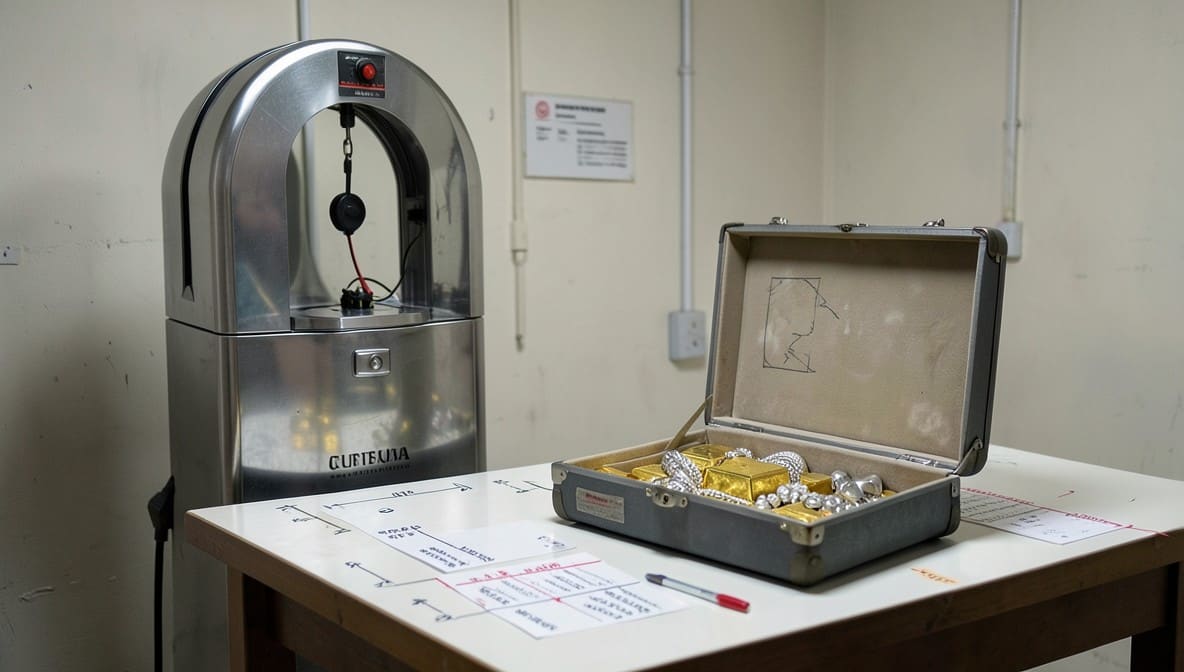
The Appellant, Shri Chandra Prakash, a resident of Nagaur, Rajasthan, engaged in the business of silver and artificial jewellery, was apprehended on 12.01.2023 at Howrah Railway Station by Directorate of Revenue Intelligence (DRI) officers while travelling on the Jodhpur Express from Howrah to Jaipur. He was found in possession of four gold bars and one small piece of yellow metal, weighing 699.000 grams in total. The DRI alleged that the gold was smuggled from Bangladesh and that the Appellant was acting on instructions from one Mr. Shri Prakash of Kolkata.
Key Facts
- The gold recovered had no foreign markings or inscriptions.
- The Chief Examiner, Central Refinery and Control Laboratory (C.R.C.L.), New Delhi, reported in its analysis dated 15.02.2023 that the gold content was 99.78% by weight, not the typical 99.99% associated with imported gold.
- The Appellant, in his statement recorded under Section 108 on 13.01.2023, claimed he was carrying the gold on behalf of his cousin, Mr. Shri Prakash, who allegedly told him the gold was smuggled from Bangladesh.
- The Appellant stated he had no personal knowledge of the gold’s origin and was merely relaying information given to him.
- The Appellant’s phone number was found to have call records with Mr. Shri Prakash and Shri Laxmi Narain (alleged recipient in Jaipur) between 02.01.2023 and 13.01.2023.
- Attempts to locate Mr. Shri Prakash and Shri Laxmi Narain failed: two summons were issued, one delivered late, the other returned unclaimed with "addressee left without instructions."
- No independent evidence - such as purchase receipts, import documents, or witness testimony - was produced to establish the gold’s foreign origin.
- The Appellant’s residential and business premises in Nagaur were verified and found to be legitimate, with no prior criminal record.
Procedural History
- 12.01.2023: Appellant apprehended at Howrah Railway Station; gold seized under Section 110 of the Customs Act.
- 13.01.2023: Statement recorded under Section 108.
- 15.02.2023: C.R.C.L. report confirming 99.78% gold purity.
- 23.06.2023: Show Cause Notice (SCN) issued proposing confiscation under Section 111(b) & (k) and penalty under Section 112(b).
- 15.02.2024: Order-in-Original passed by Additional Commissioner, Customs (P), Lucknow, upholding confiscation and imposing penalty of Rs. 5,00,000.
- 30.05.2025: Commissioner (Appeals) dismissed the Appellant’s appeal, confirming the Order-in-Original.
- 16.02.2026: Hearing before CESTAT Allahabad.
- 15.04.2026: Final Order pronounced.
Relief Sought
The Appellant sought quashing of the confiscation order and penalty, release of the seized gold, and a declaration that the proceedings were legally unsustainable due to lack of evidence.
The Legal Issue
The central question was whether a statement recorded under Section 108 of the Customs Act, 1962, which is based solely on hearsay knowledge and lacks corroboration, can trigger the burden of proof under Section 123 and justify confiscation of goods as smuggled, in the absence of foreign markings or independent evidence.
Arguments Presented
For the Appellant
The Appellant’s counsel argued that the statement recorded under Section 108 was not voluntary but made under duress, and even if accepted, it was purely hearsay - relaying information allegedly given by Mr. Shri Prakash. He emphasized that the gold had no foreign markings, the purity (99.78%) was inconsistent with typical imported gold, and no corroborative evidence - such as call transcripts, witness statements, or import documents - was produced. He relied on Sarvendra Kumar Mishra v. Commissioner and Neeraj Dutta v. State (NCT of Delhi) to argue that hearsay evidence is inadmissible without corroboration, and that Section 123 cannot be invoked without a prima facie showing of foreign origin.
For the Respondent
The Revenue contended that the Appellant’s own admission under Section 108 was sufficient to establish smuggling, citing Ramesh Chandra Mehta, Naresh J. Sukhawani, and Ganpati Overseas. It relied on call records to infer involvement and argued that the absence of foreign markings did not negate smuggling, as gold can be re-melted. It also cited Gautam Jain v. Union of India to assert that Section 108 statements are admissible and sufficient for adjudication.
The Court's Analysis
The Tribunal began by acknowledging that statements under Section 108 are admissible in evidence, as held in Ramesh Chandra Mehta and Ganpati Overseas. However, it emphasized that admissibility does not equate to sufficiency. The Court noted that the Adjudicating Authority failed to examine whether the Appellant’s statement was voluntary, as required under Ganpati Overseas.
"The statement was not based on personal knowledge of the Appellant but on what he was told by Mr. Shri Prakash. Clearly, this is hearsay evidence."
The Tribunal then applied the Supreme Court’s ruling in Neeraj Dutta v. State (NCT of Delhi), which defines hearsay as second-hand information not derived from the witness’s own senses. It held that such evidence is inadmissible unless corroborated by independent, substantive evidence.
The call records were examined and found insufficient. The Tribunal cited Shafeek P.K. v. Commissioner of Cochin to hold that mere telephonic contact, without evidence of the conversation’s content, cannot establish smuggling.
The Court further held that Section 123 imposes a burden of proof only after the Revenue establishes a prima facie case of smuggling. In the absence of foreign markings, inconsistent purity levels, and no evidence linking the gold to an import route, the Revenue failed to discharge even this preliminary burden.
"The recovery of goods at a railway station may raise suspicion, but suspicion is not reasonable belief under Section 123."
The Tribunal distinguished Gautam Jain on facts, noting that in that case, multiple consistent statements and collateral material linked the accused to smuggling. Here, there was only one hearsay statement and no corroborative evidence.
The Appellant’s explanation - that the gold was ancestral jewellery melted by his cousin - was not rebutted with evidence. The Tribunal held that the Revenue’s failure to investigate this plausible alternative rendered the confiscation legally untenable.
The Verdict
The appeal was allowed. The Tribunal set aside the Order-in-Original dated 15.02.2024 and the Order-in-Appeal dated 30.05.2025. The confiscation of 699.000 grams of gold and the penalty of Rs. 5,00,000 were quashed. The gold was ordered to be released to the Appellant, as the owner had not claimed it and the seizure was found to be unlawful. The Appellant was placed in the position he occupied prior to seizure, in accordance with the principle of restitution under Section 110(2) and Section 125(1) of the Customs Act, 1962.
What This Means For Similar Cases
Hearsay Statements Cannot Stand Alone
- Practitioners must now argue that any Section 108 statement based on third-party information is inadmissible unless corroborated by independent evidence such as call transcripts, financial trails, or witness testimony.
- Merely quoting a statement as "voluntary" is insufficient; the adjudicating authority must record a finding on voluntariness.
Section 123 Requires Prima Facie Proof
- The Revenue must establish a prima facie case of foreign origin before shifting the burden under Section 123.
- Absence of foreign markings, inconsistent purity levels, and lack of import documentation are critical factors that defeat the presumption.
Call Records Are Not Conclusive
-
Telephonic contact alone, without content analysis, cannot prove smuggling.
-
Practitioners should demand production of call logs with metadata and transcripts to challenge speculative inferences.
-
Always challenge the admissibility of Section 108 statements on hearsay grounds.
-
Insist on forensic analysis of gold purity and origin before accepting Revenue’s claims.
-
Argue that Section 123 cannot be invoked unless the goods are seized at a customs port or there is clear evidence of import.