The Customs, Excise and Service Tax Appellate Tribunal (CESTAT) Chandigarh has affirmed that the statutory right to provisional release under Section 110A of the Customs Act, 1962 cannot be denied merely because goods are alleged to be prohibited due to non-compliance with BIS or DGFT requirements. This ruling reinforces that classification as prohibited goods requires formal adjudication and cannot be assumed at the seizure stage.
Background & Facts
The Dispute
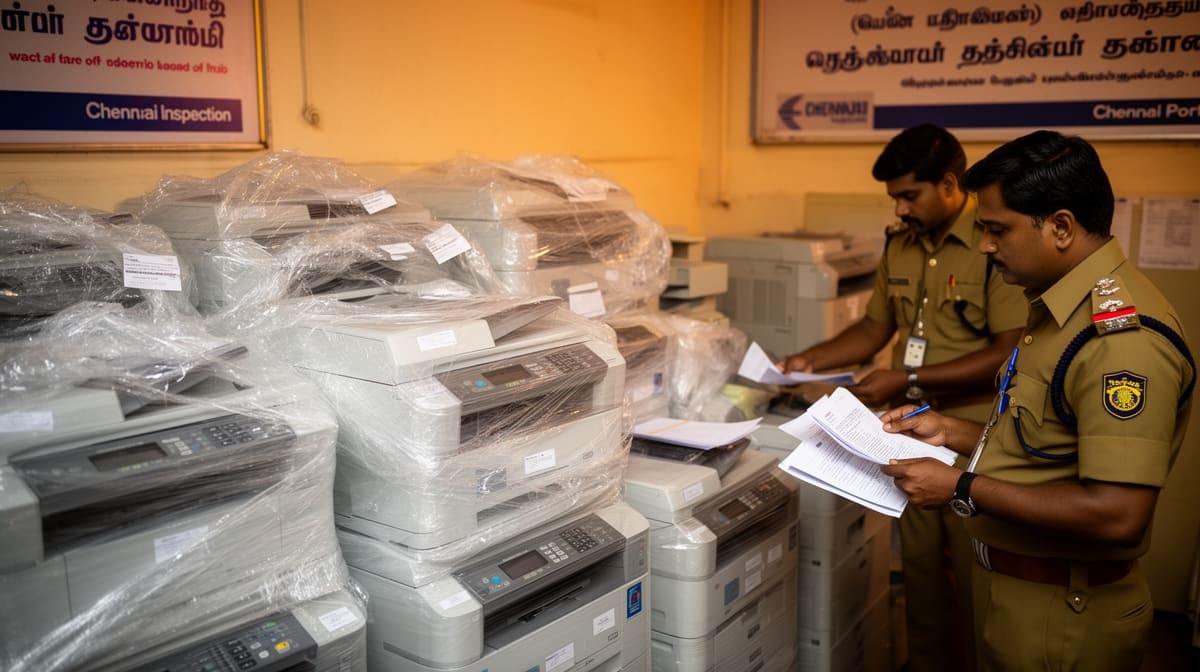
M/s Global Copier System, an importer based in Rohtak, Haryana, imported 230 units of second-hand digital multi-function print and copying machines, valued at Rs. 40,17,969, classified under CTE 84333100. The goods were seized on 14.08.2025 by the Customs Department at Ludhiana on the grounds that the importer had not obtained a valid import authorization from the Directorate General of Foreign Trade (DGFT) and had not registered with the Bureau of Indian Standards (BIS). The Department contended that these omissions rendered the goods prohibited under Section 2(33) of the Customs Act, 1962, thereby justifying seizure and denial of provisional release.
Key Facts
- The importer filed Bill of Entry No. 3552599 dated 29.07.2025 for clearance of the goods.
- On examination, the local Chartered Engineer concluded the goods were multifunctional devices and did not qualify as Highly Specialized Equipment (HSE), thereby disqualifying them from exemption under S.O. 2844(E).
- The importer had obtained a pre-export inspection certificate from a foreign Chartered Engineer, which was not disputed on technical grounds.
- The Department relied on Circular No. 35/2017-Customs, which prohibits provisional release of goods requiring statutory compliance (e.g., BIS registration) that have not been fulfilled.
- The importer submitted a request for provisional release on 15.08.2025, which was rejected by the Joint Commissioner of Customs on 15.09.2025.
- The Commissioner of Customs (Appeals), Ludhiana, upheld the rejection in an order dated 21.01.2026.
- The goods remain in customs custody as of the date of the appeal decision.
Procedural History
- 29.07.2025: Bill of Entry filed for import of 230 units of multi-function devices.
- 14.08.2025: Goods seized by Customs on suspicion of non-compliance with BIS and DGFT norms.
- 15.08.2025: Appellant requested provisional release.
- 15.09.2025: Joint Commissioner rejected provisional release application.
- 21.01.2026: Commissioner of Customs (Appeals) upheld the rejection.
- 18.03.2026: Hearing before CESTAT Chandigarh.
- 13.04.2026: Final order passed by CESTAT allowing the appeal.
The Parties' Positions
For the Appellant
- Argued that the goods are freely importable under ITC (HS) Classification and not explicitly prohibited by the Customs Act.
- Contended that non-compliance with BIS or DGFT norms does not render goods "prohibited per se" under Section 2(33), but only subject to conditions.
- Relied on the foreign Chartered Engineer’s certificate, which was not rebutted with specific reasoning.
- Cited multiple High Court judgments (Delhi, Madras, Telangana) permitting provisional release in identical cases.
- Invoked Delhi Photocopiers v. Union of India (2022) (SC), which held that provisional release cannot be denied merely because the department alleges prohibition.
- Argued that Circular No. 35/2017 is ultra vires Section 110A and void as it imposes restrictions not found in the statute.
For the Respondent
- Maintained that the goods are prohibited under Section 2(33) due to non-compliance with DGFT Notification No. 13/2024-25 and BIS Act, 2016.
- Asserted that the local Chartered Engineer’s report correctly classified the goods as non-HSE, disqualifying them from exemption under S.O. 2844(E).
- Relied on Om Prakash Bhatia v. Union of India (2003) to argue that failure to meet statutory conditions renders goods prohibited.
- Contended that High Court judgments cited by the appellant are distinguishable on facts.
- Argued that the impugned order was a speaking order and that provisional release is discretionary, not mandatory.
Relief Sought
The appellant sought:
- Setting aside of the Commissioner’s order dated 21.01.2026.
- Direction for immediate provisional release of the 230 units of imported equipment.
- Clarification that non-compliance with BIS/DGFT norms does not bar provisional release under Section 110A.
The Legal Issue
Can the Customs Department deny provisional release of seized goods under Section 110A of the Customs Act, 1962 solely on the ground that the goods are alleged to be prohibited due to non-compliance with BIS registration or DGFT authorization, without a final adjudication confirming their prohibited status?
Arguments Presented
For the Appellant
The appellant relied on the unambiguous language of Section 110A, which permits provisional release of "any goods, documents or things seized" without any distinction between prohibited and non-prohibited goods. It was argued that the Supreme Court in Delhi Photocopiers v. Union of India (2022) (SC) had unequivocally held that provisional release cannot be denied merely because the department asserts prohibition. The appellant further cited Its My Name Pvt. Ltd. v. ADG (Adjudication) (2021) (Delhi HC), which declared Circular No. 35/2017 void for imposing restrictions not found in the statute. The appellant emphasized that the foreign Chartered Engineer’s certificate was not rebutted, and that the goods were not declared prohibited by any notification under the Customs Act. The argument was that Section 110A is a remedial provision meant to protect importers from prolonged detention, and its denial defeats the legislative intent.
For the Respondent
The Department contended that Section 2(33) of the Customs Act defines prohibited goods as those prohibited under any law, including the BIS Act and Foreign Trade Policy. It relied on Om Prakash Bhatia to argue that failure to comply with statutory conditions renders goods prohibited. The Department maintained that Circular No. 35/2017 is a valid executive instruction to ensure compliance and that the local Chartered Engineer’s report was authoritative. It further argued that High Court judgments cited by the appellant were either interlocutory, fact-specific, or rendered under different regulatory frameworks (e.g., CRO 2012 vs. CRO 2021). The Department insisted that provisional release is discretionary and that the appellant had not demonstrated any prejudice warranting immediate release.
The Court's Analysis
The Tribunal conducted a rigorous statutory interpretation of Section 110A, emphasizing that the provision grants a right to provisional release without qualification. The Court observed that the Legislature deliberately omitted any exclusion for goods deemed prohibited under Section 2(33), unlike Section 125, which explicitly provides for redemption fines on prohibited goods. The Court held that Circular No. 35/2017, which bars provisional release for goods requiring statutory compliance, is ultra vires Section 110A and void, as confirmed by the Delhi High Court in Its My Name Pvt. Ltd. and followed by the Bombay High Court in Sidharth Vijay Shah.
"Clearly, provisional release may be allowed, under Section 110A of the Act, of 'any goods, documents or things seized'. The Court, as the interpreter of the legislation, cannot profess to greater wisdom than the legislator. Where the Legislature has not thought it appropriate to limit, in any manner, the nature of goods... it is no part of the function of a Court to read, into the said statutory provision, any artificial limitation, not to be found therein."
The Tribunal noted that the Department had not issued any final order confirming the goods as prohibited. The mere belief of an officer at the time of seizure does not equate to legal prohibition. The Court distinguished Om Prakash Bhatia, clarifying that while non-compliance may lead to confiscation after adjudication, it does not automatically render goods ineligible for provisional release. The Court further held that the rejection of the foreign Chartered Engineer’s certificate without reasoned rebuttal was arbitrary and violated principles of natural justice.
The Tribunal also reviewed the series of High Court judgments from Delhi, Madras, and Telangana, all permitting provisional release in identical factual matrices. It found these decisions consistent with the Supreme Court’s pronouncement in Delhi Photocopiers and concluded that the Department’s refusal was legally unsustainable.
The Verdict
The appeal was allowed. The CESTAT set aside the impugned order dated 21.01.2026 and directed the release of the 230 units of imported multi-function devices on the following conditions:
- Payment of applicable customs duty on the imported goods;
- Submission of a bond equivalent to the total value of the goods (Rs. 40,17,969);
- Submission of a Bank Guarantee equivalent to 30% of the applicable duty.
The goods shall be released within two weeks of compliance with the above conditions. The Department is directed to complete adjudication proceedings within the statutory timeframe without prejudice to the provisional release.
What This Means For Similar Cases
Provisional Release Is a Statutory Right, Not a Discretionary Favor
- Practitioners must now argue that Section 110A creates a mandatory right to provisional release unless the goods are actually confiscated under Section 125.
- Denial of release based on Circular No. 35/2017 is legally untenable and can be challenged successfully in any forum.
- Importers should immediately apply for provisional release upon seizure, even if the Department alleges prohibition.
Classification as "Prohibited" Requires Adjudication, Not Allegation
- Customs officers cannot unilaterally classify goods as prohibited; such determination must follow adjudication.
- Pre-export certificates from foreign engineers must be treated as prima facie valid unless rebutted with specific, documented evidence.
- Importers should preserve all export documentation and challenge arbitrary rejections in writ petitions if provisional release is denied.
High Court Precedents Are Binding on Customs Adjudication
- Judgments from Delhi, Madras, and Telangana High Courts on identical issues are persuasive and must be considered by Customs authorities.
- The Delhi Photocopiers (SC) precedent now forms the bedrock for all provisional release applications involving alleged non-compliance.
- Practitioners should cite these judgments in all applications for provisional release and in writ petitions filed under Article 226.