The Bombay High Court has reaffirmed that a Competent Authority under the Maharashtra Ownership Flats Act cannot use a corrigendum to effect a substantive alteration in the extent of property, as this amounts to an impermissible review of a final order. The judgment clarifies the limits of administrative correction versus judicial review, offering critical guidance to housing societies, developers, and property regulators.
Background & Facts
The Dispute
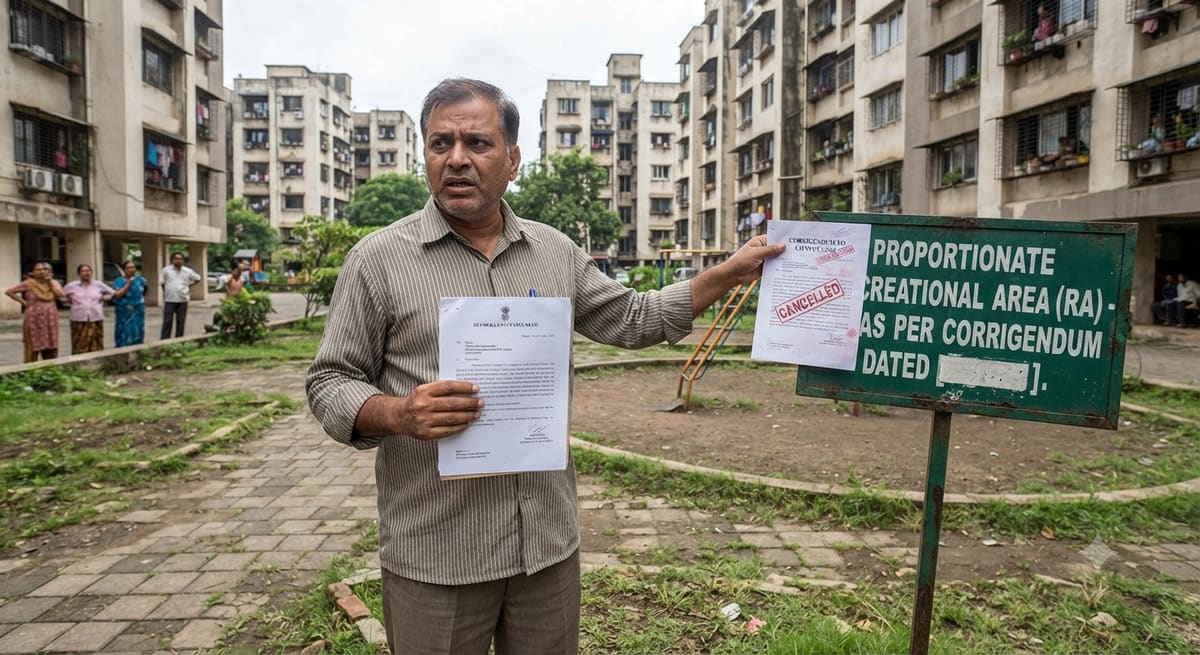
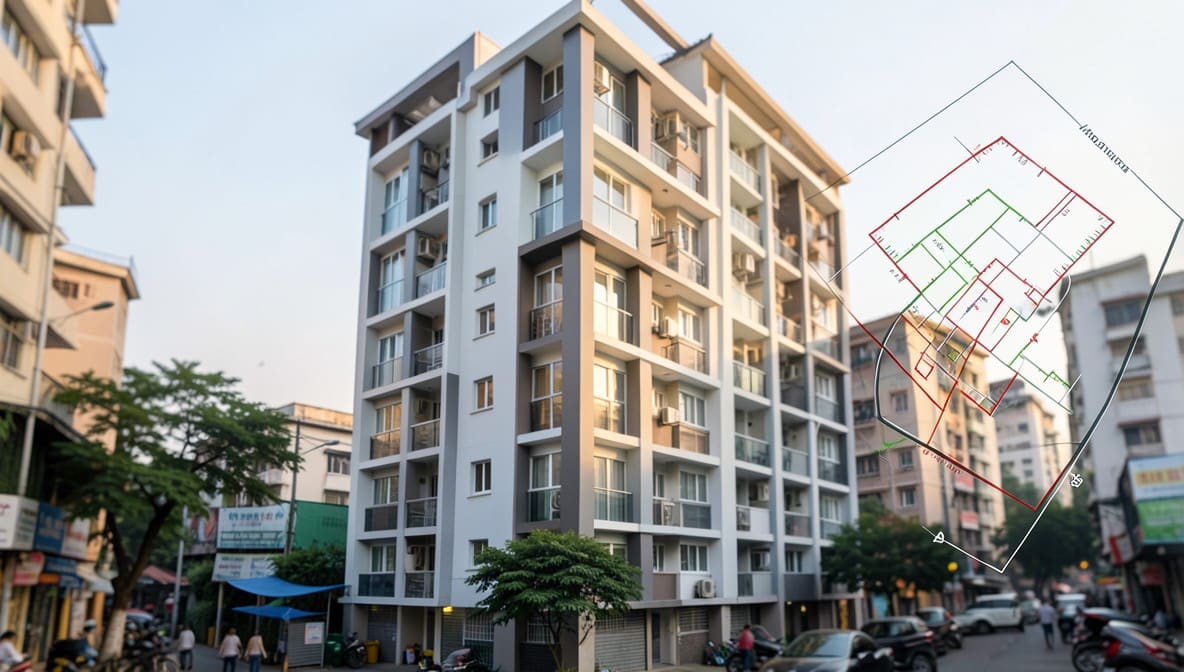
The petition arises from a corrigendum issued by the Competent Authority under Section 11 of the Maharashtra Ownership Flats Act, 1963 (MOFA), which altered the area of the apartment complex from 566.94 square metres to 828.24 square metres. The petitioners, owners in the Digitally Lumbini Cooperative Housing Society, challenged this change as a material alteration of the original order dated 07.03.2022, which had approved the layout and area of the project. The respondents, including the Housing Society and the State, defended the corrigendum as a mere correction of an error.
Key Facts
- The original order under Section 11 of MOFA was passed on 07.03.2022, approving a total area of 566.94 sq. mtrs for the housing project.
- On 15.01.2025, the Competent Authority issued a corrigendum changing the area to 828.24 sq. mtrs, without any fresh hearing, notice, or opportunity to be heard.
- The increase of 261.3 sq. mtrs (approximately 46% increase) significantly affects the proportionate share of common areas, maintenance charges, and floor area ratio entitlements of flat owners.
- The petitioners were not notified of any proposed change prior to the corrigendum.
- The corrigendum was used as the basis to issue a certificate under Section 11(5) of MOFA on 20.01.2025, validating the altered area for registration and sale purposes.
Procedural History
- 07.03.2022: Competent Authority passes original order approving 566.94 sq. mtrs area under Section 11 of MOFA.
- 15.01.2025: Competent Authority issues corrigendum increasing area to 828.24 sq. mtrs without notice or hearing.
- 20.01.2025: Certificate under Section 11(5) issued based on the modified area.
- 10.03.2025: Petitioners file Writ Petition No. 17319 of 2025 before the Bombay High Court.
- 06.04.2026: Judgment delivered by Justice Amit Borkar.
The Parties' Positions
Petitioners: Argued that the corrigendum was not a clerical error but a substantive change affecting property rights. They contended that the Competent Authority, having passed a final order, became functus officio and could not revisit the matter without due process.
Respondents: Contended that the original area was a typographical or calculation error, and the corrigendum merely corrected it. They relied on administrative convenience and claimed no prejudice to petitioners.
Relief Sought
The petitioners sought quashing of the corrigendum dated 15.01.2025 and the certificate issued under Section 11(5) of MOFA, and restoration of the original order dated 07.03.2022.
The Legal Issue
The central question was whether a Competent Authority under Section 11 of the Maharashtra Ownership Flats Act, 1963 may, after passing a final order, substantially alter the area of the project through a corrigendum, and whether such an alteration constitutes a permissible clerical correction or an impermissible review.
Arguments Presented
For the Petitioner
The petitioners relied on Kashish Park Reality Pvt. Ltd. v. State of Maharashtra (2021) 3 Mah LJ 778, arguing that once a Competent Authority exercises its power under Section 11, it becomes functus officio. Any subsequent change that alters the substance of the order - such as a 46% increase in area - is not a clerical correction but a substantive review, which the Act does not permit. They emphasized that rights of flat owners, including maintenance obligations and common area entitlements, are directly affected, and due process under Article 14 of the Constitution was violated.
For the Respondent
The respondents argued that the original area was erroneously calculated and the corrigendum merely rectified a mistake. They cited administrative practice and claimed the change was immaterial to the overall approval. No statutory provision, they contended, explicitly prohibits corrigenda, and the authority has inherent power to correct errors.
The Court's Analysis
The Court examined the distinction between clerical correction and substantive review, reaffirming the principle established in Kashish Park Reality. It held that a change affecting the very foundation of the order - such as the area of the property - cannot be justified as a typographical or arithmetical error. The increase from 566.94 sq. mtrs to 828.24 sq. mtrs is not a minor oversight but a material alteration that impacts the rights of all flat owners.
"The law makes distinction between clerical correction and substantive review. Clerical correction is allowed to remove accidental errors. But where the change goes to root of the matter and affects rights of parties, it becomes review in substance."
The Court emphasized that Section 11 of MOFA confers a one-time power to approve the layout and area. Once exercised, the authority cannot revisit the decision unless expressly permitted by statute. The corrigendum, in effect, amounted to a de facto review without notice, hearing, or reasons - violating principles of natural justice.
The Court further held that the certificate issued under Section 11(5) is derivative in nature. It cannot survive if the underlying order is invalid. The certificate, being a consequence of the corrigendum, must also be set aside.
The Court explicitly declined to examine the merits of the original order dated 07.03.2022, clarifying that its jurisdiction was limited to the legality of the corrigendum. It preserved the respondents’ right to challenge the original order through appropriate legal proceedings.
The Verdict
The petition succeeded. The Court set aside the corrigendum dated 15.01.2025 and the certificate issued under Section 11(5) of MOFA. The original order dated 07.03.2022, specifying an area of 566.94 sq. mtrs, stands restored. The respondents are granted liberty to challenge the original order through proper legal proceedings before the appropriate forum. There shall be no order as to costs.
What This Means For Similar Cases
Corrigenda Cannot Substitute Due Process
- Practitioners must challenge any post-order area changes exceeding 10% without notice or hearing as ultra vires under MOFA.
- Housing societies and developers must ensure all area calculations are accurate before seeking Section 11 approval.
- Any attempt to correct errors via corrigendum after issuance of certificate under Section 11(5) is legally untenable.
Certificates Are Derivative and Void if Base Order Is Invalid
- A Section 11(5) certificate is not an independent document; its validity is contingent on the underlying order.
- Registration authorities must verify the authenticity of the underlying Section 11 order before accepting certificates.
- Buyers and lenders should insist on certified copies of the original Section 11 order, not merely the corrigendum.
Authority Becomes Functus Officio After Final Order
- The doctrine of functus officio applies strictly under MOFA. No statutory provision permits re-adjudication.
- Authorities must exhaust all evidence and documentation before passing the final order.
- Future applications for modification must be filed as fresh petitions, not as corrigenda.