The Bombay High Court has affirmed that a subsequent reservation of land under planning law cannot nullify the statutory right to deemed conveyance when construction was lawful and completed prior to such reservation. This ruling reinforces the principle that vested rights acquired through lawful development cannot be retrospectively extinguished, offering critical clarity to housing societies facing similar obstacles.
Background & Facts
The Dispute
The petitioner, Mira Shriram Co-operative Housing Society Ltd., is a co-operative society comprising 24 residential flats and 33 commercial shops. The members purchased their units pursuant to agreements executed under Section 4 of the Maharashtra Ownership Flats Act, 1963 (MOFA). Despite full payment of consideration and possession being delivered, the promoter, M/s. Kedarnath Construction Company, failed to execute conveyance in favour of the society. The petitioner invoked Section 11 of MOFA to seek deemed conveyance, submitting all requisite documents. The Competent Authority rejected the application on the ground that the land on which the building stood was later reserved under planning law.
Key Facts
- The building was sanctioned under approved plans in 1992
- A part Occupation Certificate was granted in 1995, confirming lawful completion of construction
- The land was reserved under the Development Plan only in 1997, two years after construction was completed
- Agreements under Section 4 of MOFA were executed with all flat purchasers and are undisputed
- The petitioner filed its application under Section 11 of MOFA after repeated failures by the promoter to execute conveyance
- The original owner (Respondent No. 2) was served by hand delivery, but chose not to appear
- Respondents No. 3 to 5 (promoter entities) expressly stated they have no objection to deemed conveyance
- Respondents No. 7 and 8 (neighbouring societies) opposed the application, claiming potential prejudice
Procedural History
- 1992: Building sanctioned by competent authority
- 1995: Part Occupation Certificate granted
- 1997: Land reserved under Development Plan
- 2025: Petitioner filed application under Section 11 of MOFA
- 15 October 2025: Competent Authority rejected application on grounds of land reservation
- 2025: Writ Petition No. 15759 of 2025 filed before Bombay High Court
- 24 March 2026: Judgment delivered by Justice Amit Borkar
Relief Sought
The petitioner sought: (a) quashing of the Competent Authority’s order dated 15 October 2025; (b) direction for grant of deemed conveyance in favour of the society over the land on which the building stands and its appurtenant area; and (c) costs.
The Legal Issue
The central question was whether a subsequent reservation of land under planning law, after lawful construction and issuance of an Occupation Certificate, can legally justify the denial of deemed conveyance under Section 11 of the Maharashtra Ownership Flats Act, 1963.
Arguments Presented
For the Petitioner
The petitioner argued that the building was lawfully constructed and occupied before the reservation came into effect in 1997. The statutory obligation under Section 11 arises once agreements are executed and possession delivered, irrespective of later planning changes. The petitioner relied on the admitted facts: sanctioned plans, Occupation Certificate, and undisputed agreements. It further emphasized that the promoter and most respondents had no objection, and the objections raised by neighbouring societies were speculative and unsupported by evidence.
For the Respondent
Respondents No. 7 and 8 contended that granting conveyance would affect their rights, citing potential encroachment or ambiguity in land boundaries. They argued that the reservation rendered the land ineligible for conveyance. However, they produced no survey, title dispute, or legal document demonstrating actual interference with their rights. The State (AGP) did not oppose the petition, acknowledging the petitioner’s prima facie entitlement.
The Court's Analysis
The Court undertook a meticulous review of the timeline and legal principles under MOFA. It held that the lawfulness of construction at the time it occurred is the decisive factor. The Competent Authority erred in relying on a reservation that came into existence in 1997, after the building was completed and occupied in 1995.
"The construction cannot be said to be illegal or contrary to reservation, because such reservation was not even in existence at the relevant time. This aspect goes to the root of the matter. A subsequent reservation cannot take away rights which had already come into existence on the basis of lawful construction."
The Court emphasized that Section 11 of MOFA is remedial in nature and designed to protect flat purchasers from promoter inaction. Once agreements are executed and possession delivered, the promoter’s duty to convey becomes statutory and non-negotiable. The Court further noted that the promoter and three other respondents had no objection, and the original owner had been duly served but remained absent.
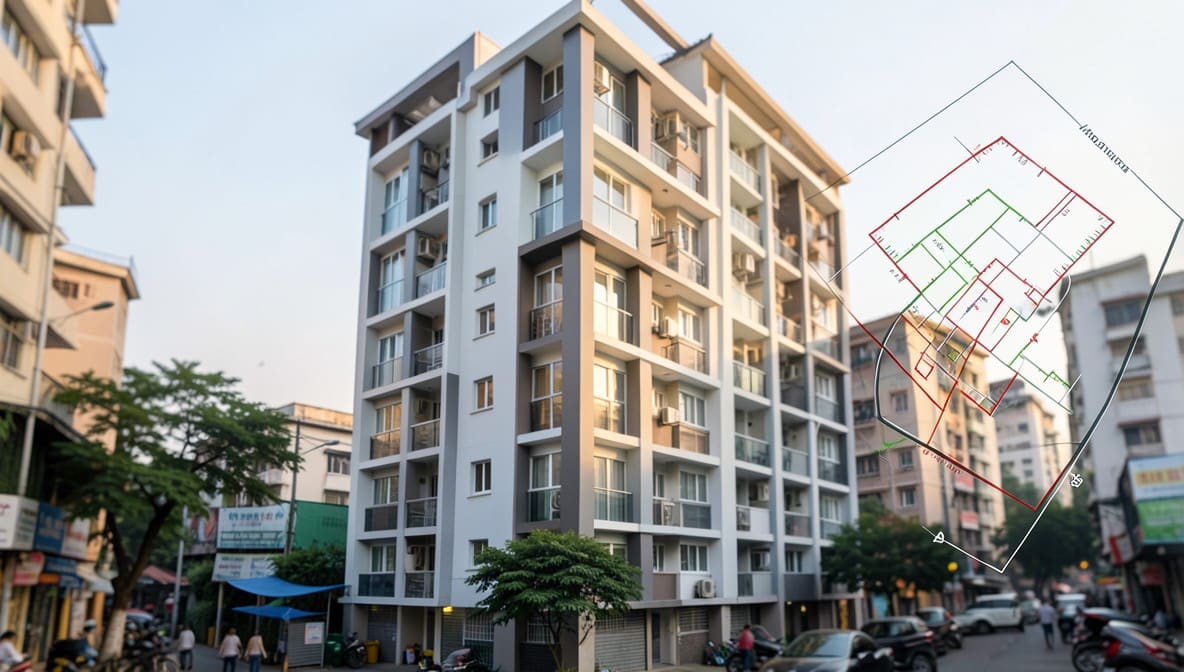
Regarding the objections of Respondents No. 7 and 8, the Court examined the map annexed to the record. It found that the petitioner’s building is separated by more than 150 meters from Respondent No. 8 and by roads and other structures from Respondent No. 7. No overlapping land or rights were demonstrated. The Court held that mere apprehension, without concrete evidence of prejudice, cannot override a statutory right.
The Court also observed that deemed conveyance had already been granted to other similar buildings in the vicinity, reinforcing the consistency of the legal position.
The Verdict
The writ petition was allowed. The Court set aside the Competent Authority’s order dated 15 October 2025 and directed the Registrar of Co-operative Societies and the Sub-Divisional Officer to execute deemed conveyance in favour of Mira Shriram Co-operative Housing Society Ltd. over the land on which the building stands and its appurtenant area within 8 weeks. Costs of Rs. 50,000 were awarded to the petitioner.
What This Means For Similar Cases
Subsequent Planning Reservation Is Not a Bar to Deemed Conveyance
- Practitioners must argue that the timing of construction and occupation is decisive, not later land use changes
- If a building was approved, constructed, and occupied before a reservation, Section 11 relief cannot be denied on that ground
- Competent Authorities and lower courts must be directed to examine the chronological sequence of events, not just the existence of a reservation
Statutory Obligation Trumps Speculative Objections
- Neighbouring societies cannot block conveyance based on vague fears of boundary disputes or future claims
- The burden lies on objectors to produce concrete evidence of legal prejudice - mere apprehension is insufficient
- Courts must rely on survey maps and physical demarcation to assess claims of interference
Promoter’s Non-Objection Strengthens Petitioner’s Case
- When the promoter and other key parties do not oppose conveyance, courts should treat this as a strong indicator of the petitioner’s legitimate entitlement
- Absence of the original landowner after proper service further strengthens the case for granting relief
- This judgment provides a clear roadmap for housing societies to overcome delays and obstruction by uncooperative promoters