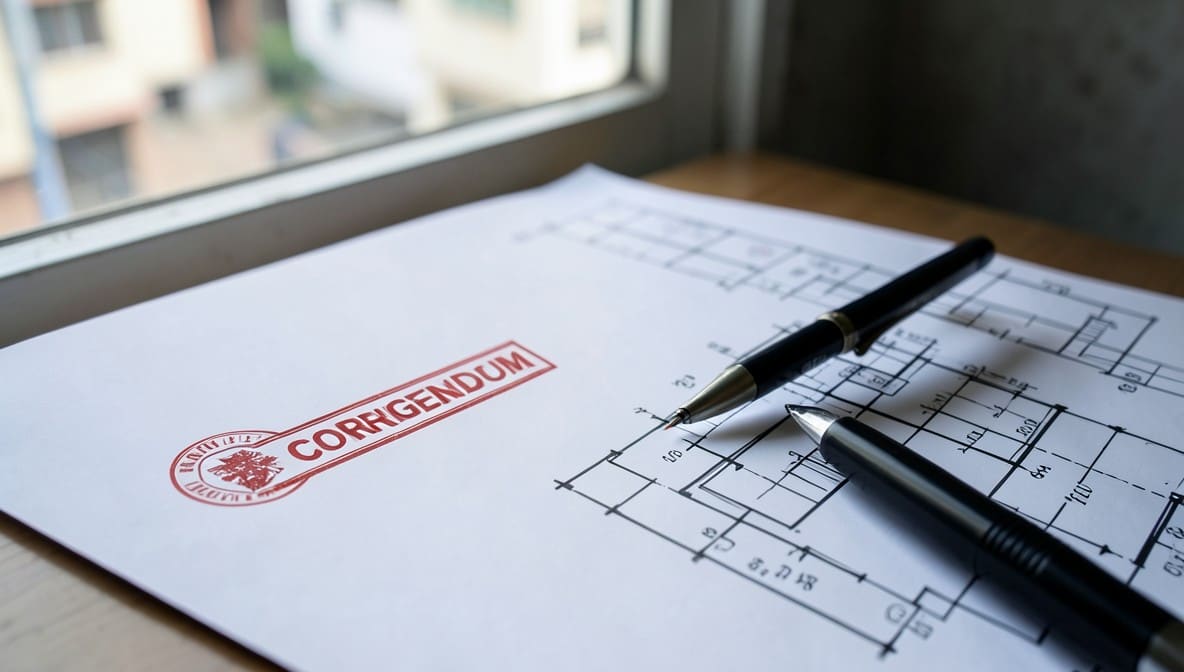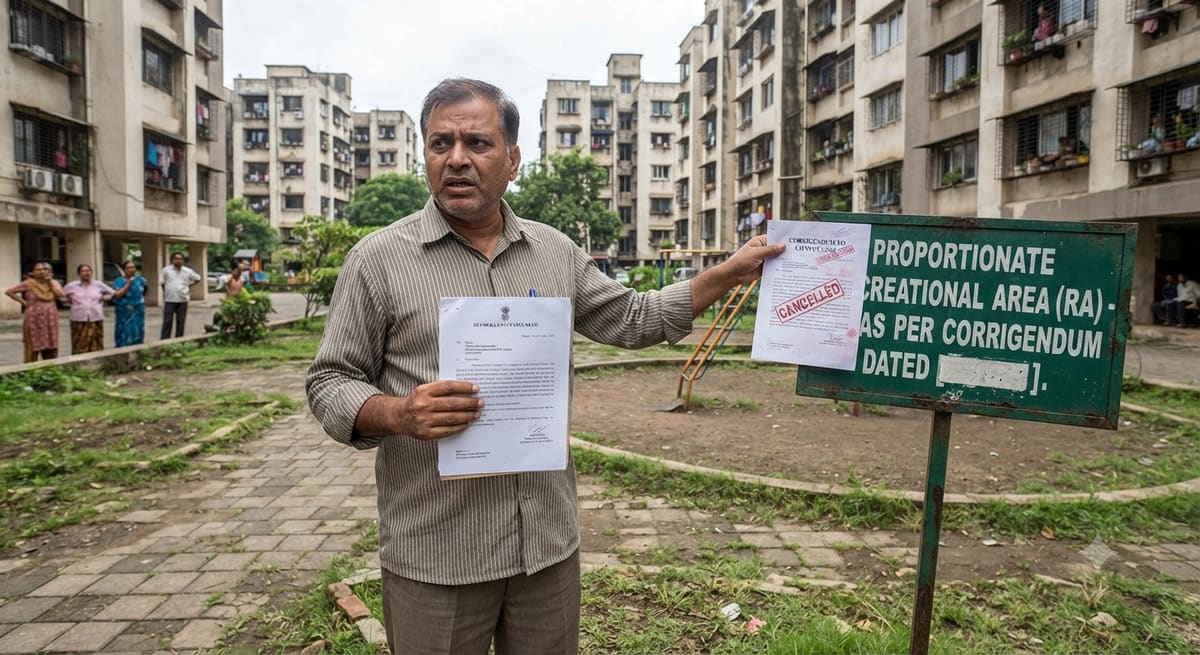
The Bombay High Court has clarified that a Competent Authority under the Maharashtra Ownership Flats Act cannot resolve substantive disputes over proportionate shares in recreational grounds by issuing a corrigendum to a deemed conveyance order. The judgment reinforces the principle that once a deemed conveyance is finalized, the authority becomes functus officio and lacks jurisdiction to adjudicate contested entitlements, even under the guise of correcting clerical errors.
Background & Facts
The Dispute
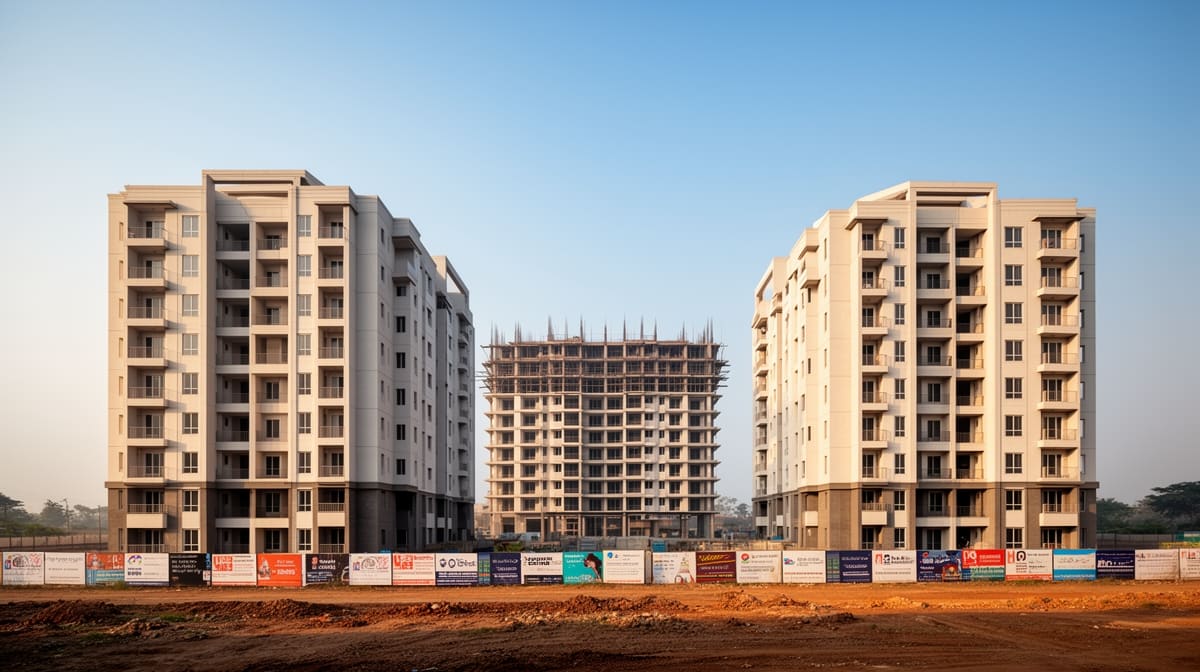
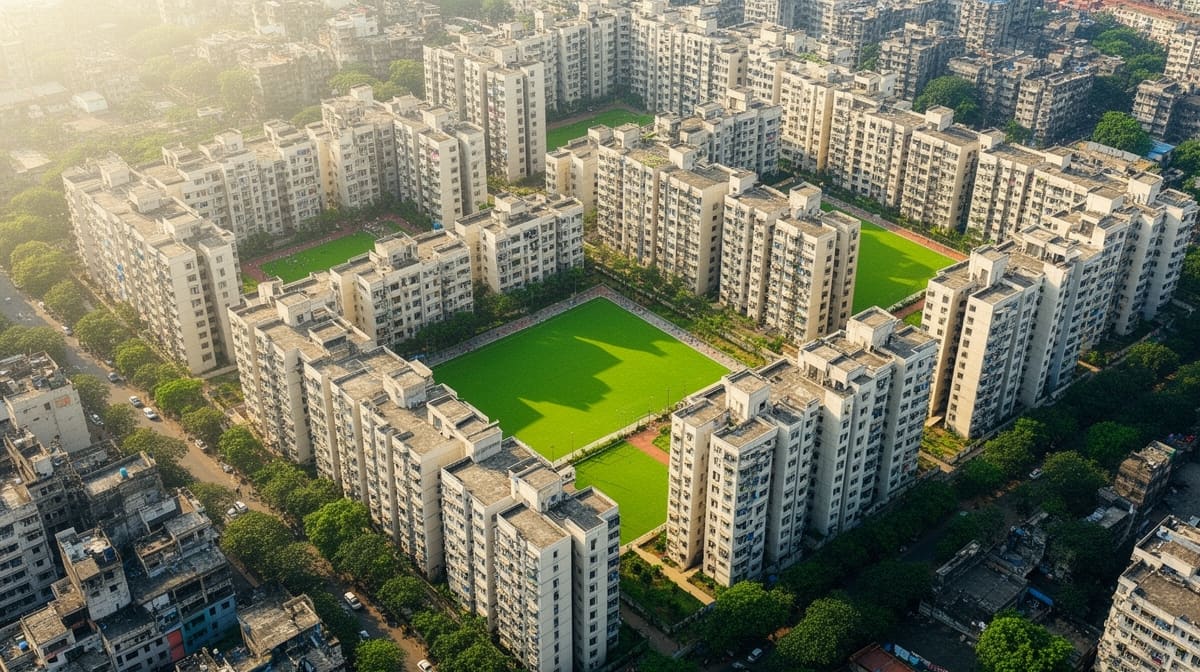
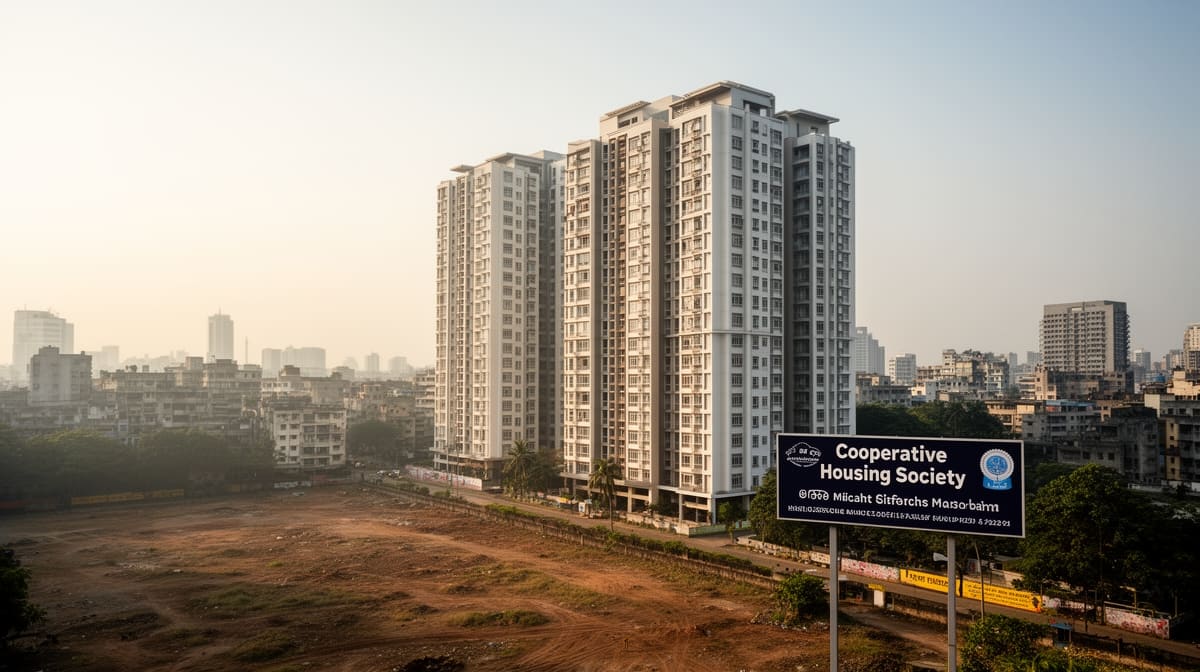
The dispute arises from the allocation of proportionate share in the Recreational Ground (RG) within a residential layout in Village Eksar, Taluka Borivali, Mumbai. The larger plot of 7240.1 sq.mtrs, spread across Survey Nos. 256 and 183 Hissa No.1 (CTS Nos. 2453/A, 2453/B, 2453/1 to 2453/30), was developed by M/s. Brij Builders into four residential buildings: A1, A2, A5, and Building No. 4. Two co-operative housing societies were formed: Respondent No. 1 (Devendra CHS) for Building A5, and Petitioner (Shree Rasraj Heights CHS) for Building No. 4. Two other structures, Ram Vihar and Ganga Vihar, occupy the remaining portions.
Key Facts
The entire layout utilized 100% of the available FSI.
Respondent No. 1 (Devendra CHS) applied for deemed conveyance under Section 11(3) of MOFA via Application No. 62 of 2016.
On 04.05.2017, the Competent Authority issued a Certificate of Unilateral Deemed Conveyance, conveying 2625.84 sq.mtrs of land along with "proportionate undivided share in all common properties, internal roads, RG, facilities and amenities."
The certificate did not specify the numerical value of the RG share.
On 25.01.2019, Respondent No. 1 registered the Deed of Conveyance based on the 2017 certificate.
In February 2022, Respondent No. 1 submitted an Architect’s Certificate claiming an RG entitlement of 463.38 sq.mtrs, calculated based on plot area proportion (2625.84 sq.mtrs out of 6154.05 sq.mtrs).
Petitioner Shree Rasraj Heights CHS contested this, asserting that RG share must be calculated based on built-up area utilised, which would entitle Respondent No. 1 to only 323.21 sq.mtrs.
Respondent No. 1 filed a Misc. Application before the Competent Authority seeking correction of the 2017 certificate.
Procedural History
04.05.2017: Competent Authority issues Certificate of Unilateral Deemed Conveyance (no RG area quantified).
25.01.2019: Deed of Conveyance registered by Respondent No. 1.
23.02.2022: Architect’s certificate submitted by Respondent No. 1 claiming 463.38 sq.mtrs RG share.
2025: Petitioner raises objections to the proposed RG allocation.
12.01.2026: Competent Authority passes order correcting the 2017 certificate to specify RG share as 463.38 sq.mtrs.
15.07.2026: Writ Petitions filed before Bombay High Court challenging the 12.01.2026 order.
The Parties' Positions
Petitioner (Shree Rasraj Heights CHS): Argues RG share must be proportionate to built-up area utilised. Claims Respondent No. 1’s entitlement is 323.21 sq.mtrs. Asserts that Respondent No. 1’s claim is based on erroneous methodology and that TDR usage by Petitioner invalidates plot-area-based calculation.
Respondent No. 1 (Devendra CHS): Claims entitlement of 463.38 sq.mtrs based on proportion of plot area (2625.84 sq.mtrs out of 6154.05 sq.mtrs). Argues that the 2017 order already crystallized its substantive right to RG, and the 2026 order merely quantifies it.
Developer (M/s. Brij Builders): Supports Respondent No. 1’s position, contending that the Competent Authority had no jurisdiction to modify the conveyance order.
Competent Authority: Held that the omission of RG quantification was a clerical/arithmetical error and that the correction did not confer new rights.
Relief Sought
Petitioners seek setting aside of the Competent Authority’s order dated 12.01.2026.
Petitioners argue that the order improperly adjudicated a disputed factual issue beyond the scope of correction.
Respondent No. 1 seeks upholding of the corrigendum as a mere clarification of an existing right.
The Legal Issue
Can a Competent Authority under Section 11(3) of MOFA issue a corrigendum to a deemed conveyance order to specify a disputed proportionate share in the Recreational Ground, when the parties contest the methodology for calculating that share?
Arguments Presented
For the Appellant/Petitioner
The learned counsel for both Petitioners relied on multiple judgments of the Bombay High Court - Surya Corporation, M/s. Aakansha Constructions Co., Kashish Park Reality, and Kuber Kartik New Link Road Premises CHSL - to establish that the Competent Authority becomes functus officio after issuing a deemed conveyance order. They argued that the 2026 order was not a mere correction of an arithmetical error but a substantive adjudication of a disputed entitlement. The Petitioners contended that the Architect’s calculation based on plot area was legally flawed, especially given the extensive use of TDR by Petitioner’s building, which rendered built-up area the only equitable metric. They cited Mohinder Singh Gill v. Chief Election Commissioner to argue that reasons for an order cannot be supplemented post-facto via affidavits.
For the Respondent/State
The counsel for Respondent No. 1 argued that the 2017 order had already granted a substantive right to proportionate RG share, and the 2026 order merely quantified it. He relied on Jaywant Ramchandra Keni to assert that correction of clerical omissions is permissible. He emphasized that the building of Respondent No. 1 was constructed on its own plot entitlement of 2625.84 sq.mtrs, and that the Petitioner’s use of TDR to construct a larger building should not dilute Respondent No. 1’s entitlement. He further argued that the corrigendum did not expand physical boundaries or confer new rights, and that setting it aside would disrupt ongoing redevelopment.
The Court's Analysis
The Court began by acknowledging the settled legal position that the Competent Authority under MOFA becomes functus officio upon issuance of a deemed conveyance order. It noted that the authority has no inherent power of review or modification, and that any attempt to do so under the guise of correction is ultra vires.
"The omission to make numerical expression of R.G. proportion was clerical/arithmetical, inasmuch as it relates to the mode of expressing an already adjudicated right, rather than determining whether such right exists."
The Court accepted that the Competent Authority’s characterization of the error as clerical was plausible on its face. However, it emphasized that the presence of a genuine dispute between the parties transformed the nature of the proceeding. The Petitioner had explicitly contested the methodology - plot area versus built-up area - and submitted a counter-calculation. The Competent Authority, instead of declining jurisdiction, engaged with the merits of the dispute, evaluated the Architect’s certificate, and resolved the conflict in favor of Respondent No. 1.
The Court distinguished Jaywant Ramchandra Keni, where the correction involved an undisputed numerical error. Here, the dispute was not about a typo or omission, but about the legal and factual basis for calculating entitlement. The Court held:
"The moment it is noticed that the Competent Authority has traveled far beyond the scope of correcting the obvious error arising out of accidental slip or omission, the Corrigendum issued by the Competent Authority will have to be necessarily set aside on the ground of lack of jurisdiction."
The Court further noted that the Competent Authority had no statutory power akin to Section 152 of the CPC to correct errors, and that even if such power existed, it could not be used to adjudicate contested factual issues. The use of TDR by the Petitioner, while relevant to the underlying dispute, was not a factor the Competent Authority was empowered to evaluate.
The Court concluded that the 12.01.2026 order was an impermissible exercise of adjudicatory power masquerading as a clerical correction.
The Verdict
The Bombay High Court set aside the order dated 12 January 2026 passed by the Competent Authority. The Court held that the corrigendum impermissibly adjudicated a disputed factual issue regarding proportionate RG share. Respondent No. 1 is not precluded from seeking redressal and is at liberty to file a fresh application challenging the original deemed conveyance order dated 4 May 2017 to seek clarification or modification of its RG entitlement. Any such application shall be decided on its merits without being influenced by the observations in this judgment. There shall be no order as to costs.
What This Means For Similar Cases
Correction Cannot Substitute Adjudication
Practitioners must distinguish between clerical errors (e.g., wrong CTS number, typographical mistake) and substantive disputes (e.g., calculation methodology, entitlement metric).
A corrigendum under MOFA is permissible only if the error is purely mechanical and undisputed.
Any attempt to resolve conflicting claims via corrigendum invites judicial intervention.
TDR Usage Does Not Override Statutory Framework
While TDR may affect FSI calculations, it does not alter the legal requirement to determine RG shares based on equitable principles.
Competent Authorities cannot use TDR as a justification to override established calculation norms without statutory backing.
Parties must raise TDR-related arguments in original conveyance applications, not in post-facto corrections.
Proportionality Metric Must Be Defined Early
Developers and societies should specify the metric for RG allocation (plot area, built-up area, or FSI) in the original conveyance application.
Ambiguity in the original order invites litigation and renders subsequent corrections vulnerable to challenge.
Legal documentation must clearly define whether RG entitlement is tied to land area or construction footprint.