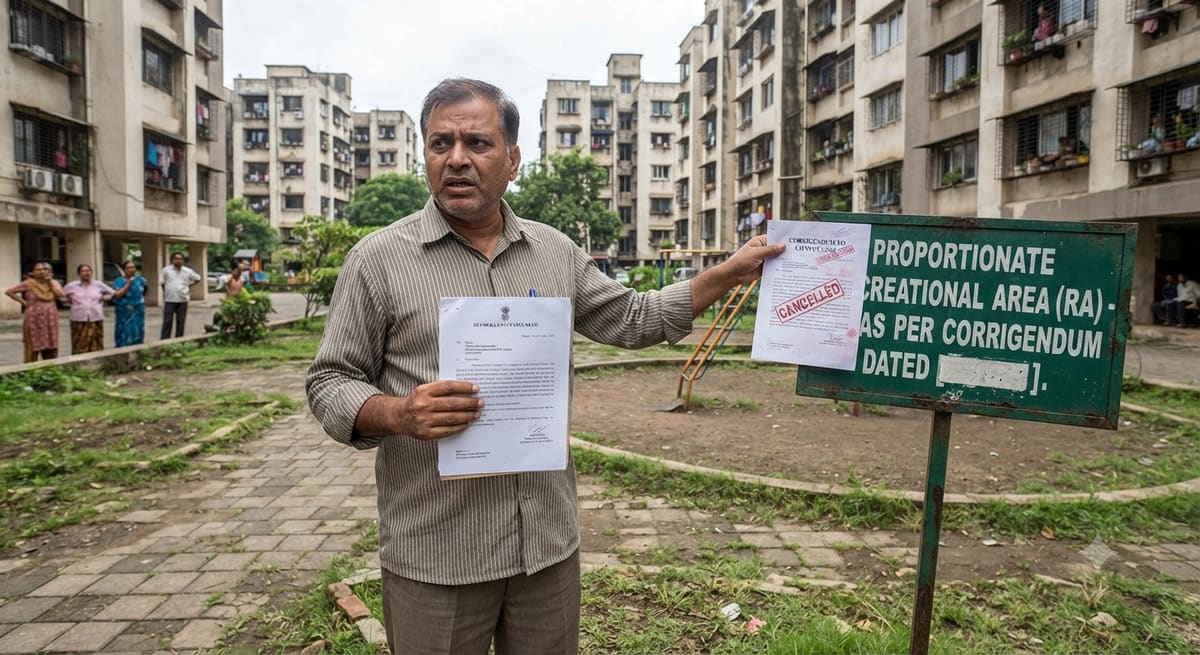
The Bombay High Court has clarified that a corrigendum to a deemed conveyance order under the Maharashtra Ownership Flats Act, 1963, which merely quantifies an already recognized undivided share, does not constitute a substantive review. The judgment also reinforces that inordinate delay in challenging such orders under Article 226 bars judicial intervention, regardless of merits.
Background & Facts
The Dispute
The petitioner, a promoter of a residential project, challenged two orders issued by the District Deputy Registrar, Cooperative Societies: the original order dated 29 September 2018 granting unilateral deemed conveyance to the housing society, and a subsequent corrigendum dated 6 March 2025 that specified exact square meterage of the undivided share in common areas.
Procedural History
- 29 September 2018: Competent Authority issued order granting deemed conveyance, recognizing society’s entitlement to 1571.90 sq. metres of land plus undivided share in common areas.
- 30 July 2025: Petitioners filed writ petition challenging the 2018 order - nearly seven years after it was passed.
- 6 March 2025: Competent Authority issued corrigendum specifying that 148.31 sq. metres of road area and 304.99 sq. metres of recreational/common areas formed part of the society’s undivided share.
- February 2026: Writ petition heard and dismissed by the Bombay High Court.
Relief Sought
The petitioners sought quashing of both the 2018 order and the 2025 corrigendum, arguing that the corrigendum amounted to an impermissible review of a concluded order under Section 11 of the Maharashtra Ownership Flats Act (MOFA).
The Legal Issue
The central question was whether a corrigendum that specifies numerical details of an undivided share previously recognized in a deemed conveyance order constitutes a substantive review, and whether a writ petition filed after seven years of inaction can be entertained under Article 226.
Arguments Presented
For the Petitioner
The petitioners relied on Kashish Park Realty Private Limited v. State of Maharashtra to argue that the corrigendum was not a mere clarification but a substantive modification. They contended that inserting specific measurements of undivided area amounted to a fresh adjudication, which is beyond the limited powers of the Competent Authority under Section 11 of MOFA. They further argued that the delay in filing the petition was excusable due to subsequent attempts at settlement after 2022.
For the Respondent
The society’s counsel submitted that the corrigendum did not create any new right. It merely quantified the undivided share already granted in the 2018 order. The original order explicitly recognized the society’s entitlement to an undivided share in common areas; the corrigendum merely broke down the total area into constituent parts. No new issue was reopened, and no additional land was granted.
The Court's Analysis
The Court examined the operative portions of the 2018 order and the 2025 corrigendum in tandem. It found that the original order clearly stated the society was entitled to an undivided share in the D.P. Road, internal roads, recreation area, and common areas. The corrigendum did not alter the total area of 1571.90 sq. metres but only specified the proportion of that share attributable to specific components.
"The corrigendum does not enlarge the land area of 1571.90 sq. metres. It only quantifies the undivided component."
The Court distinguished Kashish Park Realty, noting that case dealt with a substantive change in the nature of the grant. Here, there was no change in the nature or extent of the right - only its articulation. The Authority was merely clarifying an implicit detail, not reconsidering a concluded issue.
The Court further held that the delay of nearly seven years in challenging the 2018 order was inexcusable. The cause of action arose on the date of the order. Subsequent settlement attempts from 2022 could not cure the laches. Article 226 is not a substitute for delayed litigation, and courts are not obligated to examine merits when delay is unexplained.
The Court also emphasized that proceedings under Section 11 of MOFA are summary in nature and do not constitute final adjudication of title. Any party aggrieved retains the right to institute a civil suit, and findings in summary proceedings do not operate as res judicata.
The Verdict
The petitioners lost. The Court held that the corrigendum was a permissible clerical clarification of an existing right and did not amount to a review. The challenge to the 2018 order was dismissed on grounds of inordinate delay. No costs were awarded.
What This Means For Similar Cases
Clarification Is Not Review
- Practitioners must distinguish between substantive modification and clerical clarification in MOFA proceedings.
- If an order recognizes a general right (e.g., "undivided share in common areas"), subsequent specification of exact square footage does not require a fresh hearing.
- A corrigendum that merely breaks down an already granted entitlement cannot be challenged as a review.
Delay Bars Relief Under Article 226
- Writ petitions under Article 226 are not immune to delay; courts may refuse to examine merits if laches is established.
- Post-event settlement attempts do not cure prior inaction - petitioners must act promptly upon issuance of an adverse order.
- Legal advisors must counsel clients to file challenges within months, not years, of deemed conveyance orders.
Summary Proceedings Do Not Conclude Title
- Parties should not assume that MOFA orders are conclusive on title or ownership.
- A promoter or society may still file a civil suit to determine title, and findings in summary proceedings will not bind the civil court.
- This preserves the right to full adjudication while upholding the efficiency of summary conveyance mechanisms.