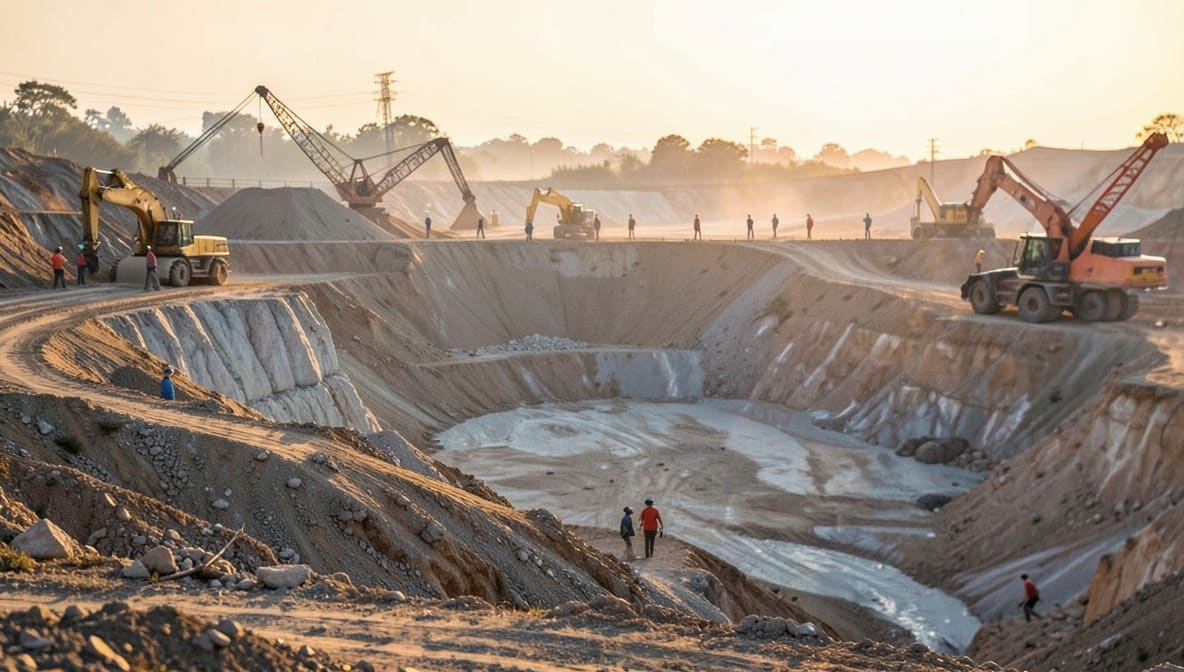
The Karnataka High Court recently addressed a writ petition seeking mandamus for the execution of a sand quarry lease, where the authorities withheld the lease deed due to a pending demand from an earlier lease. The Court disposed of the petition with a direction to expedite the revision petition challenging the demand, clarifying that the lease would be executed only if the petitioner prevails in the revision proceedings, subject to statutory clearances.
Background & Facts
The Dispute
The petitioner, Sri Ibrahim, participated in a tender process initiated by the Department of Mines and Geology, Government of Karnataka, on 06.11.2025 for the disposal of sand blocks, including a sand block measuring 4.40 acres in Survey No. 28 of Mogaru Village, Belthangady Taluk, Dakshina Kannada District. The petitioner emerged as the successful bidder in the e-auction conducted on 12.02.2026 and obtained a Letter of Intent/Provisional Acceptance Letter dated 24.02.2026 (hereinafter referred to as the Provisional Acceptance Letter).
Key Facts
- The petitioner participated in the tender process for the sand block, which required furnishing a No Due Certificate confirming no arrears payable. Respondent No. 3 issued a certificate dated 03.12.2025 to this effect, which was submitted with the tender documents.
- The petitioner's technical bid was accepted on 02.01.2026, and he subsequently obtained environmental clearance from the concerned authority.
- However, Respondent No. 3 issued a notice dated 05.01.2026, demanding payment of Rs. 39,62,678/- for an earlier sand quarry lease held by the petitioner in Survey No. 72 of Baraya Village. The demand pertained to the petitioner's failure to meet the mandatory minimum production and dispatch requirement of 50% of the permitted annual production quantity for the financial years 2019-20 to 2021-22.
- The petitioner contended that the demand was unjustified as the shortfall occurred during the pandemic period, when production could not be carried out.
- Despite the petitioner's compliance with the tender conditions and obtaining necessary clearances, the respondents withheld the execution of the lease deed on account of the pending demand.
Procedural History
- 06.11.2025: Tender process initiated by the Department of Mines and Geology for disposal of sand blocks.
- 03.12.2025: Respondent No. 3 issued a No Due Certificate to the petitioner.
- 02.01.2026: Petitioner's technical bid accepted.
- 05.01.2026: Respondent No. 3 issued a notice demanding Rs. 39,62,678/- for shortfall in production under an earlier lease.
- 12.02.2026: E-auction conducted; petitioner emerged as the successful bidder.
- 24.02.2026: Petitioner received the Provisional Acceptance Letter.
- Post-24.02.2026: Petitioner obtained environmental clearance but the lease deed was withheld due to the pending demand.
- Date not specified: Petitioner filed a revision petition challenging the demand; the matter was heard, and the final decision was awaited.
- Date of filing not specified: Present writ petition (WP No. 18350 of 2026) filed under Articles 226 and 227 of the Constitution of India seeking mandamus for execution of the lease deed.
Relief Sought
The petitioner sought a writ of mandamus directing the respondents to:
- Execute and register the sand quarry lease pursuant to the Provisional Acceptance Letter dated 24.02.2026.
- Comply with the conditions stipulated in the Provisional Acceptance Letter and the tender document.
The Legal Issue
The central question before the Court was whether the respondents could withhold the execution of a sand quarry lease on account of a pending demand arising from an earlier lease, particularly when the petitioner had complied with all tender conditions and obtained necessary statutory clearances.
Arguments Presented
For the Petitioner
- The petitioner contended that the pending demand pertained to the pandemic period, during which production could not be carried out, and thus, the demand was unjustified.
- The petitioner had already filed a revision petition challenging the demand, and the matter was sub judice.
- The petitioner had complied with all statutory clearances and tender conditions, and the respondents were obligated to execute the lease deed pursuant to the Provisional Acceptance Letter.
For the Respondents
- The respondents disputed the petitioner's contention, arguing that the demand was valid as it arose from the petitioner's failure to meet the mandatory production requirements under the earlier lease.
- The respondents contended that the execution of the lease deed could not be compelled while the demand remained unresolved, as the petitioner would be required to pay the demand if the terms of the lease were strictly adhered to.
The Court's Analysis
The Court observed that the petitioner did not dispute the shortfall in production under the earlier lease. The Court noted that if the terms of the lease were strictly adhered to, the petitioner would indeed be liable to pay the pending demand. The Court further acknowledged that the petitioner had filed a revision petition challenging the demand, and the final decision was awaited.
The Court emphasized that the execution of the lease deed was contingent upon the resolution of the pending demand. It held that no directions could be issued to the respondents to execute the lease deed while the demand remained unresolved, as this would prejudge the outcome of the revision petition.
However, the Court disposed of the petition with a direction to the revisional authority to decide the revision petition expeditiously. The Court clarified that if the petitioner prevails in the revision petition, the respondents would be obligated to execute and register the lease deed, subject to the petitioner obtaining all statutory and necessary clearances.
"Considering the controversy involved in the present case, we are unable to accept that any directions are required to be issued to the concerned authority for execution of the quarry lease in favour of the petitioner, pending settlement of the outstanding demand."
The Verdict
The Court disposed of the writ petition with the following directions:
- The revisional authority was directed to decide the petitioner's revision petition as expeditiously as possible.
- In the event the petitioner prevails in the revision petition, the respondents were directed to execute and register the lease deed in favour of the petitioner, subject to the petitioner obtaining all statutory and necessary clearances.
- No costs were awarded.
What This Means For Similar Cases
Conditional Execution of Lease Deeds
This judgment underscores the principle that execution of mining or quarry leases can be made conditional upon the resolution of pending demands or disputes from earlier leases. Practitioners should note:
- Courts may withhold directions for lease execution if there are unresolved financial or compliance-related disputes.
- The burden of resolving pending demands lies with the lessee, and until such resolution, the authorities may legitimately withhold lease deeds.
Expeditious Disposal of Revision Petitions
- The Court's direction to expeditiously dispose of the revision petition highlights the importance of timely adjudication of disputes arising from earlier leases.
- Practitioners should actively pursue revision petitions and seek interim relief where necessary to avoid delays in obtaining lease deeds.
Compliance with Statutory Clearances
- The judgment reiterates that execution of lease deeds is subject to obtaining all statutory clearances. Lessees must ensure:
- Environmental clearances are obtained before seeking execution of lease deeds.
- No Due Certificates and other compliance documents are accurate and up-to-date to avoid disputes.
- Production and dispatch requirements under earlier leases are strictly adhered to, as non-compliance can lead to valid demands that may delay new leases.