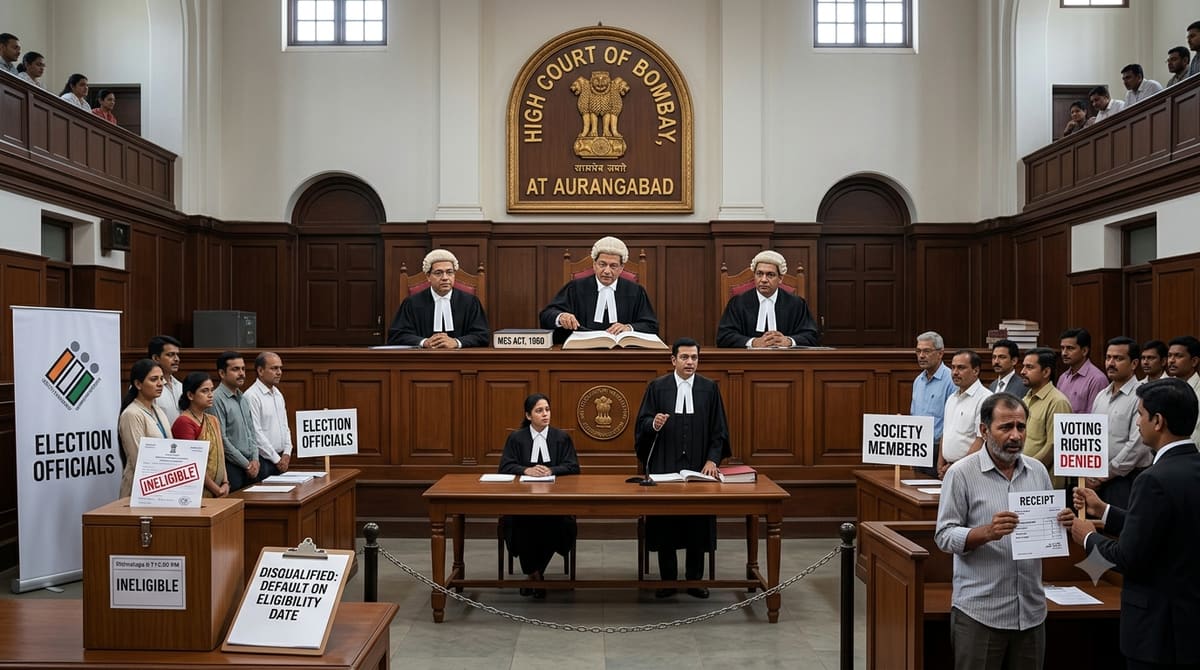
The Bombay High Court has clarified that under the Maharashtra Co-operative Societies Act, a member society’s voting rights in bank elections are determined solely by its default status on the statutory cut-off date, not by subsequent clearance of dues. This ruling reinforces the principle that statutory eligibility criteria must be applied strictly as written, with no room for equitable relief after the deadline.
Background & Facts
The Dispute
The petitioner, Smt. Sumanbai, a member of Seva Sahakari Society Ltd., Kaudgaon, challenged the inclusion of Respondent No.1 Society in the voters list for the election of the Nanded District Central Co-operative Bank (NDCC Bank). The petitioner objected on the ground that Respondent No.1 Society was a defaulter on the eligibility cut-off date and therefore disqualified under Section 27(10) read with Section 73CA of the Maharashtra Co-operative Societies Act, 1960.
Key Facts
The District Co-operative Election Officer issued a public notice on 12.03.2026 inviting nominations for delegates to the NDCC Bank election.
The notice fixed 03.04.2026 as the cut-off date for determining eligibility for inclusion in the voters list.
The notice directed societies to consider Section 27(10) and Section 73CA of the MCS Act while preparing resolutions.
As of 03.04.2026, Respondent No.1 Society had an outstanding loan dues of Rs.88,303/- with the NDCC Bank.
Respondent No.1 Society cleared the dues on 20.04.2026, after the cut-off date.
The petitioner filed an objection on 15.04.2026, citing the default status on the qualifying date.
Respondent No.2 (District Co-operative Election Officer) rejected the objection on 25.05.2026, holding that the dues had been cleared and that no prior demand notice had been served.
Procedural History
12.03.2026: Public notice issued by Respondent No.2 fixing 03.04.2026 as eligibility cut-off date.
15.04.2026: Petitioner filed formal objection to inclusion of Respondent No.1 Society.
20.04.2026: Respondent No.1 Society paid outstanding dues of Rs.88,303/-.
25.05.2026: Respondent No.2 rejected objection, allowing inclusion in voters list.
18.06.2026: Writ Petition No.5658 of 2026 filed before Bombay High Court, Aurangabad Bench.
Relief Sought
The petitioner sought quashing of the order dated 25.05.2026, deletion of Respondent No.1 Society’s name from the voters list, and direction to reconstitute the list in accordance with Section 27(10) of the MCS Act.
The Legal Issue
The central question was whether a co-operative society loses its right to vote under Section 27(10) of the Maharashtra Co-operative Societies Act if it is in default on the statutory cut-off date for voter eligibility, even if it clears the dues after that date.
Arguments Presented
For the Petitioner
The petitioner relied on the plain language of Section 27(10), which disqualifies a member from voting if it is a defaulter on the relevant date. Citing Himat v. Rajendra and Ors. (Civil Appeal No.905 of 2021), the petitioner argued that the Supreme Court has consistently held that default status must be assessed as of the cut-off date, not the date of payment. The petitioner emphasized that the statute does not require prior notice of demand for disqualification to apply, and that Respondent No.2 erred in introducing a procedural requirement not found in the law.
For the Respondent
Respondent No.2 contended that since the dues were cleared before the final voters list was published, the society should not be penalized. It further argued that fairness required notice of default to be served before disqualification, and that the absence of such notice rendered the disqualification invalid. Respondent No.1 supported this view, asserting that the society’s subsequent compliance should be recognized.
The Court's Analysis
The Court examined the statutory scheme under Section 27(10) and Section 73CA of the MCS Act. It noted that the provision explicitly links voting rights to default status on the relevant date, without any condition requiring notice or opportunity to cure. The Court emphasized that the legislature deliberately chose to fix a cut-off date to ensure certainty and prevent last-minute manipulation of voter eligibility.
"According to that notification, the primary voters list was to be prepared on the basis of cut-off date as 07.05.2020. Further, as per Section 27 of the Maharashtra Cooperative Societies Act, 1960, the defaulter members on the cut-off date are not eligible to vote and, therefore, cannot participate in the election process."
The Court held that the Supreme Court’s observation in Himat v. Rajendra was directly applicable: default status as of the cut-off date is decisive. The fact that dues were paid after 03.04.2026 was legally irrelevant. The Court further rejected the argument that a demand notice was a precondition for disqualification, noting that Section 27(10) operates automatically upon default, irrespective of notice. The Respondent No.2’s reliance on procedural fairness was misplaced, as the statute itself provides the only conditions for eligibility.
The Court concluded that Respondent No.2 committed a jurisdictional error by ignoring the statutory mandate and substituting its own equitable considerations. The impugned order was therefore unsustainable in law.
The Verdict
The writ petition was allowed. The Court quashed the order dated 25.05.2026 passed by Respondent No.2. The name of Respondent No.1 Society was directed to be deleted from the voters list for the NDCC Bank election. The District Co-operative Election Officer was directed to reconstitute the voters list excluding Respondent No.1 Society, in strict compliance with Section 27(10) of the MCS Act, within 7 days.
What This Means For Similar Cases
Cut-off Date Is Absolute
Practitioners must verify default status strictly as of the statutory cut-off date, not the date of publication or payment.
Any attempt to argue for equitable relief based on post-cut-off payment will fail under the current interpretation.
No Notice Required for Disqualification
Co-operative societies cannot claim procedural unfairness for lack of demand notice before disqualification under Section 27(10).
The provision is self-operating: default on the cut-off date = automatic loss of voting rights.
Election Authorities Must Apply Law Strictly
Election officers must not introduce additional conditions (e.g., notice, opportunity to pay) not found in the statute.
Failure to apply the law as written renders their orders liable to be quashed on judicial review.