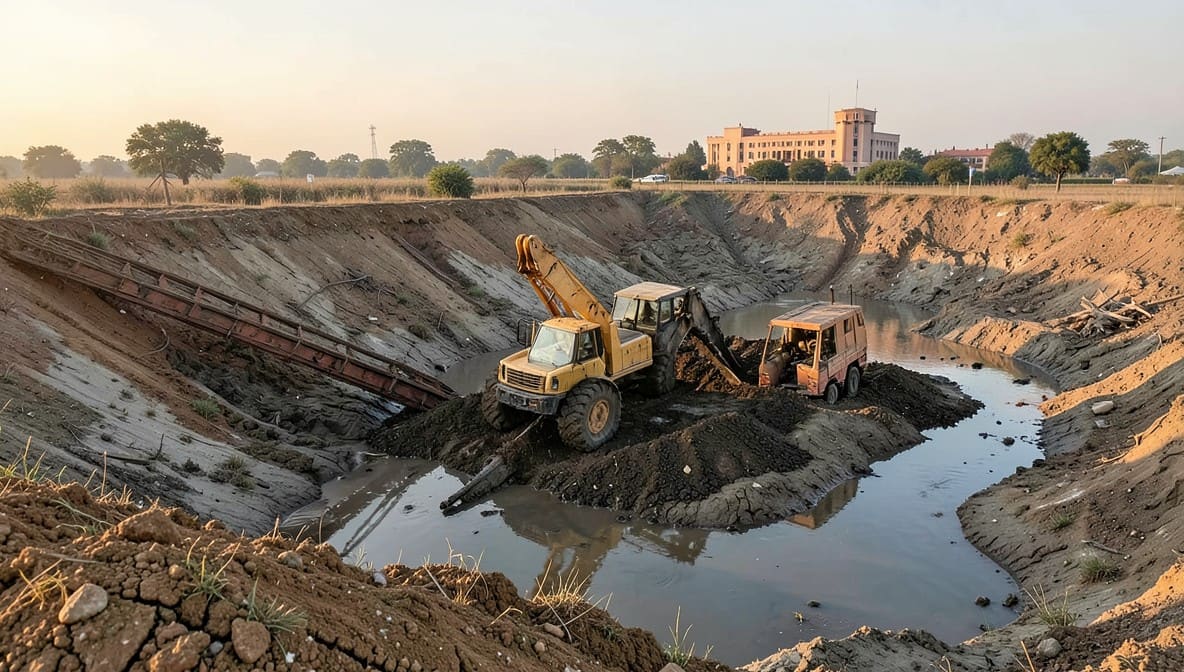
The Allahabad High Court has established a critical precedent that the State’s failure to promptly terminate a mining lease under Rule 58 of the U.P. Minor Minerals (Concession) Rules, 1963, despite clear default by the lessee, may constitute arbitrary State action violative of Article 14 of the Constitution. This ruling redefines the balance of obligations in statutory mining leases, holding that the State cannot indefinitely prolong liability while denying the lessee any exit mechanism.
Background & Facts
The Dispute
The petitioner, Jai Shakti Realcon, was granted a mining lease for sand and moram in Village Korrakanak, Fatehpur district, Uttar Pradesh, under a lease deed executed on 29.11.2018 and registered on 30.11.2018. The lease covered 40.48 hectares in Gata No. 391 Mi, with a royalty rate of Rs. 255 per cubic meter and a term from 29.11.2018 to 28.11.2023. The petitioner deposited Rs. 3,87,09,000 as security and an equal amount as the first installment of royalty.
Key Facts
- The lease deed was executed in Form MM-6, as mandated by Rule 29 of the U.P. Minor Minerals (Concession) Rules, 1963
- The petitioner was required to pay quarterly royalty installments: Rs. 7,74,18,000 each on 01.01.2019 and 01.04.2019
- The petitioner mined and transported 39,329 cubic meters of sand/moram between December 2018 and May 2019, as per the State’s own records
- The petitioner paid Rs. 50,00,000 on 17.10.2019 and Rs. 20,00,000 on 26.11.2019, totaling Rs. 70,00,000
- The State alleged the petitioner had not paid the second and third quarterly installments due on 01.01.2019 and 01.04.2019
- The petitioner claimed that due to a shift in the course of the Yamuna River, part of the leased area fell within the jurisdiction of District Banda, and local authorities in Banda obstructed mining operations
- Three joint surveys were conducted: on 06.03.2019, 02.04.2019, and 08.05.2019 - 10.05.2019, all concluding no overlap between Village Kurra Kanak (Fatehpur) and Village Jauharpur (Banda)
- The petitioner submitted multiple applications requesting re-survey and relief from royalty liability, all of which were ignored
- The District Magistrate, Fatehpur, issued notices on 12.04.2019, 24.04.2019, and 21.05.2019 demanding payment of outstanding installments and alleging illegal mining
- On 01.01.2020, the District Magistrate determined the lease and blacklisted the petitioner’s firm for two years
Procedural History
- 29.11.2018: Lease deed executed for mining sand/moram in Village Korrakanak, Fatehpur
- 30.11.2018: Lease deed registered
- 08.02.2019: Petitioner applied for reduction in royalty due to submerged land
- 06.03.2019: First survey by Regional Office, Prayagraj conducted
- 11.03.2019: Petitioner requested re-survey and demarcation
- 14.03.2019: District Magistrate, Fatehpur wrote to District Magistrate, Banda for joint demarcation
- 02.04.2019: Joint inspection report submitted; Banda team absent
- 12.04.2019: First demand notice issued for unpaid installments
- 20.04.2019: District Magistrate, Fatehpur again wrote to Banda for demarcation
- 24.04.2019: Second demand notice issued
- 25.04.2019: Director, Geology and Mining, Lucknow ordered resurvey
- 08.05.2019 - 10.05.2019: Third joint demarcation survey conducted
- 13.05.2019: Final survey report issued confirming no boundary overlap
- 21.05.2019: Show-cause notice issued demanding payment and alleging illegal mining
- 17.10.2019: Petitioner deposited Rs. 50,00,000
- 26.11.2019: Petitioner deposited Rs. 20,00,000
- 09.12.2019: Final notice issued threatening lease termination
- 01.01.2020: Order determining lease and blacklisting issued
- 13.10.2020: Recovery certificate issued (challenged separately in Writ-C No. 10943/2021)
- 10.08.2021: Writ-C No. 10943/2021 dismissed by this Court
- 12.06.2020: Writ-C No. 3056/2020 filed challenging lease termination and blacklisting
- 20.12.2019: Writ-C No. 18896/2019 filed challenging notices dated 24.04.2019 and 21.05.2019
- 08.05.2026: Judgment delivered
The Parties' Positions
For the Petitioner: Argued that royalty liability is limited to minerals actually extracted under Section 15(3) of the U.P. Mines and Minerals (Development and Regulation) Act, 1957 and Condition No. 1 of the lease deed. Claimed that obstruction by Banda authorities and river course change rendered mining impossible after May 2019. Contended that the State’s delay in invoking Rule 58 to terminate the lease was arbitrary and caused unjust enrichment of royalty liability.
For the Respondent: Maintained that the petitioner had full access to the leased area, as confirmed by three surveys. Argued that the petitioner deliberately delayed payment and fabricated claims of obstruction to avoid liability. Asserted that Rule 58 provides an additional remedy to recover dues as arrears of land revenue, and that the State was not obligated to terminate the lease immediately.
Relief Sought
The petitioner sought:
- Quashing of the order dated 01.01.2020 determining the lease
- Quashing of the blacklisting order
- Cancellation of recovery demands for installments due on 01.07.2019 and 01.10.2019
- Adjustment of Rs. 70,00,000 deposited on 17.10.2019 and 26.11.2019 towards the unpaid installments of 01.01.2019 and 01.04.2019
- Deletion of blacklisting as a punitive measure
The Legal Issue
The central question was whether the State’s prolonged inaction in terminating a mining lease under Rule 58(1) of the U.P. Minor Minerals (Concession) Rules, 1963, despite clear default by the lessee and no possibility of further mining, constitutes arbitrary State action violative of Article 14 of the Constitution.
Arguments Presented
For the Petitioner
The petitioner relied on Kumari Shrilekha Vidyarthi v. State of U.P. and Verigamto Naveen v. Govt. of A.P. to argue that the State’s failure to act promptly under Rule 58(1) after the expiry of the 30-day notice period amounted to an abuse of power. It was submitted that Rule 58(1) imposes a duty on the State to act expeditiously to prevent disproportionate liability on the lessee, especially when the lessee has no statutory or contractual right to terminate the lease. The petitioner emphasized that the State’s delay, without any disclosed reason, caused the liability to escalate from Rs. 7.74 crore to over Rs. 14 crore, which was unjust and oppressive. The petitioner also cited M.P. Power Management Co. Ltd. v. SKY Power Southeast Solar India Pvt. Ltd. to argue that lack of good faith and oblique motive in delay renders State action arbitrary.
For the Respondent
The State contended that Rule 58(1) is permissive, not mandatory, and that the power to terminate the lease is in addition to the power to recover dues as arrears of land revenue. It argued that the petitioner had ample opportunity to mine and had not been obstructed by the State. The State maintained that the petitioner’s repeated applications for survey were dilatory tactics to evade payment, and that the delay in termination was due to ongoing investigations and attempts at demarcation. The State further relied on M/s Sharad Enterprises v. State of U.P. to assert that royalty liability is not limited to extracted minerals under the lease deed.
The Court's Analysis
The Court began by rejecting the petitioner’s argument that royalty liability is limited to minerals actually extracted, citing M/s Sharad Enterprises and Raj Pratap Yadav v. State of U.P., which held that the lease deed’s fixed installment structure binds the lessee regardless of extraction volume. The Court emphasized that the lease, executed in Form MM-6 under Rule 29, is a statutory contract, and the lessee cannot unilaterally alter its terms.
The Court then turned to the core issue: whether the State’s delay in invoking Rule 58(1) was arbitrary. It examined the structure of Rule 58(1), which permits termination after a 30-day notice following non-payment within 15 days of the due date. The Court noted that while the rule grants discretion, it does not permit indefinite delay. The Court observed that the petitioner had ceased mining operations by May 2019, and the State had confirmed through three surveys that no boundary dispute existed. Yet, the State took eight months - from May 2019 to January 2020 - to terminate the lease.
"The inaction or delay on the part of the authority in not invoking power under Rule 58 of Rules, 1963 despite existence of conditions contemplated under such rule to invoke power of determination of lease results in causing serious prejudice to the lessee as on the one hand, he cannot exit from the lease deed, and on the other hand, his liability continues to soar for no fault of his."
The Court held that the State, as a public authority bound by Article 14, cannot act with caprice or silence. The absence of any explanation for the delay, despite the petitioner’s repeated attempts to resolve the issue, indicated a lack of application of mind. The Court cited Kumari Shrilekha Vidyarthi and M.P. Power Management Co. Ltd. to affirm that State action lacking a discernible principle, reason, or good faith is arbitrary.
The Court further noted that the lease deed provided no exit mechanism for the lessee, creating a one-sided contractual relationship. In such circumstances, the State’s duty to act reasonably and promptly becomes paramount. The failure to terminate the lease after May 2019, when mining had effectively ceased, was not merely procedural negligence - it was an abuse of power that inflated the petitioner’s liability without justification.
The Verdict
The petitioner succeeded in part. The Court set aside the recovery demands for royalty installments due on 01.07.2019 and 01.10.2019, holding them illegal due to the State’s arbitrary delay in terminating the lease. The Rs. 70,00,000 deposited by the petitioner on 17.10.2019 and 26.11.2019 was directed to be adjusted towards the unpaid installments of 01.01.2019 and 01.04.2019. The order determining the lease and blacklisting the firm was upheld, but the Court held that the two-year blacklisting period had expired and must not bar the petitioner from future auctions. No costs were awarded.
What This Means For Similar Cases
State Action Must Be Timely and Reasoned
- Practitioners must now argue that any delay by the State in terminating a mining lease under Rule 58(1) after the notice period expires must be justified with documented reasons
- Silence or inaction by the State, especially when the lessee has no exit right, will be presumed arbitrary under Article 14
- In future litigation, the burden shifts to the State to explain why termination was delayed beyond the statutory window
Royalty Liability Is Not Infinite
- Lessees can now challenge post-cessation royalty demands if the State unreasonably delays termination
- Recovery of dues beyond the point of actual mining cessation, without prompt lease termination, is unsustainable
- Adjustments of deposits made after default must be applied to the earliest outstanding installments, not future ones
Lease Terms Are Not One-Sided
- Statutory leases like Form MM-6, while binding on lessees, cannot be enforced by the State in a manner that creates gross imbalance
- Courts will now scrutinize whether the State’s conduct aligns with the constitutional principle of non-arbitrariness, even in contractual contexts
- This judgment opens the door for challenges to other one-sided statutory contracts where the State holds all termination rights