The Andhra Pradesh High Court has clarified that authorities cannot retain a vehicle seized for minor mineral transportation violations merely because the penalty has not been paid. The judgment reinforces procedural legality under the AP Minor Mineral Concession Rules, 1966, and upholds constitutional protections against arbitrary state action.
Background & Facts
The Dispute
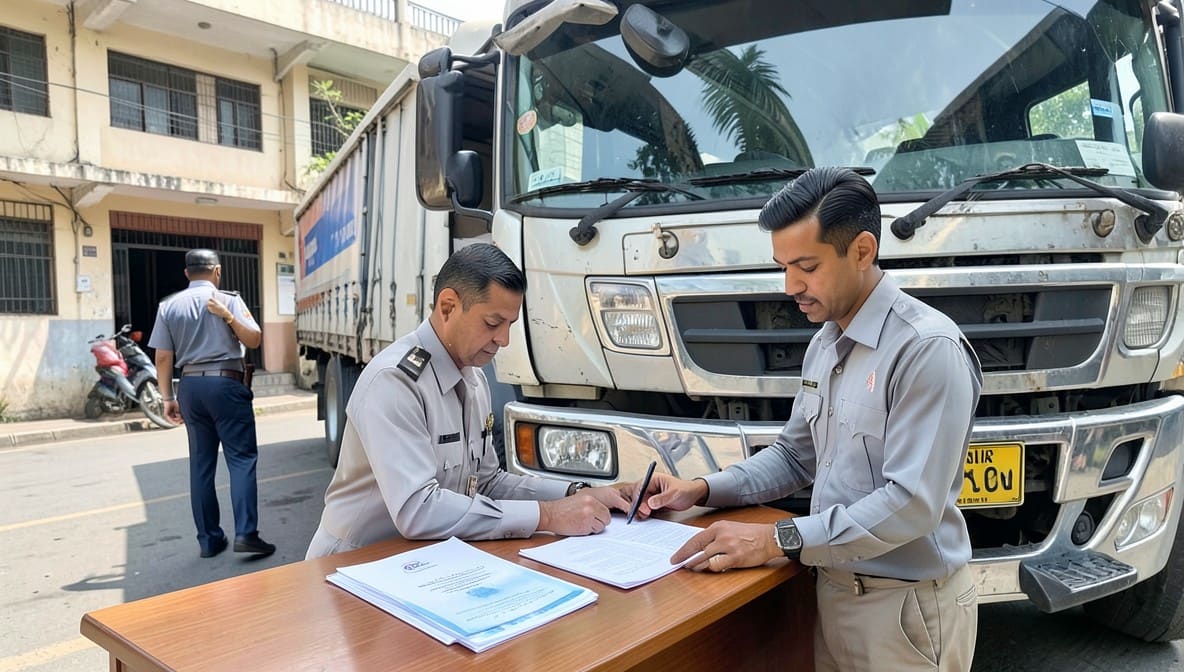
The petitioner, Puli Babu, a private transporter, had his tipper lorry bearing registration number AP 39 UU 3233 seized by the 3rd respondent - the Station House Officer of Thulluru Police Station - on grounds of alleged violation of the Andhra Pradesh Minor Mineral Concession Rules, 1966. The seizure occurred without issuance of any formal notice, record of interception, or opportunity to produce a transit permit. The petitioner contended that the seizure was not only unauthorized but also violated statutory procedures and fundamental rights under Articles 14, 19(1)(g), and 300-A of the Constitution.
Key Facts
- The vehicle was seized on an unspecified date prior to the filing of the writ petition on 28.04.2026
- No record of interception or seizure memo was produced by the respondents
- The petitioner claimed ownership of the vehicle and was prepared to pay any lawful dues
- The vehicle remained in custody of the 3rd respondent for an indefinite period without any adjudication
- The petitioner had not been provided any opportunity to produce a transit permit or explain the absence thereof
Procedural History
- The writ petition was filed on 28.04.2026 under Article 226 of the Constitution
- An interlocutory application (IA No. 1 of 2026) was filed seeking interim custody of the vehicle pending disposal
- The matter was listed for hearing on the same day as filing
- No counter-affidavit was filed by the respondents challenging the factual assertions of the petitioner
The Parties' Positions
Petitioner’s Position:
- The seizure was illegal as it did not comply with Sub-rule (3)(iii) of Rule 26 of the AP Minor Mineral Concession Rules, 1966
- The rule permits imposition of penalty but does not authorize detention of the vehicle until payment
- Relied on W.P. No. 1570 of 2026 (dated 20.01.2026) and Naganath v. State of A.P. (WA No. 4 of 2021) to support the argument
- Argued that retention of the vehicle without due process violates Article 19(1)(g) (right to profession) and Article 300-A (right to property)
Respondents’ Position:
- Did not dispute the petitioner’s submissions
- Accepted that the issue was squarely covered by the earlier decision of the High Court in Naganath v. State of A.P.
- Did not contest the applicability of Sub-rule (3)(iii) or the interpretation thereof
Relief Sought
- Declaration that the seizure was illegal, arbitrary, and violative of statutory and constitutional provisions
- Direction to release the vehicle immediately
- Interim custody of the vehicle pending final disposal
The Legal Issue
The central question was whether Sub-rule (3)(iii) of Rule 26 of the AP Minor Mineral Concession Rules, 1966 permits the authorities to retain a vehicle indefinitely until the penalty and seigniorage fee are paid, or whether the vehicle must be released upon imposition of the penalty, irrespective of payment.
Arguments Presented
For the Petitioner
The petitioner’s counsel relied on the binding precedent set by the Hon’ble Division Bench in Naganath v. State of A.P. (WA No. 4 of 2021), which held that the rule only authorizes the imposition of a penalty equal to five times the seigniorage fee - not the detention of the vehicle until payment. He further cited the Supreme Court’s observation in Sunderbhai Ambalal Desai v. State of Gujarat that mere retention of vehicles serves no legitimate purpose and amounts to arbitrary state action. He emphasized that the absence of a transit permit triggers a monetary penalty, not a custodial remedy.
For the Respondent
The Assistant Government Pleader for Mines and Geology did not contest the petitioner’s submissions. He conceded that the issue was already settled by the High Court’s earlier decision in Naganath and that the respondents had no legal basis to oppose the release of the vehicle upon compliance with the penalty regime under Rule 26(3)(iii).
The Court's Analysis
The Court undertook a textual and purposive interpretation of Sub-rule (3)(iii) of Rule 26 of the AP Minor Mineral Concession Rules, 1966. The provision states that if a driver or owner fails to produce a valid transit permit, the officer may require payment of five times the normal seigniorage fee as penalty, in addition to the normal seigniorage fee, DMF, and MERIT amounts. Crucially, the rule contains no language authorizing the detention or retention of the vehicle until such payment is made.
"On a reading of the above Rule, there is nothing to indicate, the vehicle cannot be released, unless the penalty and seigniorage fee is paid. All that the rule states is that the penalty equal to market value of the mineral seized along with seigniorage fee prevalent at that time can be ordered to be paid at the time of interception of the vehicle, if driver or person-in-charge of the vehicle fails to produce a valid permit. But, nowhere the Rule postulates that the vehicle cannot be released, unless the same is paid."
The Court reaffirmed that the purpose of the penalty is compensatory and deterrent, not punitive detention. Retaining the vehicle beyond the point of penalty imposition serves no statutory objective and violates the principle of proportionality under Article 14. The Court also noted the Supreme Court’s observation in Sunderbhai Ambalal Desai that keeping vehicles in custody without adjudication is an abuse of power.
The Court further held that the respondents’ failure to produce any record of interception or notice of violation rendered the seizure procedurally defective. The absence of due process, even if the underlying violation was arguable, rendered the action arbitrary and unconstitutional.
The Verdict
The writ petition was allowed. The Court directed the 2nd respondent to levy the penalty and seigniorage fee as prescribed under Sub-rule (3)(iii) of Rule 26 of the AP Minor Mineral Concession Rules, 1966. Upon payment of the penalty, the petitioner was directed to produce the payment receipt and ownership documents to the 3rd respondent, who was then directed to release the seized tipper lorry bearing registration number AP 39 UU 3233. No costs were awarded. All pending interlocutory applications stood closed.
What This Means For Similar Cases
Vehicle Detention Requires Statutory Authority
- Practitioners must challenge any seizure of vehicles under minor mineral rules where detention continues beyond imposition of penalty
- Authorities cannot invoke general police powers to retain vehicles; the remedy must be strictly confined to the statutory provision invoked
- Failure to issue a seizure memo or notice of violation renders the action void ab initio
Penalty Is Not a Prerequisite for Release
- Payment of penalty is not a condition precedent to release of the vehicle
- The vehicle must be released immediately upon imposition of the penalty, even if payment is pending
- Authorities may pursue recovery of penalty through recovery proceedings under the rules, but not by holding the vehicle hostage
Procedural Compliance Is Non-Negotiable
- Any interception must be documented with a seizure memo, time, location, and reason
- The burden of proving lawful interception lies with the state
- Courts will not uphold seizures based on mere suspicion or administrative convenience