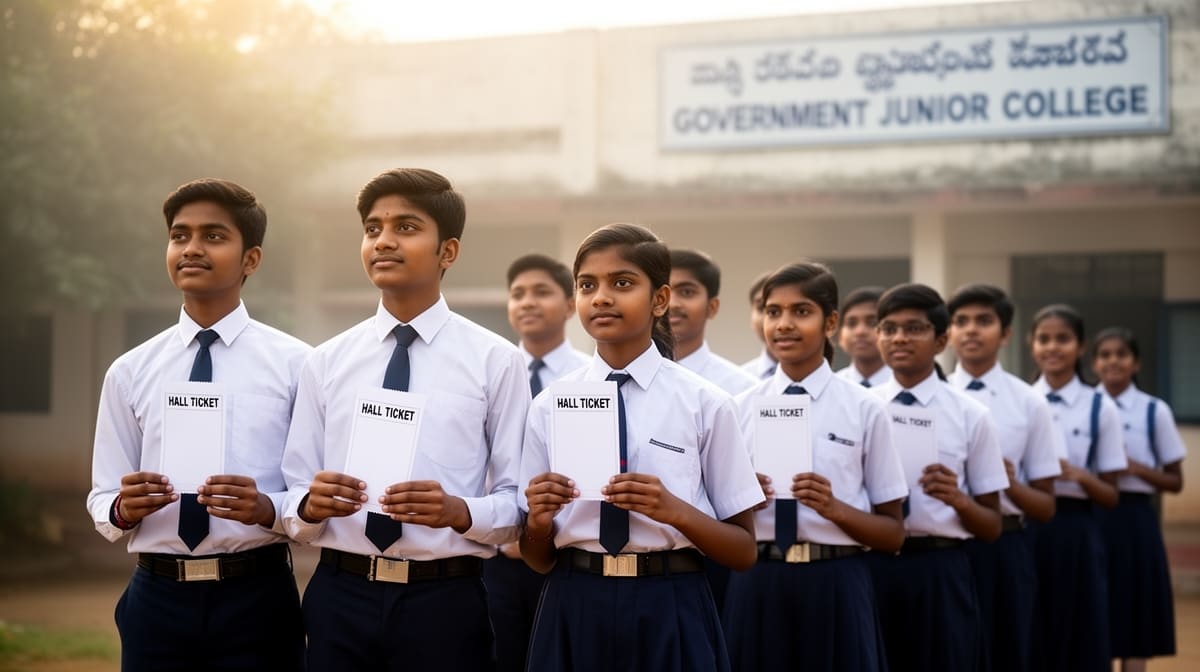
The Telangana High Court has reaffirmed the right to education as a fundamental right under Articles 14 and 21 of the Constitution, directing the Intermediate Board to issue hall tickets to students despite procedural lapses in registration. This judgment underscores the judiciary's role in ensuring substantive justice when administrative failures threaten academic futures, particularly in time-sensitive examination scenarios.
Background & Facts
The Dispute
The case involves multiple writ petitions filed by students of Intermediate (Class 11 and 12) courses in Telangana, who were denied hall tickets for their public examinations scheduled to commence on 25.02.2026. The Telangana State Board of Intermediate Education refused to issue hall tickets due to non-uploading of student details on the official portal by their respective colleges. The petitioners, represented by their natural guardians, approached the High Court seeking a writ of mandamus to compel the Board to issue hall tickets and permit them to appear for both practical and theory examinations.
Procedural History
The petitions followed a pattern of judicial intervention in similar cases:
- 12.02.2026: The Court, in W.P. No. 4178 of 2026, directed the Board to issue hall tickets to similarly situated students and facilitate their appearance in practical examinations.
- 19.02.2026: A Division Bench, in W.A. Nos. 209 and 210 of 2026, allowed students to register belatedly and directed the Board to issue hall tickets by 20.02.2026.
- 20.02.2026: The present batch of petitions was heard, with the Board conceding to consider the petitioners' cases in line with earlier orders.
Relief Sought
The petitioners sought the following reliefs:
- A declaration that the Board's refusal to issue hall tickets was illegal, arbitrary, and violative of Articles 14 and 21.
- A writ of mandamus directing the Board to issue hall tickets and permit the petitioners to appear for examinations, either manually or through alternative mechanisms.
- Interim relief to enable the petitioners to appear for examinations pending disposal of the writ petitions.
The Legal Issue
The central question before the Court was whether the Telangana State Board of Intermediate Education could deny students the right to appear for examinations on procedural grounds, such as non-uploading of details on the portal, when such denial would effectively deprive them of their right to education under Articles 14 and 21 of the Constitution.
Arguments Presented
For the Petitioners
The petitioners' counsel argued:
- The Board's action was arbitrary and violative of natural justice, as the students were not at fault for the colleges' failure to upload their details.
- Denial of hall tickets would irreparably harm the students' academic careers, infringing their right to education as recognized in Unnikrishnan J.P. v. State of Andhra Pradesh and subsequent judgments.
- The Court had already intervened in similar cases, directing the Board to issue hall tickets, and the same principle should apply here.
- The Board's refusal was contrary to the doctrine of proportionality, as the students were willing to comply with all substantive requirements, including payment of fees.
For the Respondents
The Special Government Pleader for the Board and the Government Pleader for Education submitted:
- The Board's actions were in accordance with its statutory regulations, which required timely uploading of student details for hall ticket issuance.
- The Board had no obligation to issue hall tickets to students whose details were not registered on the portal, as this would compromise the integrity of the examination process.
- However, the Board fairly conceded that the petitioners' cases could be considered in line with the Court's earlier orders in W.P. No. 4178 of 2026 and W.A. Nos. 209 and 210 of 2026.
The Court's Analysis
The Court's analysis centered on the constitutional dimensions of the right to education and the duty of the state to ensure substantive justice in administrative matters. Key observations included:
-
Right to Education as a Fundamental Right: The Court reiterated that the right to education is an integral part of the right to life under Article 21, as established in Unnikrishnan J.P. v. State of Andhra Pradesh and Mohini Jain v. State of Karnataka. The denial of hall tickets, without fault on the part of the students, would amount to a violation of this right.
-
Arbitrariness and Natural Justice: The Court held that the Board's refusal to issue hall tickets was arbitrary under Article 14, as it failed to consider the students' willingness to comply with all substantive requirements. The action also violated principles of natural justice, as the students were not given an opportunity to rectify the procedural lapse caused by their colleges.
-
Precedential Guidance: The Court relied on its earlier orders in W.P. No. 4178 of 2026 and W.A. Nos. 209 and 210 of 2026, where it had directed the Board to issue hall tickets to similarly situated students. The Court emphasized that consistency in judicial orders was essential to uphold the rule of law and protect students' rights.
-
Proportionality and Substantive Justice: The Court applied the principle of proportionality, noting that the Board's refusal to issue hall tickets was disproportionate to the harm caused to the students. The Court observed that the Board could have adopted alternative mechanisms, such as manual issuance of hall tickets, to ensure that the students were not deprived of their right to appear for examinations.
"The right to education is not merely a statutory right but a fundamental right enshrined under Article 21 of the Constitution. The state has a duty to ensure that no student is deprived of this right due to procedural lapses, particularly when the student is not at fault."
- Role of the Judiciary: The Court underscored the judiciary's role in correcting administrative failures that threaten fundamental rights. It held that the Court could issue directions under Article 226 to ensure that the Board complied with its constitutional obligations.
The Verdict
The Court allowed the writ petitions and issued the following directions:
- The Telangana State Board of Intermediate Education was directed to verify the case of each petitioner and issue hall tickets to enable them to appear for the theoretical examinations scheduled from 25.02.2026 (first year) and 26.02.2026 (second year).
- The Board was further directed to facilitate the petitioners' appearance in practical examinations, either by scheduling them at a convenient date or through alternative mechanisms.
- The Court held that the Board's refusal to issue hall tickets was illegal, arbitrary, and violative of Articles 14 and 21, and that the students were entitled to appear for their examinations despite procedural lapses.
What This Means For Similar Cases
Procedural Compliance Cannot Trump Substantive Rights
The judgment reinforces that procedural requirements under statutory regulations cannot be used to deny substantive rights, particularly when the affected party is not at fault. Practitioners should:
- Argue for alternative mechanisms to comply with procedural requirements when administrative failures threaten fundamental rights.
- Cite this judgment to challenge arbitrary refusals by authorities to issue essential documents, such as hall tickets, licenses, or permits, on procedural grounds.
The Judiciary's Role in Correcting Administrative Failures
The Court's intervention highlights the judiciary's proactive role in ensuring that administrative bodies do not act in a manner that infringes fundamental rights. Key takeaways include:
- Courts can issue directions under Article 226 to compel authorities to adopt alternative mechanisms when procedural lapses threaten rights.
- Consistency in judicial orders is crucial, and authorities must align their actions with earlier court directions to avoid contempt proceedings.
Right to Education as a Justiciable Right
The judgment reaffirms that the right to education is a justiciable right under Article 21, and authorities cannot deny this right on technical grounds. Practitioners should:
- Invoke Articles 14 and 21 to challenge actions that deprive students of educational opportunities.
- Argue for proportionality when authorities impose disproportionate penalties for procedural lapses, particularly in time-sensitive matters like examinations.