
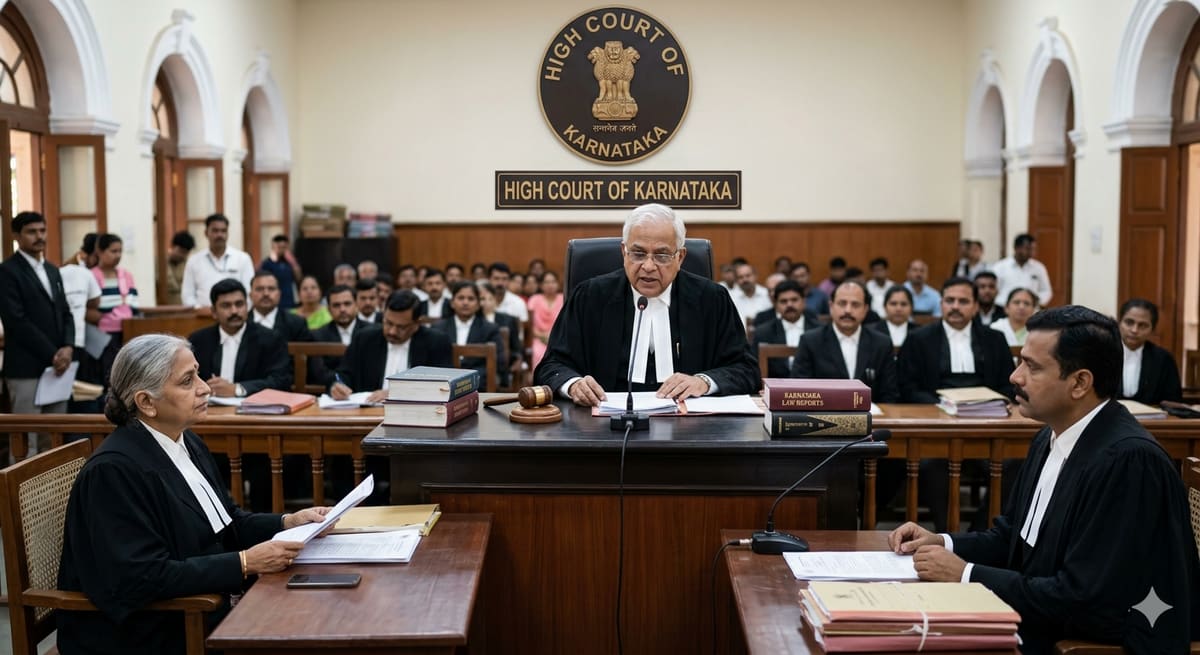
The Karnataka High Court has clarified a critical principle in public employment: reservation policies cannot be mechanically applied to positions that are singular in nature. This judgment resolves a long-standing ambiguity in the implementation of affirmative action at the grassroots level, offering clear guidance to local bodies on the limits of reservation in non-multiple post scenarios.
Background & Facts
The Dispute
The petitioner, Smt. Tara Gouda, challenged the validity of a notification issued by the Bilgi Grama Panchayat for the recruitment of a cleaner. The respondents, the Panchayat Development Officer and the President of the Grama Panchayat, had issued a notification dated 06.03.2019, published in the local newspaper Karavali Munjavu on 07.03.2019, which prescribed reservation categories for the post of cleaner. The petitioner contended that since the post was a single, non-redundant position, the application of reservation was legally impermissible.
Key Facts
The post of cleaner in Bilgi Grama Panchayat is a single, non-repeating position.
A prior notification dated 10.09.2014, which had also attempted to apply reservation to the same post, was subsequently withdrawn.
The impugned notification dated 06.03.2019 was issued after the withdrawal of the 2014 notification.
The notification was published in the local newspaper Karavali Munjavu on 07.03.2019.
No cleaner had been appointed to date due to an interim order restraining recruitment.
The petitioner, a housewife from Aanesalu, Bilgi, sought to be considered for the post without reservation-based categorization.
Procedural History
10.09.2014: First notification issued for cleaner post with reservation categories.
29.09.2020: Respondents filed a memo confirming withdrawal of the 2014 notification.
06.03.2019: Second notification issued, again applying reservation to the single post.
07.03.2019: Notification published in Karavali Munjavu.
2019: Writ Petition No. 111230 of 2019 filed before the High Court of Karnataka, Dharwad Bench.
23.04.2026: Final hearing and disposal of the writ petition.
Relief Sought
The petitioner sought:
Quashing of the notification dated 06.03.2019, published on 07.03.2019, insofar as it applied reservation to the cleaner post.
A writ of mandamus directing the respondents to re-issue the notification strictly in accordance with Government Order Annexure-D, which allegedly did not mandate reservation for single posts.
Any other relief deemed fit by the Court, including costs.
The Legal Issue
The central question was whether reservation under Articles 15 and 16 of the Constitution can be applied to a single post in a Grama Panchayat, where no multiple vacancies exist and no possibility of simultaneous appointment arises.
Arguments Presented
For the Petitioner
The petitioner’s counsel argued that the post of cleaner is a singular, non-redundant position. Applying reservation to such a post violates the principle of equality and creates artificial exclusion. He relied on the settled doctrine that reservation is meant to ensure representation where multiple posts are available, not to fragment a single position into reserved and unreserved slots. He emphasized that the withdrawal of the 2014 notification indicated administrative recognition of this legal infirmity.
For the Respondent
The respondents’ counsel contended that the 2019 notification was issued in compliance with state government directives on reservation in local bodies. He argued that the absence of a specific exemption for single posts in the relevant government orders meant that reservation must be applied uniformly. He further submitted that the interim order had already stalled recruitment, and any change would require a fresh policy direction from higher authorities.
The Court's Analysis
The Court examined the nature of the post and the constitutional framework governing reservation. It noted that reservation is a tool for affirmative action in contexts where multiple positions are filled simultaneously, enabling equitable distribution among groups. When only one post exists, reservation cannot operate meaningfully - it either excludes a candidate from consideration or forces an arbitrary selection from a reserved category, defeating the purpose of merit and equal opportunity.
"Reservation policy is designed to ensure representation in a pool of multiple posts, not to create a quota for a solitary position where no comparative selection is possible."
The Court observed that the withdrawal of the 2014 notification was not a mere procedural step but an implicit acknowledgment of the legal untenability of applying reservation to a single post. The 2019 notification, being a reiteration of the same flawed approach, suffered from the same infirmity.
The Court further held that the respondents’ reliance on general government orders was misplaced, as such orders cannot override the constitutional principle that reservation must be applied rationally and not mechanically. The absence of a clear statutory mandate permitting reservation for single posts rendered the notification ultra vires.
The Verdict
The writ petition was allowed. The Court quashed the notification dated 06.03.2019, published on 07.03.2019, insofar as it applied reservation to the post of cleaner. The respondents are directed to fill the post of cleaner by following the due process of law, without any reservation-based categorization. The Court directed that the selection be conducted on merit, with no discrimination on grounds of caste or category, and ordered compliance within four weeks.
What This Means For Similar Cases
Reservation Cannot Be Applied to Single Posts
Practitioners must challenge any reservation-based recruitment for singular positions in Panchayats, Municipalities, or State Departments.
The principle applies regardless of whether the post is classified as "Group D" or "unskilled labor" - the number of vacancies, not the nature of work, determines applicability.
Government orders mandating blanket reservation must be scrutinized for compliance with this constitutional limit.
Due Process Must Prevail Over Administrative Convenience
Local bodies cannot use reservation as a default mechanism to avoid transparent selection.
Recruitment for single posts must be open to all eligible candidates, with selection based on merit, qualifications, and interview.
Any attempt to reserve a single post invites judicial intervention under Articles 14 and 16.
Administrative Withdrawal Has Legal Significance
When a prior notification is withdrawn on legal grounds, reissuing the same notification without amendment constitutes an abuse of power.
Courts will treat such reissues as bad faith attempts to circumvent judicial or administrative clarity.
Practitioners should cite withdrawal as evidence of the original order’s invalidity in pending litigation.





