The Gujarat High Court has held that mere absence or non-production of a driving licence does not, by itself, constitute contributory negligence in a motor accident claim. Setting aside a Motor Accident Claims Tribunal finding that attributed 50% negligence to the claimant on this ground alone, the Court reassessed compensation at Rs.10,03,045, enhancing the award by Rs.5,81,456 with interest at 9% per annum from the date of the claim application.
Background & Facts
The Accident and Claim
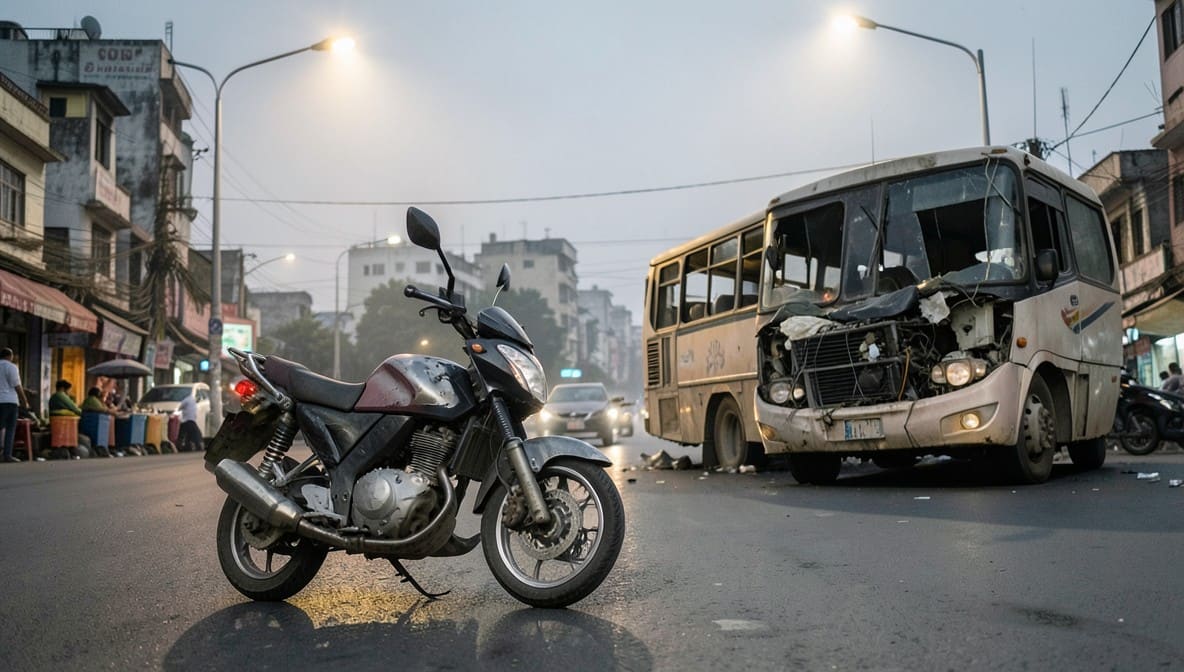
On 12.01.2021, the appellant Manubhai Mahijibhai Thakor, aged 51 years (date of birth 01.01.1970), was proceeding towards the Borsad Taluka Panchayat Office on his motorcycle bearing registration No. GJ-23-J-1083. At about 5:00 p.m., while passing near Kismat Kathiyavadi Hotel on the Borsad-Tarapur Road, a car bearing registration No. GJ-16-CS-9130 driven by respondent No.1 Nirajsinh Pushpasinh Yadav at an excessive speed in a rash and negligent manner dashed against the motorcycle. The appellant sustained fractures of the right hand and ankle, left leg tibia fibula, and injuries on other parts of his body. He was shifted to Shraddha Hospital, Borsad for primary treatment and subsequently referred to Karamsad Hospital where he remained as an indoor patient for 10 days. An operation was performed on his right hand with a rod inserted. The appellant, who was earning Rs.9,000 per month from agricultural and contractor work, claimed that the injuries caused disability adversely affecting his earning capacity.
Key Facts
- Date of accident: 12.01.2021
- Appellant's age at accident: 51 years (DOB 01.01.1970)
- Appellant's claimed monthly income: Rs.9,000/- (agricultural and contractor work)
- Vehicle driven by appellant: Motorcycle GJ-23-J-1083
- Offending vehicle: Hyundai Creta Car GJ-16-CS-9130 driven by respondent No.1
- Injuries: Fracture right hand and ankle, left leg tibia fibula, other bodily injuries
- Hospitalization: Shraddha Hospital (primary), Karamsad Hospital (10 days indoor, surgery with rod insertion)
- FIR registered and charge-sheet filed against respondent No.1
- Disability agreed at 28% of the body as a whole by both parties via pursis at Exh.57
- Claim petition filed seeking Rs.15,00,000/- compensation
Procedural History
- Claim Petition: M.A.C.P. No. 242 of 2021 filed before M.A.C.T. (Aux.) and 4th Additional District Judge, Anand
- Tribunal Award (17.09.2025): Partly allowed claim, assessed income at Rs.8,000/month, attributed 50% contributory negligence to claimant for non-production of driving licence, awarded Rs.4,21,589/- with 9% interest from date of claim petition till realization against respondents jointly and severally
- Present Appeal: First Appeal No. 4300 of 2025 under Section 173 of the Motor Vehicles Act, 1988 filed by original claimant seeking enhancement
- Judgment Date: 03.11.2026
The Parties' Positions
Appellant's contentions: (1) Tribunal erred in attributing 50% negligence solely on non-production of driving licence without cogent reasons; (2) Income assessed on lower side, minimum wages not considered; (3) Entitled to 10% addition for future prospects at age 51; (4) Pain, shock and suffering award of Rs.25,000/- inadequate; (5) Actual loss of income requires recalculation on minimum wages basis.
Respondent No.2 (Insurance Company) contentions: (1) Appeal devoid of merit; (2) Tribunal rightly assessed income at Rs.8,000/month; (3) Claimant not holding driving licence on accident date; (4) Respondent No.1's evidence showed he was driving correctly at moderate speed when motorcycle rider attempted to cross road; (4) Tribunal's findings just and proper.
Relief Sought
Enhancement of compensation awarded by the Tribunal, setting aside the finding of 50% contributory negligence, reassessment of income at minimum wages with future prospects addition, and enhancement of awards under various heads including pain and suffering.
The Legal Issue
The central questions were: (1) Whether mere non-production or absence of a driving licence, without evidence of causal connection to the accident, can sustain a finding of contributory negligence; (2) Whether the Tribunal's income assessment at Rs.8,000/month was sustainable in the absence of cogent evidence of earnings, and whether minimum wages should apply; (3) Whether the claimant aged 51 years was entitled to a 10% addition towards future prospects.
Arguments Presented
For the Appellant
Learned advocate Mr. Nishit A. Bhalodi submitted that the Tribunal's finding of contributory negligence was based solely on the claimant's failure to produce a driving licence, which is contrary to settled law. He relied on Saraswati Palariya and Ors. v. New India Assurance Company Limited and Ors., (2019) ACJ 42, where the Supreme Court held that driving without a valid licence may expose a claimant to other liabilities but no inference of contributory negligence can be drawn on that basis. He further argued that income should be reassessed at the prevailing minimum wage of Rs.9,079/month with 10% future prospects addition per National Insurance Company Limited v. Pranay Sethi, (2017) 16 SCC 680, and that awards for pain, shock and suffering, actual loss of income, and special diet/attendant charges required enhancement.
For the Respondent
Learned advocate Mr. H.G. Mazmudar for respondent No.2 (Insurance Company) contended that the Tribunal correctly assessed income at Rs.8,000/month and properly considered the claimant's lack of a driving licence. He relied on respondent No.1's examination-in-chief (Exh.62) stating he was driving on the correct side at moderate speed when the motorcycle rider attempted to cross the road, and that nothing fruitful emerged from cross-examination. He submitted the Tribunal's findings were just and proper and required no interference.
The Court's Analysis
The Court first addressed the contributory negligence finding. It observed that the Tribunal, in paragraph 12 of its judgment, attributed 50% negligence to the claimant solely on the ground that he had not produced a copy of his driving licence, drawing an adverse inference that he was not holding one. The Court held that contributory negligence requires proof of negligence or conduct that materially contributed to the accident. The relevant test is whether, by exercising reasonable care, the victim could have avoided the consequences of the negligence that caused the accident. Mere violation of law by the victim does not, by itself, constitute contributory negligence; there must be a causal connection between such violation and the occurrence of the accident or the impact of the injury. The burden of establishing contributory negligence lies upon the party alleging it.
"Mere absence, invalidity or non-production of a driving licence, by itself, does not constitute contributory negligence."
The Court noted it was an admitted position that an FIR and charge-sheet were filed against respondent No.1, who had not filed a written statement but only his examination-in-chief. The panchnama (Exh.33) produced by the claimant did not support any contribution by the claimant to the accident. Relying on Saraswati Palariya, the Court held that driving without a valid licence may expose the claimant to other liabilities but no inference of contributory negligence can be drawn on that basis alone. In the absence of any other independent evidence, and considering the FIR and charge-sheet against respondent No.1, the Tribunal's finding of 50% contributory negligence was unsupported by evidence and was set aside. Respondent No.1 was held 100% negligent.
On income assessment, the Court found no cogent evidence of the claimant's agricultural or other earnings. The Tribunal had assessed income at Rs.8,000/month considering minimum wages. The minimum wage prevailing at the time of the accident (12.01.2021) was Rs.9,079/- per month. Accordingly, the Court reassessed income at Rs.9,079/month. Applying National Insurance Company Limited v. Pranay Sethi, a 10% addition towards future prospects was warranted for a 51-year-old claimant, bringing the monthly income to Rs.9,987/-.
For disability, both parties had agreed at 28% (pursis Exh.57). Using the multiplier of 11 for age 51 per Sarla Varma's case, future loss of income was calculated at Rs.9,987 x 28% x 12 x 11 = Rs.3,69,072/-. Medical expenses (Rs.4,89,499/-) were retained. Pain, shock and suffering enhanced from Rs.25,000/- to Rs.75,000/-. Actual loss of income for three months enhanced from Rs.24,000/- to Rs.54,474/- (based on reassessed income). Special diet, transportation and attendant charges enhanced from Rs.9,000/- to Rs.15,000/-. Total compensation reassessed at Rs.10,03,045/- (vs Tribunal's Rs.8,43,179/- before 50% deduction). After removing the 50% contributory negligence deduction, net compensation stood at Rs.10,03,045/-, yielding an enhanced amount of Rs.5,81,456/- over the Tribunal's award of Rs.4,21,589/-.
The Verdict
The appeal was partly allowed. The judgment and award dated 17.09.2025 passed by the M.A.C.T. (Aux.) and 4th Additional District Judge, Anand in M.A.C.P. No. 242 of 2021 was modified. The finding of 50% contributory negligence was set aside; respondent No.1 held 100% negligent. Compensation reassessed at Rs.10,03,045/- with interest at 9% per annum from the date of the claim application till realization. The enhanced amount of Rs.5,81,456/- along with interest as awarded by the Tribunal shall be deposited by the respondent Insurance Company before the Tribunal within four weeks from receipt of the order. The total amount lying with the Tribunal, including enhanced amount and accrued interest, shall be disbursed to the claimant by Account Payee Cheque/NEFT/RTGS after verification. The Tribunal directed to recover deficit court fees, if any, on the enhanced amount before disbursal.
What This Means For Similar Cases
Absence Of Driving Licence Is Not Contributory Negligence
The judgment reinforces the principle established in Saraswati Palariya that mere non-production or absence of a driving licence cannot sustain a finding of contributory negligence. Practitioners must ensure that tribunals do not mechanically attribute negligence on this ground without evidence of a causal link between the licence violation and the accident. The burden remains on the party alleging contributory negligence to prove both negligence and causation. Where an FIR and charge-sheet exist against the offending driver, and no independent evidence suggests the claimant's conduct contributed to the collision, courts will set aside such findings.
Minimum Wages As Floor For Income Assessment
Where a claimant's earnings are not substantiated by cogent evidence, minimum wages prevailing at the time of the accident constitute the appropriate baseline for income assessment. The Court applied the minimum wage of Rs.9,079/month (prevailing on 12.01.2021) rather than the Tribunal's lower assessment of Rs.8,000/month. This provides a clear benchmark for practitioners: in the absence of documentary proof of higher earnings, the statutory minimum wage is the floor, not a discretionary lower figure.
Future Prospects Addition For Claimants Up To 55 Years
Following Pranay Sethi, the Court confirmed that claimants aged 51 years are entitled to a 10% addition towards future prospects. The age threshold for this addition extends to claimants below 55 years. Practitioners should routinely claim this addition for clients in this age bracket, as it materially impacts the multiplier calculation for future loss of income.
Quantified Enhancement Heads For Reference
- Pain, shock and suffering: Enhanced from Rs.25,000 to Rs.75,000 for fractures requiring surgery and 10-day hospitalization
- Actual loss of income (3 months): Recalculated on reassessed income (Rs.54,474 vs Rs.24,000)
- Special diet/attendant/transport: Enhanced from Rs.9,000 to Rs.15,000
- Interest: 9% per annum from date of claim application (not award date)
- Compliance deadline: 4 weeks for deposit of enhanced amount