The Bombay High Court has affirmed that the absence of a railway ticket does not disqualify a deceased from being a bonafide passenger under the Railways Act, 1989, and that accidental falling from a running train constitutes an untoward incident attracting strict liability. This ruling reinforces the welfare-oriented interpretation of railway compensation law and clarifies the burden of proof in such claims.
Background & Facts
The Dispute
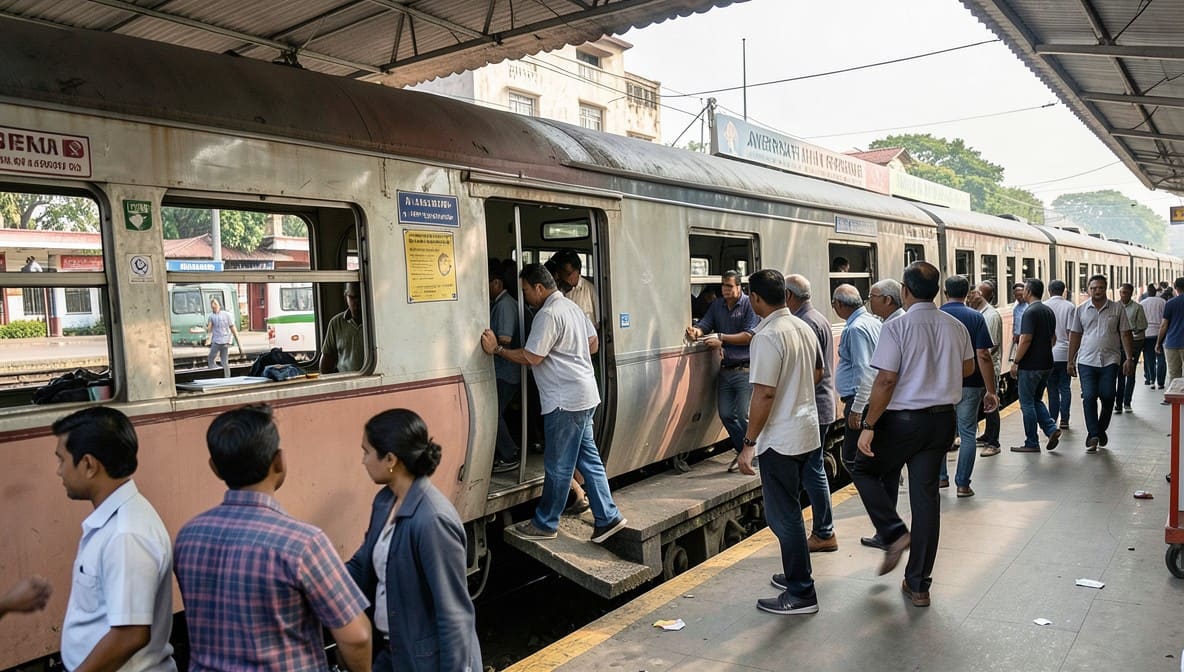
The appellants, Smt. Satyabhama Bhaskar Patil and her son Amol Bhaskar Patil, filed a claim before the Railway Claims Tribunal seeking compensation for the death of Mr. Bhaskar Balu Patil, their husband and father, who died on 13.06.2013 after falling from a local train between Airoli and Rabale Railway Stations in Thane district, Maharashtra. The deceased was travelling in a second-class compartment with a return ticket, which was lost during the incident. The Railway contested the claim, arguing that the deceased was not a bonafide passenger and that the incident did not qualify as an untoward incident under Section 123(c)(2) of the Railways Act, 1989.
Key Facts
- The deceased, Mr. Bhaskar Balu Patil, boarded a local train from Thane to Rabale on 13.06.2013 with a valid second-class return ticket.
- Appellant No. 2, his son, de-boarded at Airoli Station; the deceased continued the journey and fell from the train near Rabale Station.
- No ticket was recovered from the deceased’s person during post-mortem or investigation.
- The Inquest Panchnama dated 13.06.2013 recorded that the deceased was found lying near the railway track with grievous injuries, and the Station Master’s memo suggested he may have been crossing the tracks.
- No motorman, guard, or railway employee reported seeing the deceased fall or being struck by the train.
- The Railway did not produce any eyewitnesses or expert testimony to establish that the deceased was trespassing or attempting suicide.
- The appellants submitted an affidavit from Appellant No. 2 affirming the deceased’s possession of a valid ticket and his status as a bonafide passenger.
- The death certificate, ration card, and PAN card were submitted to establish the appellants’ relationship as spouse and son.
Procedural History
- 13.06.2013: Incident occurred - deceased fell from train between Airoli and Rabale stations.
- 15.06.2013: Inquest Panchnama prepared by police.
- 20.06.2013: Station Master’s memo submitted to Railway authorities.
- 12.07.2013: Claim Application No. OA (II u)/MCC/2013/1214 filed before Railway Claims Tribunal, Mumbai.
- 18.08.2021: Tribunal dismissed the claim, holding that the deceased was not a bonafide passenger and the incident was not an untoward incident.
- 22.09.2021: Notice of appeal filed before the Bombay High Court.
- 06.05.2026: Appeal heard and reserved.
- 09.06.2026: Judgment pronounced by Justice Rajesh S. Patil.
Relief Sought
The appellants sought compensation of Rs. 8,00,000 under the amended Railway Accidents and Untoward Incidents (Compensation) Rules, 1990, with interest from the date of accident, and costs.
The Legal Issue
The central questions were: (1) Whether the absence of a ticket negates the status of a bonafide passenger under Section 124-A of the Railways Act, 1989? (2) Whether accidental falling from a running train qualifies as an ‘untoward incident’ under Section 123(c)(2)? (3) Whether interest is payable from the date of accident, and at what rate?
Arguments Presented
For the Appellant
The appellants relied on Union of India v. Rina Devi (2019) 3 SCC 572, arguing that mere absence of a ticket does not disqualify a claimant from being a bonafide passenger. They submitted that the affidavit of Appellant No. 2, corroborated by the lack of any railway employee testimony, discharged the initial burden. They further contended that falling from a train, even if due to negligence, constitutes an untoward incident under Section 123(c)(2), as held in Union of India v. Prabhakaran Vijaya Kumar (2008 ACJ 1895). They emphasized that the Railways Act is a beneficial statute requiring liberal interpretation and that negligence cannot be equated with criminal intent under the proviso to Section 124-A, as clarified in Jameela & Ors. v. Union of India (AIR 2010 SC 3705).
For the Respondent
The Railway contended that the deceased could not be a bonafide passenger because no ticket was recovered, and the Inquest Panchnama suggested he was crossing the tracks, which would constitute trespassing. They argued that the nature of the injuries - the body being cut into two pieces - indicated the deceased was run over by the train while trespassing, not falling from it. They relied on the Tribunal’s observation that such injuries were inconsistent with a fall from a train and invoked the proviso to Section 124-A, alleging self-inflicted injury or criminal act.
The Court's Analysis
The Court undertook a detailed review of statutory provisions and binding precedents. It held that Section 124-A imposes strict liability on the Railway for untoward incidents, irrespective of fault, and that the definition of ‘passenger’ under Section 124-A includes any person who has purchased a valid ticket, even if not in possession at the time of incident.
"Mere absence of ticket with such injured or deceased will not negative the claim that he was a bona fide passenger. Initial burden will be on the claimant which can be discharged by filing an affidavit of the relevant facts and burden will then shift on the Railways..."
The Court emphasized that the Supreme Court in Rina Devi had explicitly rejected the notion that absence of a ticket is conclusive evidence of non-passenger status. The affidavit of Appellant No. 2, uncontroverted by any railway witness, was sufficient to discharge the initial burden. The Railway failed to produce any motorman, guard, or expert to prove the deceased was trespassing or committing a criminal act.
Regarding the untoward incident, the Court held that Section 123(c)(2) explicitly includes "the accidental falling of any passenger from a train carrying passengers." The Court rejected the Tribunal’s speculative inference that the nature of injuries (body cut into two pieces) could not result from a fall, citing Vidya wd/o Dyaneshwar Wankhede and Sadashiv Kotiyan, which held that such injuries are not uncommon when a person becomes entangled in train wheels or railway equipment after falling. The Court observed:
"It is not unknown that a body may badly cut up and crush up after falling from the train either on account of bonafide passenger getting entangled in the place of the train and thereafter in the wheels..."
The Court further held that negligence, even recklessness, does not equate to a criminal act under the proviso to Section 124-A, which requires malicious intent or mens rea. The Railway’s failure to prove suicide, self-inflicted injury, or criminal act rendered the proviso inapplicable.
On interest, the Court applied Rina Devi and held that interest at 9% per annum from the date of accident (13.06.2013) is just and reasonable, in line with Motor Vehicles Act jurisprudence. The compensation under the 1990 Rules as amended in 2016 was Rs. 8,00,000, but the interest on the original Rs. 4,00,000 over eight years amounted to Rs. 4,68,000, making the total Rs. 8,68,000 - the higher amount, which must be awarded under the principle of beneficial legislation.
The Verdict
The First Appeal was allowed. The Tribunal’s order dated 18.08.2021 was set aside. The appellants were awarded compensation of Rs. 8,68,000, to be equally divided between the wife and son. The Railway was directed to deposit the amount in the appellants’ bank accounts within eight weeks of furnishing bank details. If unpaid within that period, the amount shall carry further interest at 9% per annum until payment.
What This Means For Similar Cases
Absence of Ticket Is Not Fatal to a Claim
- Practitioners must file affidavits from family members affirming purchase of ticket - this discharges the initial burden under Rina Devi.
- Railway must rebut with concrete evidence (witnesses, CCTV, guard reports); mere absence of ticket is insufficient.
- In all untoward incident claims, the burden shifts to the Railway to prove exclusion under the proviso to Section 124-A.
Falling from Train Is Unambiguously an Untoward Incident
- Any accidental fall from a running train - whether during boarding, alighting, or while seated - qualifies under Section 123(c)(2).
- Injuries such as dismemberment or crushing do not negate the claim; expert testimony is required to prove alternative causes.
- Tribunals must avoid speculative reasoning based on injury severity without forensic or railway expert evidence.
Interest Must Be Calculated from Date of Accident, Not Award
- Interest at 9% p.a. from the date of incident is mandatory under Rina Devi.
- Where compensation has been revised post-accident, the higher of (a) revised amount or (b) original amount plus interest must be awarded.
- Practitioners must calculate total compensation as: original rate + compounded interest + revised rate, and claim the maximum.
Burden of Proof for Proviso to Section 124-A Is on Railway
- To invoke suicide, self-inflicted injury, or criminal act, the Railway must prove intent - negligence is irrelevant.
- No presumption of guilt arises from injury pattern or lack of ticket.
- Failure to examine motormen or guards renders the Railway’s case untenable.