The Andhra Pradesh High Court has established a balanced procedural safeguard for vehicle owners facing seizure over tax and permit violations, directing release upon partial payment of dues pending inquiry. This ruling reinforces proportionality in enforcement and affirms that punitive detention must yield to due process under Article 21.
Background & Facts
The Dispute
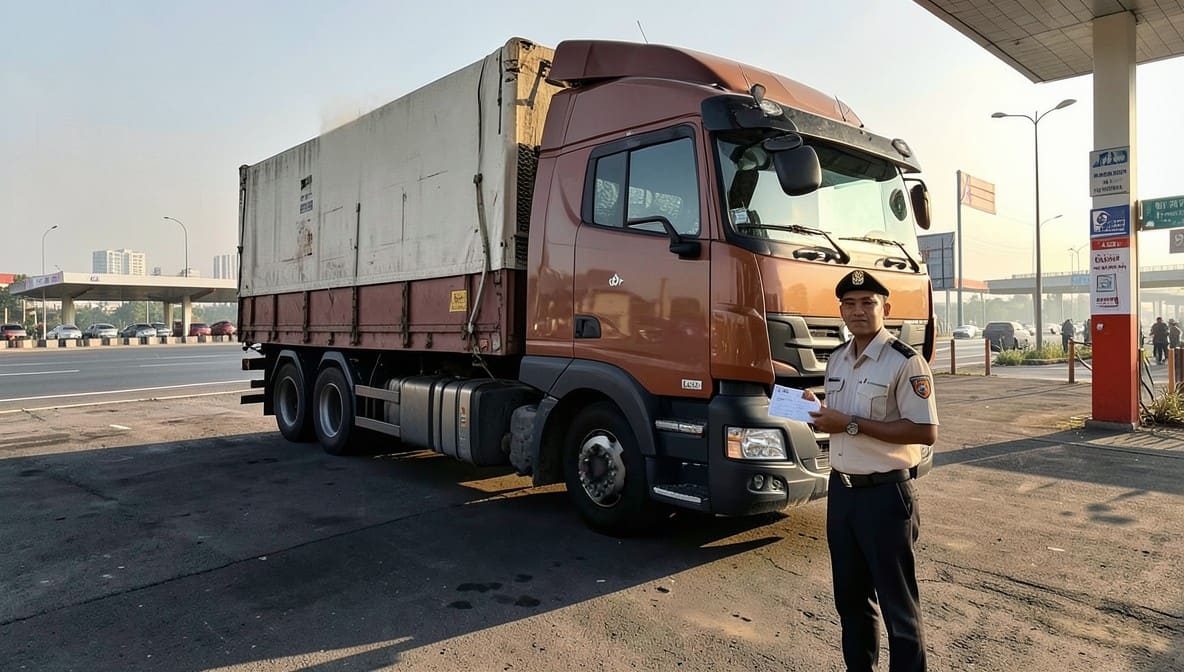
The petitioner, J. Prakash, owner of a motor vehicle bearing registration No. DD 01 R 9855, was alleged to have been operating the vehicle without a valid permit and without payment of road tax. On 09.02.2026, the Fourth Respondent, the Motor Vehicles Inspector, Narasaraopet, seized the vehicle under the online challan dated 09.02.2026, Challan No. AP258773260209194247. The challan demanded payment of outstanding tax, penalty, and compounding fees for the release of the vehicle.
Key Facts
- The petitioner’s vehicle was seized on 09.02.2026 without prior notice or opportunity of hearing
- The challan did not specify the period of tax arrears or the basis for penalty calculation
- No formal show-cause notice or adjudication order preceded the seizure
- The petitioner contended that the vehicle was being used for legitimate business purposes and that the seizure was disproportionate
- The petitioner had no prior history of repeated violations
Procedural History
- 09.02.2026: Vehicle seized by Motor Vehicles Inspector, Narasaraopet
- 15.02.2026: Petitioner filed representation seeking release of vehicle, which remained unacknowledged
- 28.02.2026: Legal notice sent to the Transport Department, no response received
- 01.03.2026: Writ Petition No. 8701/2026 filed before the Andhra Pradesh High Court
- 02.04.2026: Hearing conducted before the Hon’ble Justice Venkateswarlu Nimmagadda
Relief Sought
The petitioner sought:
- A writ of mandamus declaring the seizure illegal and violative of Articles 14, 19(1)(g), and 21 of the Constitution
- Immediate release of the vehicle
- Direction to the respondents to refrain from imposing arbitrary compounding fees
- Costs of litigation
The Legal Issue
The central question was whether the authorities may lawfully seize a vehicle for non-payment of tax and lack of permit without affording the owner an opportunity of hearing, and whether the condition of paying 50% of the tax and compounding fees as a precondition for release is legally sustainable under principles of natural justice and proportionality.
Arguments Presented
For the Petitioner
The petitioner’s counsel argued that the seizure was arbitrary and violated the principles of natural justice under Article 14 and 21. He relied on the doctrine of proportionality, asserting that complete detention of a vehicle for a tax default, without adjudication, amounted to excessive state action. He cited Saleem Tours and Travels v. Joint Transport Commissioner to argue that interim release on partial payment is a recognized equitable remedy. He further contended that the absence of a show-cause notice rendered the seizure procedurally invalid.
For the Respondent
The Government Pleader conceded that the vehicle was seized due to non-payment of tax and absence of permit, but argued that the seizure was statutorily authorized under the Motor Vehicles Act, 1988. He maintained that the state had a legitimate interest in ensuring revenue collection and that the petitioner had ample opportunity to regularize the status. However, he did not dispute the petitioner’s claim of lack of notice or hearing.
The Court's Analysis
The Court acknowledged that while the state has the power to seize vehicles for non-compliance with tax and permit provisions under the Motor Vehicles Act, such power must be exercised in a manner consistent with constitutional guarantees. The Court emphasized that seizure without notice or opportunity of hearing violates the foundational principle of audi alteram partem.
"The power of seizure cannot be exercised as a tool of coercion without affording the owner a fair opportunity to explain his position. Complete detention of a vehicle pending adjudication, without any interim relief, is disproportionate and violates Article 21."
The Court referred to its own Division Bench judgment in Saleem Tours and Travels v. Joint Transport Commissioner, which had previously held that partial payment of tax and compounding fees, coupled with an undertaking, is a reasonable condition for interim release. The Court found that the petitioner’s conduct did not indicate wilful evasion, and that the vehicle was being used for lawful business. The Court held that requiring payment of 50% of the tax and compounding fees strikes a fair balance between the state’s revenue interest and the petitioner’s right to livelihood under Article 19(1)(g).
The Court further noted that the condition of submitting an undertaking to produce the vehicle for enquiry and not alienate it safeguards the state’s interest in the adjudicatory process. The absence of costs was justified as the matter was resolved on equitable grounds without adversarial acrimony.
The Verdict
The writ petition was disposed of with directions. The respondents were directed to release the vehicle bearing registration No. DD 01 R 9855, seized on 09.02.2026, upon the petitioner paying 50% of the tax and compounding fees as of 02.04.2026, and producing a demand draft or payment receipt. The petitioner was required to submit a written undertaking that the vehicle would be produced for enquiry and not alienated pending final adjudication. There shall be no order as to costs.
What This Means For Similar Cases
Partial Payment Enables Interim Release
- Practitioners may now invoke this precedent to seek release of seized vehicles in cases of tax or permit defaults, provided the owner agrees to pay 50% of the assessed dues
- The undertaking requirement is now a standard condition - drafting it with clear terms on production and non-alienation is essential
Seizure Without Notice Is Procedurally Defective
- Any seizure conducted without a prior show-cause notice or opportunity to be heard is vulnerable to challenge under Article 14 and 21
- Courts will treat such seizures as prima facie arbitrary unless justified by exigent circumstances
Proportionality Over Rigidity in Enforcement
- Revenue collection cannot justify complete deprivation of property without due process
- Authorities must consider the nature of default, history of compliance, and economic impact before resorting to seizure
- This judgment reinforces that enforcement must be calibrated, not coercive