The Madhya Pradesh High Court has clarified that administrative authorities cannot proceed with public land allotment without duly considering objections raised by affected parties, even where the land is classified as government property. The judgment underscores the procedural obligation to apply mind to submissions before final orders are passed, reinforcing the principles of natural justice in land administration.
Background & Facts
The Dispute
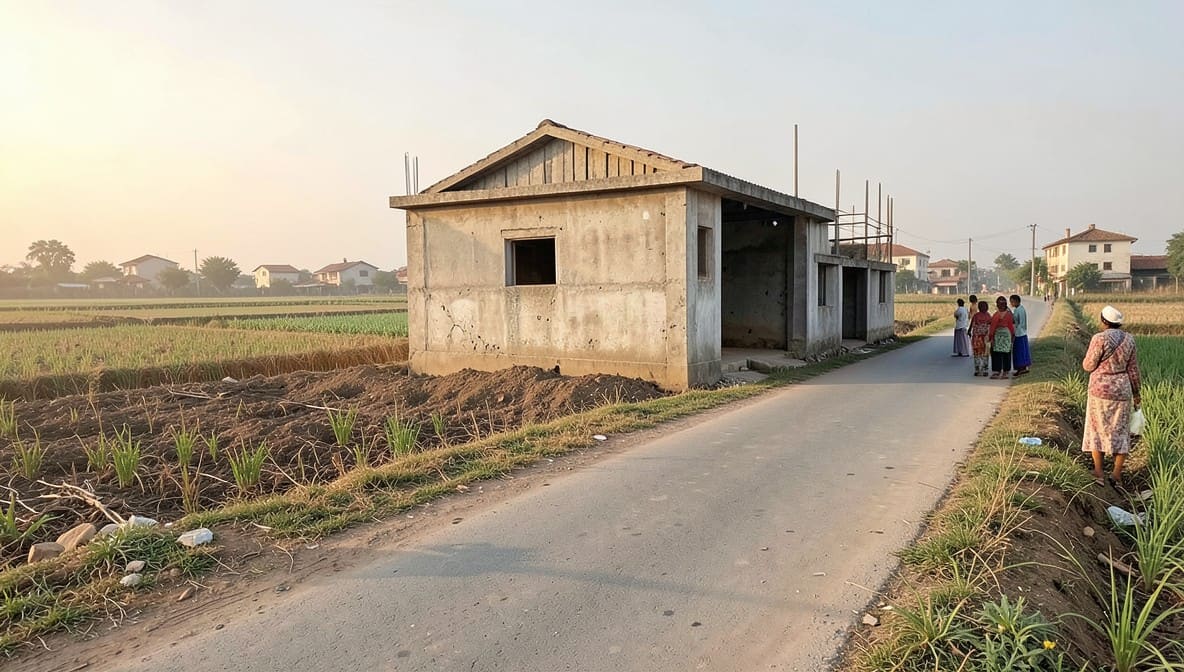
The dispute centers on the proposed construction of a Panchayat Bhavan for Gram Panchayat Todi on land bearing Survey No. 53, Village Todi, District Guna. The petitioners, Ramesh Chand Ahirwar and others, claim exclusive possession and livelihood dependence on this land for over three decades. The Gram Panchayat, however, sought to construct the Panchayat Bhavan on Survey No. 53 after earlier funds sanctioned for construction on Survey No. 99(B) - the site of the old Panchayat Bhavan - were misused, leading to its collapse.
Key Facts
- The old Panchayat Bhavan was located on Survey No. 99(B), admeasuring 2.120 hectares, and had been in use for 30 years.
- Construction funds were sanctioned under MGNREGA on 25.06.2014 but were not utilized; a false report was submitted by the then Sarpanch and Secretary.
- On 14.04.2025, the Gram Panchayat passed a resolution to reconstruct the Panchayat Bhavan on the same land (Survey No. 99(B)).
- Despite this, respondents 5 and 6 (local officials) initiated proceedings to allocate a portion of Survey No. 53 (total area 0.544 hectares) for construction.
- A public notice inviting objections was issued by the Tehsildar, Ramdi, Tehsil Chanchoda.
- The petitioners submitted objections within the stipulated time.
- An affidavit dated 09.06.2025 was submitted by the Sarpanch and Secretary affirming that the proposed land was free from dispute.
- The petitioners have been in continuous, exclusive possession of Survey No. 53 and depend on it for livelihood.
- Eviction proceedings were initiated against the petitioners in Tehsildar Case No. 0097/A-68/2025-26, resulting in an eviction order and a fine of Rs. 20,000.
- A civil suit for declaration and injunction was filed by the petitioners before the Court of Civil Judge, Chanchoda, challenging the allotment order dated 05.02.2026; no interim stay was granted.
- Administrative sanction Order No. Panchayat Raj/Nirman/56/2025/952, Bhopal dated 30.05.2025, mandates that land proposed for Panchayat Bhavan construction must be free from dispute.
Procedural History
- 25.06.2014: MGNREGA funds sanctioned for construction on Survey No. 99(B)
- 14.04.2025: Gram Panchayat resolution to reconstruct Panchayat Bhavan on Survey No. 99(B)
- 09.06.2025: Affidavit submitted by Sarpanch and Secretary affirming no dispute over Survey No. 53
- [Date unspecified]: Tehsildar issued public notice inviting objections to allotment of Survey No. 53
- [Date unspecified]: Petitioners submitted objections
- 04.02.2026: Tehsildar submitted memorandum of enquiry, including witness statements and spot inspection report
- 05.02.2026: Collector passed order allotting 0.045 hectares of Survey No. 53 for Panchayat Bhavan, without deciding petitioners’ objections
- 12.01.2026: High Court directed Collector to consider petitioners’ representation in accordance with law
- 15.01.2026: Petitioners submitted fresh representation with certified copy of High Court order
- 18.02.2026: Collector passed impugned order rejecting petitioners’ objections without reference to the enquiry report
- [Date unspecified]: Civil suit filed before Civil Judge, Chanchoda, challenging the 05.02.2026 order (pending)
- 21.02.2026: Order-sheet reveals enquiry report was forwarded to Collector only after the 18.02.2026 order was passed
- 30.04.2026: Writ petition decided by High Court
Relief Sought
The petitioners sought:
- Quashing of the impugned order dated 18.02.2026
- Direction to the Collector to reconsider their representation in light of the enquiry report
- Stay on construction of the Panchayat Bhavan on Survey No. 53 until disposal of their representation
- Any other suitable relief
The Legal Issue
The central question was whether an administrative authority may pass an order allotting government land for a public project without considering objections duly submitted by affected parties, and whether the pendency of a civil suit without interim relief operates as a legal bar to such allotment.
Arguments Presented
For the Petitioner
The petitioners contended that the Collector’s order dated 18.02.2026 was passed without considering the enquiry report submitted by the Tehsildar and the findings of the Joint Collector, violating principles of natural justice. They emphasized that the land was under dispute, as evidenced by their pending civil suit and their long-standing possession. They relied on the administrative directive dated 30.05.2025, which explicitly required land to be free from dispute before allotment. They argued that the Collector’s order was procedurally flawed and arbitrary, especially since the High Court had already directed consideration of their representation.
For the Respondent/State
The State contended that the land in question was government land, and the petitioners were in unauthorized occupation, having already been evicted and fined in Tehsildar Case No. 0097/A-68/2025-26. The Collector had considered all relevant materials - including the Tehsildar’s report, Patwari’s record, spot inspection, and Panchanama - before passing the order. The State argued that mere pendency of a civil suit, without any interim injunction, does not create a legal impediment to state action. The affidavit submitted by the Sarpanch and Secretary was not false, as the portion allotted (0.045 hectares) was adjacent to a paved road and clearly part of government land.
The Court's Analysis
The Court undertook a detailed review of the record and found that the Collector’s order dated 18.02.2026 was not passed in vacuum. The judgment explicitly states: "The order itself reflects that the authority examined the documents submitted along with the objections, the statements of both parties, cross-examination records, the report of the Patwari, the spot inspection, the Panchanama, as well as the report submitted by the Tehsildar."
"The In-charge Officer of the Nazul Branch, i.e. the Joint Collector, arrived at a categorical finding that out of total land admeasuring 0.544 hectares comprised in Survey No. 53, an area of 0.045 hectares proposed for construction is situated adjacent to a paved road and forms part of government land."
The Court rejected the petitioners’ claim that the enquiry report was not considered, noting that the order-sheet dated 21.02.2026, which showed the report’s forwarding, was generated after the impugned order. This did not prove non-consideration; rather, it indicated procedural sequencing. The Court held that the Collector had applied his mind and relied on documented evidence, including the eviction order and fine imposed on the petitioners.
The Court further clarified that the pendency of a civil suit, absent any interim stay, does not create a legal bar to administrative action. The Court observed: "Mere pendency of a civil suit, in absence of any interim order, does not create a legal bar on the State authorities from proceeding in accordance with law, particularly when the land in question has been found to be government land."
The Court emphasized the limited scope of writ jurisdiction under Article 226: "This Court does not sit as an appellate authority over administrative decisions unless the same are shown to be arbitrary, perverse, or in violation of statutory provisions."
No such perversity or illegality was established. The Court found the Collector’s decision rational, grounded in evidence, and consistent with the administrative directive.
The Verdict
The writ petition was dismissed. The impugned order dated 18.02.2026 was upheld. The Court held that the Collector had duly considered the objections and acted within his authority. No monetary relief, stay, or direction for reconsideration was granted. The petitioners were, however, expressly permitted to avail any other legal remedies available to them under law.
What This Means For Similar Cases
Administrative Decisions Must Be Reasoned, Not Mechanical
- Practitioners must ensure that administrative orders explicitly reference the materials considered, even if not attached as annexures
- A mere assertion that "objections were considered" is insufficient; the order must demonstrate engagement with the substance of objections
- In land allotment cases, authorities must record findings on possession, title, and dispute status to withstand judicial scrutiny
Pendency of Civil Suit ≠ Automatic Stay on State Action
- Government agencies may proceed with public projects on disputed land if the dispute is unadjudicated and no interim order exists
- Petitioners seeking to halt state construction must obtain an interim injunction from civil courts, not rely on the mere filing of a suit
- This reinforces the principle that civil remedies and administrative actions operate independently unless restrained by court order
Land Disputes Require Proactive Legal Strategy
- Individuals in unauthorized possession of government land must challenge eviction orders promptly before appellate forums
- Delay in challenging eviction or failure to seek interim relief weakens subsequent objections to land allotment
- Documentation of possession and livelihood dependence must be submitted at the earliest administrative stage to be effective