The Allahabad High Court has affirmed that procedural fairness and good faith conduct must prevail over rigid enforcement of contractual terms when a petitioner demonstrates willingness to comply and a statutory settlement scheme is available. This judgment reinforces the principle that administrative authorities must provide meaningful opportunities for remediation, particularly where economic hardship and public policy intersect.
Background & Facts
The Dispute
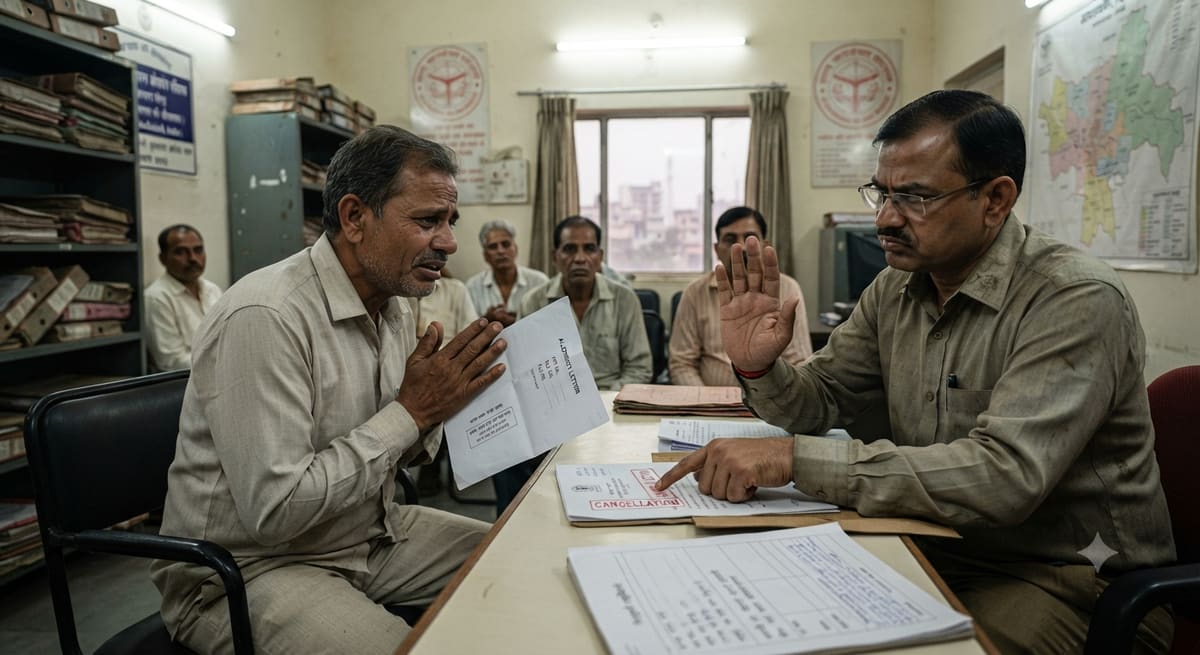
The petitioner, Brahmdev Yadav, was allotted Flat No.304, Block 03, Vasundhara Enclave Phase-I by the Gorakhpur Development Authority (GDA) pursuant to a public housing scheme published in local newspapers. The total cost of the flat was Rs.26,09,000. The petitioner deposited Rs.21,09,215 by 26.05.2025, leaving an outstanding balance of Rs.5,00,000. Despite this, GDA issued an impugned order dated 26/27.09.2025 cancelling the allotment on the false ground that the petitioner owed Rs.33,27,093 - an amount more than the total cost of the flat.
Key Facts
- The GDA published the "Vasundhara Enclave Phase-I" scheme in local newspapers
- Petitioner paid registration fee of Rs.1,30,450 on 25.02.2015
- Allotment was confirmed via lottery on 03.03.2015 and formal letter dated 26.03.2015
- Total flat cost: Rs.26,09,000
- Amount paid by 26.05.2025: Rs.21,09,215
- Outstanding balance claimed by GDA: Rs.5,00,000 (actual); Rs.33,27,093 (erroneous in impugned order)
- Petitioner offered to clear the correct outstanding amount upon receipt of a verified calculation chart
Procedural History
- 26.03.2015: Allotment letter issued for Flat No.304, Block 03
- 26.05.2025: Last payment of Rs.21,09,215 made
- 26/27.09.2025: GDA issued order cancelling allotment based on inflated dues
- 28.10.2025: Division Bench of Allahabad HC granted interim relief
- Accepted petitioner’s offer to deposit Rs.8,00,000 within two weeks
- Directed no coercive action pending hearing
- Connected case with Writ C No.36536 of 2025
- 10.11.2025: Case listed for final hearing
- 18.04.2026: State Government launched One Time Settlement Scheme (OTS Scheme, 2026)
- 17.07.2026: Last date for applications under OTS Scheme, 2026
- 15.05.2026: Final hearing before Division Bench
Relief Sought
The petitioner sought:
- Quashing of the impugned order dated 26/27.09.2025
- Direction to GDA not to charge penalty interest
- Restoration of flat allotment
- Costs of the petition
The Legal Issue
The central question was whether an administrative authority may cancel a housing allotment on the basis of a demonstrably erroneous calculation of dues, when the petitioner has demonstrated good faith, paid a substantial portion of the amount, and a statutory settlement scheme offering relief is in force.
Arguments Presented
For the Petitioner
Learned Senior Counsel Umesh Vats submitted that the GDA’s calculation of outstanding dues was grossly inflated and factually incorrect. He emphasized that the petitioner had already deposited Rs.8,00,000 pursuant to the interim order, demonstrating bona fides. He further argued that the State Government’s OTS Scheme, 2026, explicitly aimed at providing relief to defaulting allottees, particularly those from economically weaker sections, and that the petitioner qualified for such relief. He contended that cancellation without opportunity to regularize under the OTS Scheme violated principles of natural justice and proportionality.
For the Respondent
Shri Narendra Pratap Singh, counsel for GDA, initially opposed the relief on grounds of breach of terms. However, he fairly conceded that since the petitioner had complied with the interim order by depositing Rs.8,00,000 and the GDA had itself adopted the OTS Scheme, 2026, there was no objection to allowing the petitioner to apply under the scheme. He acknowledged the petitioner’s conduct as cooperative and the scheme’s intent as remedial.
The Court's Analysis
The Court observed that the impugned order cancelling the allotment was based on a mathematically absurd claim of Rs.33,27,093 - exceeding the total cost of the flat by over Rs.7,00,000. This error, the Court noted, was not merely clerical but indicative of arbitrary administrative action. The Court emphasized that the petitioner had not acted in bad faith; he had paid over 80% of the cost and had consistently expressed willingness to clear the correct balance.
"The petitioner has demonstrated bona fides by depositing Rs.8,00,000 pursuant to this Court’s interim order, and the State has itself created a remedial mechanism through the OTS Scheme, 2026, which is designed precisely for cases such as this."
The Court further held that the existence of a statutory settlement scheme, adopted by the very authority that issued the impugned order, created a legitimate expectation of relief. Denying access to such a scheme, especially after partial compliance and without opportunity to regularize, would amount to punitive action disproportionate to the default. The Court rejected the notion that arbitration clauses could bar writ jurisdiction where administrative illegality and public policy are involved.
The Verdict
The writ petition was allowed. The impugned order dated 26/27.09.2025 was set aside. The petitioner was granted one week to avail the benefit of the OTS Scheme, 2026, by depositing the amount as quantified by the Secretary, GDA. The Rs.8,00,000 deposited under the interim order shall be adjusted against the OTS payment. In case of default, GDA may proceed in accordance with law. The writ petition stands disposed of.
What This Means For Similar Cases
Settlement Schemes Override Rigid Enforcement
- Practitioners must now argue that statutory settlement schemes create a legitimate expectation of relief, even where contractual defaults exist
- Authorities cannot cancel allotments or contracts while a remedial scheme is active unless the applicant is clearly ineligible or in bad faith
Partial Compliance + Good Faith = Right to Remediation
- Depositing a substantial portion of dues (even if not the full amount) and expressing willingness to pay can establish good faith
- Courts will not permit cancellation based on erroneous or inflated dues when the petitioner has acted cooperatively
Writ Jurisdiction Applies Despite Arbitration Clauses
- Arbitration clauses do not oust writ jurisdiction where administrative action is arbitrary, mala fide, or violates public policy
- Courts retain power to intervene when statutory schemes are in place to protect vulnerable beneficiaries