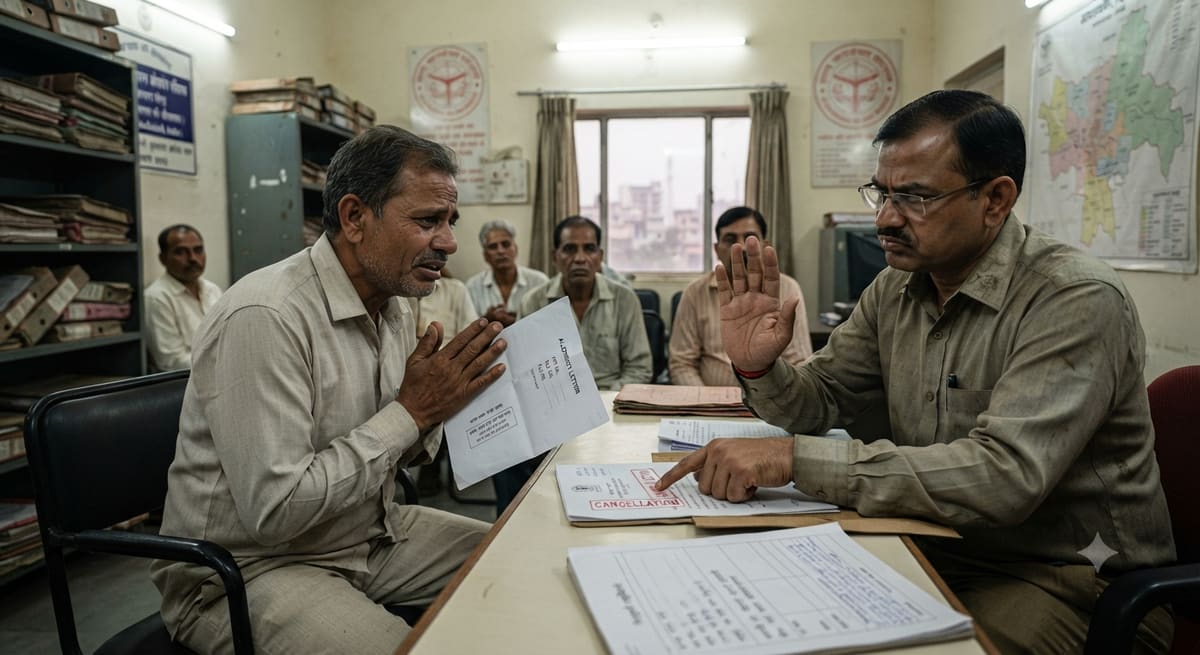
The Allahabad High Court has affirmed that procedural rigidity must yield to substantive justice when a homebuyer faces extraordinary personal hardship. In a significant ruling, the Court set aside the cancellation of a flat allotment and granted the petitioner a final opportunity to avail a state-sponsored settlement scheme, emphasizing that financial defaults arising from genuine calamity cannot justify punitive action without due regard to equity.
Background & Facts
The Dispute
The petitioner, Smt. Sita Singh, was allotted Flat No. 202, Block 23, Vasundhara Enclave Phase-II by the Gorakhpur Development Authority (GDA) under a registered agreement dated 02.05.2019. The advertised cost of the flat was Rs. 32,95,000. The agreement permitted payment of the balance amount in monthly installments over a period of 6.5 years. The petitioner made payments totaling Rs. 25,33,529 by May 2019. In February 2020, GDA issued a notice proposing a one-time settlement scheme under which only Rs. 8,87,597 remained payable. The petitioner deposited Rs. 5,75,000 under this scheme in 2024 - 25.
Key Facts
- Registered agreement dated 02.05.2019 provided for 6.5-year installment plan
- Petitioner paid Rs. 25,33,529 by May 2019
- GDA’s notice dated 17.02.2020 offered one-time settlement requiring payment of Rs. 8,87,597
- Petitioner paid Rs. 5,75,000 under the scheme in 2024 - 25
- GDA arbitrarily claimed Rs. 47,67,850 remained unpaid and cancelled the allotment
- Petitioner’s husband, the primary earner, died on 04.08.2023 after prolonged illness during the Covid-19 pandemic
- The petitioner’s failure to pay installments was directly linked to these dual hardships
Procedural History
- 26/27.09.2025: GDA issued impugned order cancelling flat allotment and imposing penalty interest
- 27.10.2025: High Court granted interim relief, directing GDA to refrain from enforcing cancellation
- 10.11.2025: Matter listed for final hearing; petitioner offered to deposit Rs. 10,00,000 as good faith gesture
- 15.03.2026: State Government notified One Time Settlement Scheme (OTS Scheme 2026)
- 18.04.2026: GDA commenced accepting applications under OTS Scheme 2026
- 17.07.2026: Deadline for applications under OTS Scheme 2026
- 15.05.2026: Final hearing before Division Bench; petitioner had already deposited Rs. 10,00,000 pursuant to interim order
Relief Sought
The petitioner sought:
- Quashing of the impugned cancellation order dated 26/27.09.2025
- Direction to GDA to cease charging penalty interest
- Opportunity to regularize the allotment under the OTS Scheme 2026
The Legal Issue
The central question was whether a housing authority may cancel a flat allotment and impose exorbitant penalty interest solely on account of delayed payments, when the default arises from documented personal hardship and a state-sponsored settlement scheme is available to provide relief.
Arguments Presented
For the Petitioner
Learned Senior Counsel Umesh Vats argued that the petitioner’s default was not wilful but arose from the death of her husband during the pandemic, a circumstance beyond her control. He emphasized that the petitioner had consistently paid over Rs. 31 lakh and had made a substantial deposit of Rs. 10,00,000 under the Court’s interim order, demonstrating bona fides. He contended that the GDA’s calculation of outstanding dues was arbitrary and that the penalty interest was disproportionate and violative of principles of natural justice. He relied on the newly notified OTS Scheme 2026 as a statutory mechanism designed precisely to accommodate such cases.
For the Respondent
Counsel for GDA conceded that the petitioner had violated payment terms but fairly acknowledged that the interim deposit of Rs. 10,00,000 had been made and that the GDA had itself adopted the OTS Scheme 2026. He submitted that while the petitioner was technically in breach, the authority had no objection to the matter being referred to the competent authority for processing under the OTS Scheme, provided the Court’s observations were respected.
The Court's Analysis
The Court observed that the petitioner’s conduct, though technically non-compliant, was not mala fide. The death of her husband during the pandemic constituted a compelling personal hardship that materially affected her financial capacity. The Court noted that the GDA had itself initiated the OTS Scheme 2026, indicating a policy shift toward rehabilitation rather than punitive enforcement.
"The petitioner has demonstrated bona fides through consistent payments and a substantial deposit of Rs. 10,00,000 pursuant to this Court’s interim order. To deny her the benefit of a scheme designed for exactly such cases would be to elevate procedural technicalities over substantive justice."
The Court rejected the argument that arbitration under Clause 14 of the agreement barred judicial intervention, noting that the petitioner was not challenging the arbitration clause but seeking relief under a state policy that supersedes individual contractual enforcement. The Court held that the impugned order was arbitrary, disproportionate, and failed to consider the petitioner’s circumstances, thereby violating Article 14 and principles of natural justice.
The Verdict
The writ petition was allowed. The impugned order dated 26/27.09.2025 was set aside. The petitioner was granted one week to avail the benefit of the OTS Scheme 2026 by depositing the amount as quantified by the Secretary, GDA. The Rs. 10,00,000 already deposited under the interim order shall be adjusted against the OTS payment. In case of default, GDA may proceed in accordance with law. The matter is disposed of.
What This Means For Similar Cases
Settlement Schemes Override Rigid Contractual Enforcement
- Practitioners must now argue that when a state or public authority introduces a settlement scheme, it creates a legitimate expectation for beneficiaries to be given a fair opportunity to avail it
- Cancellation of allotments or contracts based on technical defaults becomes legally untenable if the scheme explicitly aims to provide relief
- The existence of an OTS scheme must be raised at the earliest opportunity in litigation
Hardship Must Be Considered in Administrative Discretion
- Financial defaults arising from death, illness, or pandemic-related disruption are now recognized as valid grounds for equitable relief
- Authorities cannot impose penalty interest without a transparent, auditable calculation of dues
- Petitioners should submit medical records, death certificates, and payment history as evidence of bona fides
Judicial Intervention Is Warranted Even When Arbitration Clauses Exist
- Arbitration clauses do not bar writ jurisdiction when the dispute involves violation of statutory policy or public interest
- Courts may intervene to prevent manifest injustice even if a contractual remedy exists
- The doctrine of exhaustion of remedies does not apply where the remedy itself is arbitrary or discriminatory