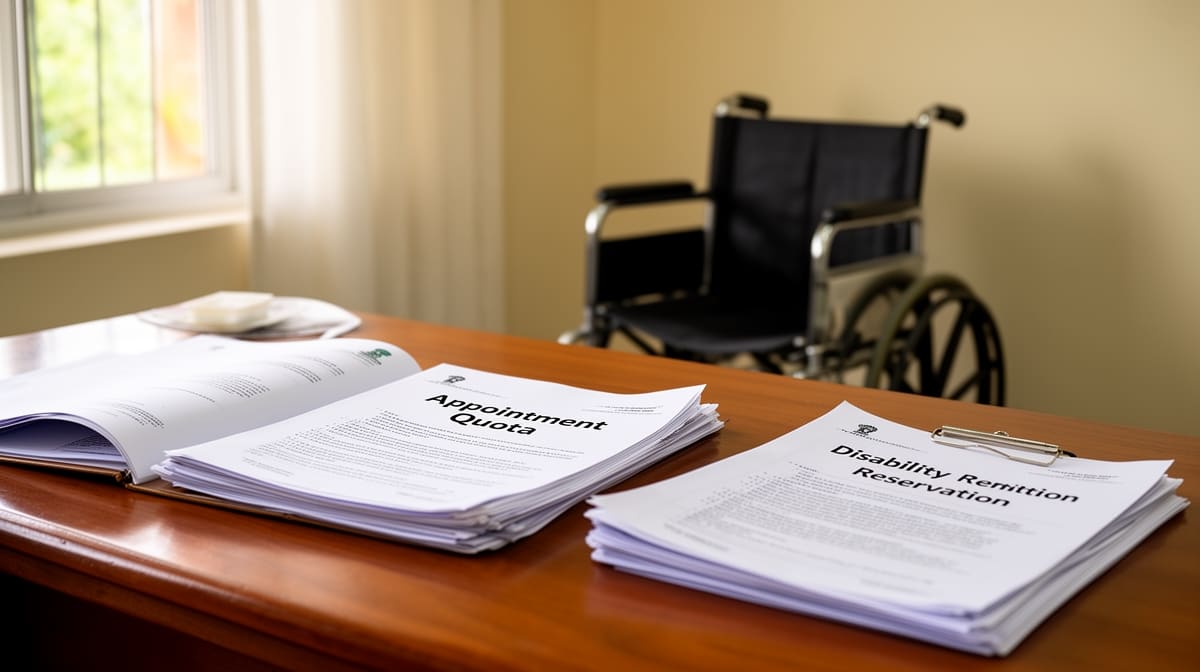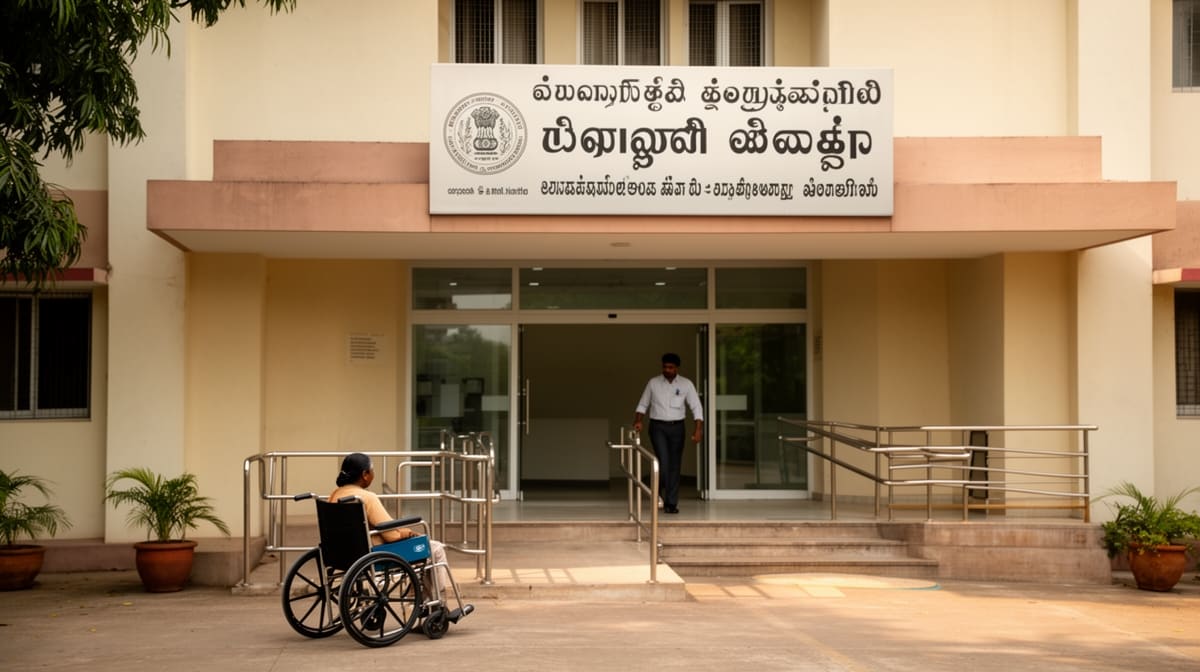
The Madras High Court has delivered a landmark ruling affirming that public employers cannot deny promotion to employees with disabilities based on physical criteria that are irrelevant to job performance. This judgment reinforces the statutory mandate of non-discrimination under the Rights of Persons with Disabilities Act, 2016 and aligns with constitutional guarantees of equality.
Background & Facts
The Dispute
The respondent, S. Annanda Padmavathi, joined the Central Excise Department as an Upper Division Clerk in 1994 under the disability quota. In 1999, the Department identified the post of Inspector of Central Excise as suitable for persons with disabilities. Despite being notionally promoted to Inspector in 2008 following a High Court order, she was later required to undergo a physical test for confirmation. Her height of 142 cm fell short of the prescribed 152 cm for women in the General category, leading to her reversion to the post of Senior Tax Assistant after serving over eight years as Inspector.
Procedural History
- 1994: Respondent appointed as Upper Division Clerk under disability quota
- 1999: Post of Inspector identified as suitable for persons with disabilities
- 2007: High Court directed notional promotion to Inspector
- 2011: Tribunal directed consideration of promotion per notification
- 2014: Writ petition for confirmation of promotion filed and later closed with direction to approach Tribunal
- 2024: Central Administrative Tribunal allowed her claim, directing promotion without physical test
- 2025: Union of India filed Writ Petition under Article 226 to quash Tribunal’s order
Relief Sought
The Union sought quashing of the Tribunal’s order directing the respondent’s promotion to Inspector without enforcing height requirements. The respondent sought enforcement of her right to promotion and consequential benefits from 2002.
The Legal Issue
The central question was whether Section 20(3) of the Rights of Persons with Disabilities Act, 2016 permits denial of promotion to a person with disability solely on the basis of physical standards such as height, when the disability does not impair job performance.
Arguments Presented
For the Petitioner
The Union argued that Recruitment Rules 2002 mandated a minimum height of 152 cm for women in the General category for the post of Inspector. It contended that relaxation of physical standards was permissible only for specific ethnic groups and not for persons with disabilities. It relied on Departmental circulars from 2007 and 2008 asserting that reservations under disability quotas applied only to Group C and D posts, not Group B posts like Inspector. It further claimed that the respondent’s reversion was lawful due to non-compliance with physical eligibility.
For the Respondent
The respondent argued that the Department had itself identified the Inspector post as suitable for persons with disabilities in 1999. She relied on Sections 32 and 33 of the Persons with Disabilities Act, 1995, and Section 20(3) of the RPwD Act, 2016, which prohibit denial of promotion merely on the ground of disability. She highlighted her eight-and-a-half years of exemplary service, high APAR ratings, and recognition as an honest officer. She contended that the physical standard was irrelevant to her duties and that the circulars were superseded by the 2016 Act.
The Court's Analysis
The Court conducted a comprehensive review of the statutory framework under the Rights of Persons with Disabilities Act, 2016, emphasizing its purpose to give effect to the United Nations Convention on the Rights of Persons with Disabilities. The Court held that the Act is not merely a welfare measure but a rights-based instrument grounded in dignity, non-discrimination, and equal opportunity.
"Section 20(3) very specifically states that no promotion shall be denied to a person merely on the ground of disability."
The Court rejected the Union’s reliance on pre-2016 circulars, observing that they were rendered obsolete by the enactment of the 2016 Act, which explicitly overrides inconsistent departmental instructions. The Court noted that the respondent’s short stature did not impair her physical or mental capacity to perform the duties of an Inspector, and that her performance records were unimpeachable.
The Court further held that Section 21 imposes a positive obligation on government establishments to formulate and register an equal opportunity policy, which the Union had failed to do. The Court distinguished between acquired disability and congenital or lifelong conditions, noting that the respondent’s condition was present at the time of recruitment and had never hindered her work.
The Court emphasized that the Constitution’s Article 14 prohibits arbitrary classification, and that imposing physical standards irrelevant to job function constitutes discrimination. The Court concluded that the Department’s insistence on height requirements for a post it had itself designated as suitable for persons with disabilities was illogical and unconstitutional.
The Verdict
The writ petition was dismissed. The Court upheld the Tribunal’s order, holding that the respondent must be promoted to the post of Inspector of Central Excise and Customs under the Physically Handicapped category without enforcing the height requirement. She is entitled to consequential benefits from 19.12.2002, the date of her notional promotion.
What This Means For Similar Cases
Promotion Cannot Be Denied on Physical Standards Alone
- Practitioners must now argue that Section 20(3) RPwD Act, 2016 creates an absolute bar against denying promotion solely due to disability
- Physical criteria must be directly linked to essential job functions; otherwise, they are discriminatory
- Performance records and functional capacity must override arbitrary physical benchmarks
Government Establishments Must Have Equal Opportunity Policies
- Every public employer must now formulate, publish, and register an equal opportunity policy under Section 21
- Failure to do so renders any discriminatory practice legally indefensible
- Policies must explicitly address promotion pathways for employees with disabilities
Pre-2016 Circulars Are No Longer Valid
- Departmental instructions issued before the RPwD Act, 2016 that restrict reservations to Group C/D posts are void to the extent they conflict with the Act
- The Act applies to all government establishments regardless of post classification
- Legal challenges to promotion denials must cite the 2016 Act as the governing statute, not outdated circulars