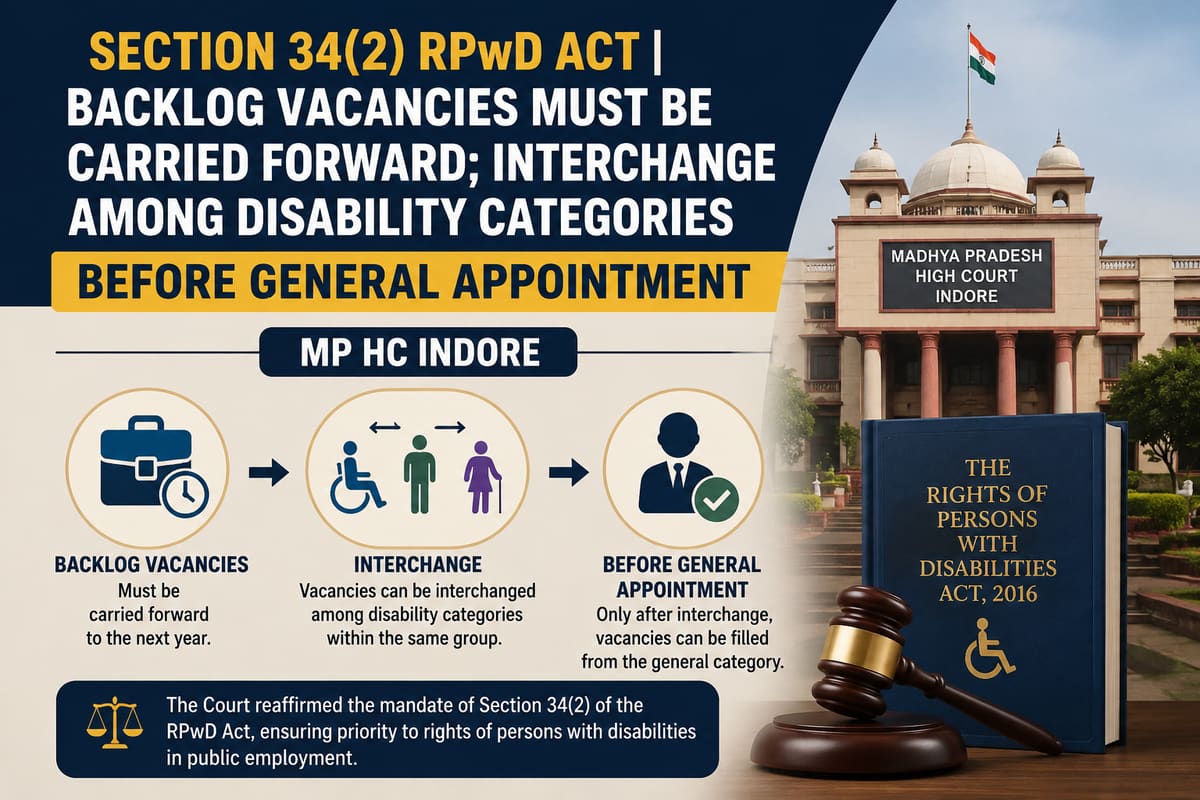
The Central Administrative Tribunal has delivered a significant ruling reinforcing the promotion rights of disabled employees under Section 34 of the Rights of Persons with Disabilities Act 2016. The judgment clarifies that departments cannot arbitrarily deny promotional opportunities to disabled employees, even in isolated posts, and must follow reservation norms in promotions as mandated by recent Supreme Court directives.
Background & Facts
The Dispute
The applicant, Sushila Yadav, a visually impaired employee, was appointed as a Lower Division Clerk (LDC) in the National Zoological Park in 1987. Despite her long service of over 27 years, she was denied promotion while her juniors, including Mrs. Veena Chandra, were promoted to Upper Division Clerk (UDC). The applicant contended that her designation was arbitrarily changed from LDC to Hindi Typist to deny her promotional benefits, violating her rights under Articles 14 and 16 of the Constitution and Section 34 of the RPwD Act 2016.
Procedural History
The dispute progressed through the following stages:
- 1987: Applicant appointed as LDC under the Physically Handicapped (Visually Impaired) quota.
- 1991: Applicant qualified Hindi typing test and was assigned additional duties as Hindi Typist.
- 2014: Departmental Promotion Committee (DPC) promoted juniors, ignoring the applicant’s seniority.
- 2014: Applicant’s representation challenging the promotion was rejected.
- 2015: Original Application (OA) filed before the Central Administrative Tribunal (CAT).
Relief Sought
The applicant sought:
- Setting aside the promotion order of juniors dated 11.03.2014.
- Promotion to UDC with seniority over her juniors.
- Notional benefits, including pay fixation and seniority, without arrears.
The Legal Issue
The Tribunal had to resolve:
- Whether the department’s arbitrary change of the applicant’s cadre from LDC to Hindi Typist was legally valid.
- Whether the promotion of juniors over a disabled employee violated Section 34 of the RPwD Act 2016 and Articles 14 and 16 of the Constitution.
- Whether the applicant’s prolonged denial of promotion (27 years) amounted to a violation of service rules and natural justice.
Arguments Presented
For the Applicant
The applicant’s counsel argued:
- The applicant was appointed as LDC, and the department had no authority to unilaterally change her cadre to Hindi Typist.
- The promotion of juniors over the applicant violated seniority principles and service rules, as well as Articles 14 and 16 of the Constitution.
- The denial of promotion for 27 years was contrary to Government of India service norms, which entitle employees to at least three promotions during their tenure.
- The applicant’s identity card and official correspondence consistently reflected her designation as LDC, contradicting the department’s claim.
- The department’s actions violated natural justice, as the applicant was not given an opportunity to object to her cadre change.
For the Respondents
The respondents’ counsel contended:
- The applicant was appointed as a Hindi Typist under the Physically Handicapped quota and not as an LDC.
- The post of Hindi Typist was an isolated post with no promotional avenues to UDC, as there were no approved Recruitment Rules (RRs) for the post.
- The applicant failed to raise objections to her position in the gradation list, thereby accepting her designation as Hindi Typist.
- The identity card reflecting the applicant as LDC was a clerical error and did not alter her actual appointment.
- The DPC followed due procedure, and the applicant’s promotion could not be claimed as a matter of right.
The Court's Analysis
The Tribunal critically examined the rival contentions and the documentary evidence on record. Key observations included:
-
Cadre Change Arbitrariness: The Tribunal noted inconsistencies in the applicant’s service records, which reflected her designation as both LDC and Hindi Typist. The department’s claim that the applicant was appointed as a Hindi Typist was contradicted by the appointment letter dated 27.10.1987, which clearly stated her appointment as LDC. The Tribunal held that the department’s unilateral change of cadre was mala fide and aimed at denying the applicant promotional benefits.
-
Violation of Seniority Principles: The Tribunal observed that the DPC promoted juniors over the applicant, ignoring her seniority and clear service record. This was held to be a gross violation of the law, particularly in light of the Supreme Court’s directives in Rajeev Kumar Gupta v. Union of India and Siddaraju v. State of Karnataka, which mandate reservation in promotions for disabled employees under Section 34 of the RPwD Act 2016.
"The promotion of juniors over the applicant, who is visually handicapped, is a gross violation of the law of the land and has greatly de-motivated and discouraged the applicant."
-
Supreme Court Directives on Reservation in Promotion: The Tribunal relied on the DoPT Office Memoranda (OMs) dated 17.05.2022 and 28.12.2023, which provide detailed instructions on reservation in promotion for Persons with Benchmark Disabilities (PwBD). The OMs were issued in compliance with the Supreme Court’s judgments in Rajeev Kumar Gupta and Siddaraju, which directed the government to implement Section 34 of the RPwD Act 2016 in promotions.
-
Natural Justice and Procedural Fairness: The Tribunal held that the department’s failure to provide the applicant an opportunity to object to her cadre change violated principles of natural justice. The applicant’s prolonged denial of promotion without cogent reasons was also held to be arbitrary and discriminatory.
The Verdict
The Tribunal allowed the Original Application and directed the respondents to:
- Promote the applicant to UDC over and above her juniors, considering her due date of promotion.
- Grant the applicant notional benefits, including seniority and pay fixation, without arrears of pay on the principle of ‘No work; No Pay’.
- Complete the promotion process within three months from the receipt of the order.
What This Means For Similar Cases
Promotion Rights of Disabled Employees Are Non-Negotiable
The judgment reinforces that disabled employees cannot be denied promotional opportunities on arbitrary grounds. Departments must:
- Ensure compliance with Section 34 of the RPwD Act 2016 and DoPT OMs on reservation in promotions.
- Avoid unilateral cadre changes that deprive employees of promotional benefits.
- Provide opportunities for objections before altering an employee’s designation or seniority.
Documentary Evidence Prevails Over Oral Claims
- Appointment letters and official correspondence carry greater weight than subsequent claims by departments.
- Clerical errors in identity cards or service records cannot override the original terms of appointment.
Departments Must Justify Denial of Promotions
- Prolonged denial of promotions (e.g., 27 years) without cogent reasons will be viewed as arbitrary and discriminatory.
- DPC decisions must be based on seniority, service records, and statutory reservation norms.
- Isolated posts do not exempt departments from complying with reservation in promotion under the RPwD Act.