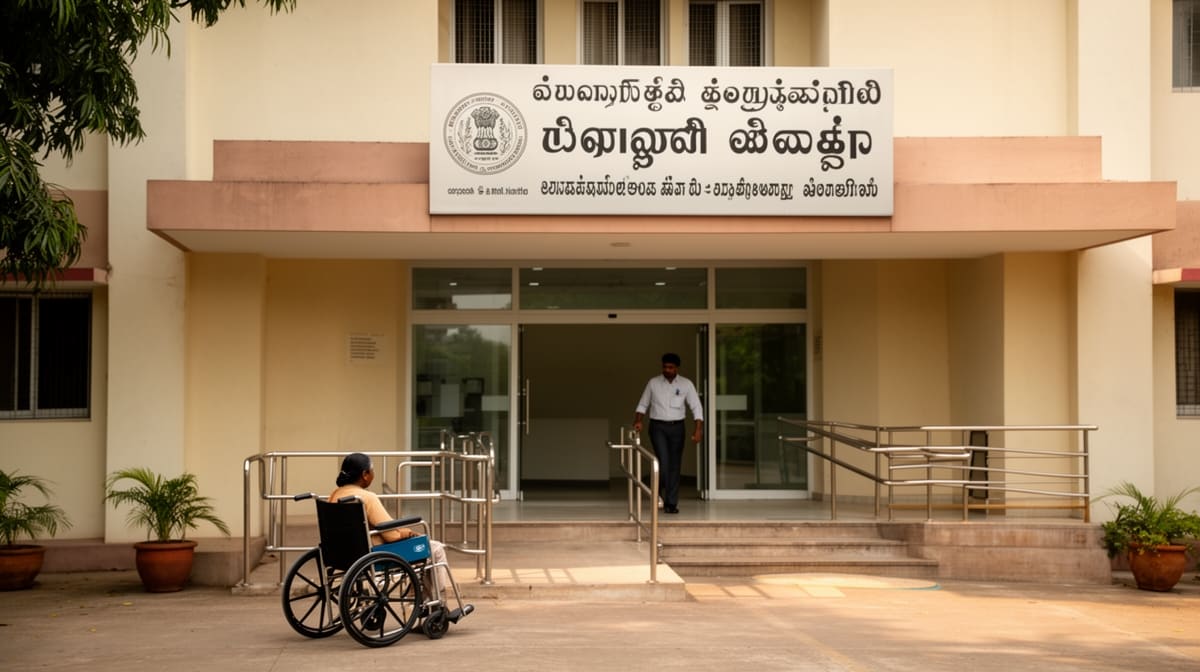
The Rajasthan High Court has affirmed that administrative transfers of employees with permanent disabilities must account for physical hardship, establishing that arbitrary relocations without accommodation violate the principle of reasonable adjustment under constitutional and statutory obligations. This judgment reinforces the duty of public employers to ensure equitable workplace access.
Background & Facts
The Dispute
The petitioner, Mahesh Kumar Sharma, a teacher with permanent locomotor disability, was serving as Teacher Grade-III (Level-1 General) at the Government Upper Primary Sanskrit School, Sharma Colony, Churu. On 06.04.2026, the Commissioner, Directorate of Sanskrit Education, issued an order transferring him to the Government Upper Primary Sanskrit School, Dabla Road, Churu. The petitioner challenged this transfer as arbitrary, unjust, and discriminatory, given his physical condition.
Key Facts
- The petitioner suffers from a permanent locomotor disability, requiring mobility assistance and accessible infrastructure
- He has been serving at the Sharma Colony school since his appointment
- The transfer destination, Dabla Road, Churu, lacks equivalent accessibility features for persons with locomotor disabilities
- No prior consultation or medical assessment was conducted before issuing the transfer order
- The petitioner had not committed any misconduct or administrative lapse warranting transfer
- The transfer was not linked to any exigency of public service, reorganization, or disciplinary action
Procedural History
- 06.04.2026: Impugned transfer order issued by the Commissioner, Directorate of Sanskrit Education
- 11.05.2026: Writ Petition No. 8374/2026 filed before the High Court of Judicature for Rajasthan at Jodhpur
- 11.05.2026: Court heard arguments and passed interim order on the same day
Relief Sought
The petitioner sought:
- Quashing of the transfer order dated 06.04.2026
- Direction to continue his service at the existing posting at Government Upper Primary Sanskrit School, Sharma Colony, Churu
The Legal Issue
The central question was whether an administrative transfer of a government employee with permanent locomotor disability, without consideration of physical hardship or accessibility, constitutes arbitrary action violative of Article 14 and the rights of persons with disabilities under the Rights of Persons with Disabilities Act, 2016.
Arguments Presented
For the Petitioner
Learned counsel for the petitioner argued that the transfer order was issued without any valid reason, medical evaluation, or consultation. He relied on National Federation of the Blind v. Union of India to emphasize that public authorities must make reasonable accommodation for persons with disabilities. He contended that relocating the petitioner to a facility with inadequate accessibility amounted to discrimination and violated his right to equal opportunity in public employment under Article 16.
For the Respondent
The State, through the Public Prosecutor, did not contest the factual assertion of the petitioner’s disability or the inaccessibility of the new posting. However, it submitted that transfer orders are within the domain of administrative discretion and cannot be interfered with unless mala fide or perverse. No specific justification for the transfer was provided in the counter-affidavit.
The Court's Analysis
The Court observed that the petitioner’s permanent locomotor disability renders him dependent on accessible infrastructure, including ramps, elevators, and proximity to medical facilities. The transfer to Dabla Road, Churu, without any assessment of accessibility or alternative arrangements, would impose undue physical and mental hardship. The Court noted that the State has a constitutional and statutory obligation under Section 2(q) and Section 4 of the Rights of Persons with Disabilities Act, 2016, to ensure reasonable accommodation in employment.
"The State cannot treat a person with disability as an ordinary employee and impose transfers without accounting for the physical barriers they face daily. Such indifference amounts to indirect discrimination."
The Court further held that while administrative discretion exists, it is not unfettered. When a transfer causes disproportionate hardship to a disabled employee, the authority must justify it with compelling reasons and explore alternatives. No such justification was offered here.
The Court declined to directly quash the transfer order, recognizing the need for internal grievance redressal. Instead, it directed the petitioner to file a representation before the Grievance Committee constituted on 15.04.2026, ensuring procedural fairness while preserving the status quo.
The Verdict
The writ petition was disposed of with the following directions:
- The petitioner must file a detailed representation with a certified copy of the transfer order before the Grievance Committee within seven days
- The Grievance Committee shall decide the representation expeditiously, preferably within two months
- The impugned transfer order dated 06.04.2026 is stayed until the Grievance Committee’s decision
- The petitioner shall continue to discharge duties at his current posting at Government Upper Primary Sanskrit School, Sharma Colony, Churu
- The stay application is disposed of as redundant
What This Means For Similar Cases
Reasonable Accommodation Is Not Discretionary
- Public employers must proactively assess accessibility needs before transferring employees with disabilities
- Failure to accommodate constitutes discrimination under the Rights of Persons with Disabilities Act, 2016
- Administrative convenience cannot override statutory obligations under Section 4 of the Act
Grievance Committees Must Be Meaningful
- Internal grievance mechanisms must be functional, time-bound, and empowered to override arbitrary transfers
- Delays beyond two months in deciding disability-related grievances will be viewed as non-compliance
- Petitioners may approach courts if committees fail to act within the stipulated period
Transfer Orders Require Justification
- Transfer orders affecting disabled employees must be accompanied by written reasons
- Absence of medical or accessibility assessment renders transfers vulnerable to judicial review
- Courts will intervene where transfers impose disproportionate hardship, even without mala fide intent