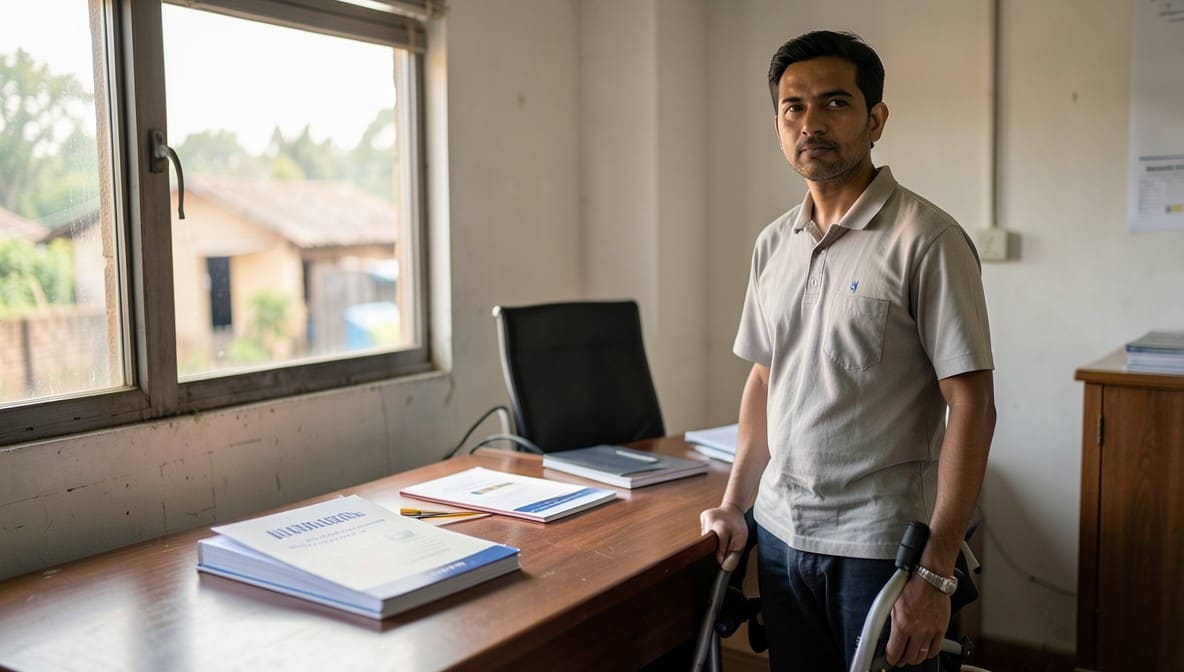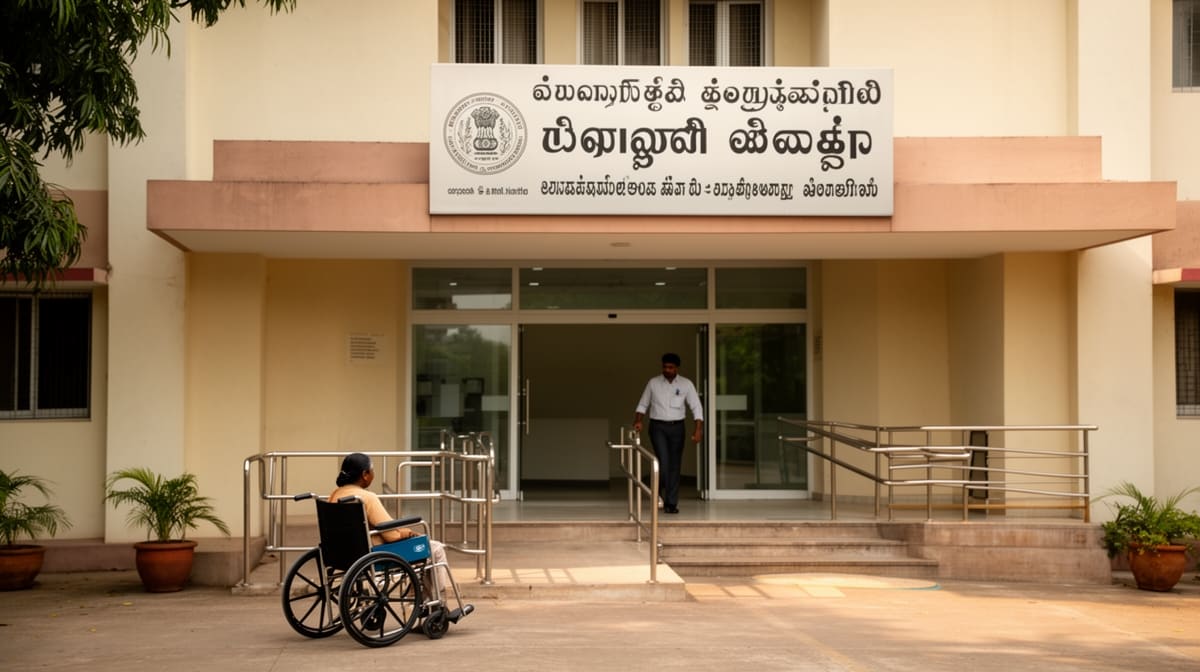
The Madras High Court has affirmed that public employers have a legal obligation to consider transfer requests from physically challenged employees, particularly when such requests are grounded in documented disability and personal hardship. This judgment reinforces the duty of administrative authorities to act in accordance with established disability welfare policies, not merely as a matter of discretion but as a constitutional imperative under Article 14 and 21.
Background & Facts
The Dispute
The petitioner, R. Velrajan, a Technical Assistant employed by Annamalai University, suffers from 91% hearing impairment and seeks transfer from his current posting at the Government College of Engineering, Dharmapuri, to a location near or within Chidambaram town. He was appointed on 01.04.2004 and was subsequently deputed to Dharmapuri by order dated 15.02.2020 for a period of three years. Despite repeated representations, his request for transfer has remained unaddressed.
Key Facts
- The petitioner was appointed as a Technical Assistant in Annamalai University on 01.04.2004
- He was deputed to the Government College of Engineering, Dharmapuri, by order dated 15.02.2020 for a period of three years
- The petitioner suffers from 91% hearing impairment, documented and recognized as a physical disability
- He submitted multiple representations seeking transfer to Chidambaram, citing difficulty in commuting and lack of accessibility support in Dharmapuri
- The most recent representation was dated 24.10.2025, which remained unacknowledged and unconsidered
- Chidambaram is the headquarters of Annamalai University, where administrative offices and medical facilities are located
Procedural History
- 01.04.2004: Appointment as Technical Assistant, Annamalai University
- 15.02.2020: Deputation order issued to Government College of Engineering, Dharmapuri
- Between 2020 - 2025: Multiple representations submitted by petitioner for transfer
- 24.10.2025: Final representation submitted, no response received
- 2026: Writ Petition No. 9826 of 2026 filed under Article 226 of the Constitution
- 16.03.2026: Hearing before the Madras High Court
The Parties' Positions
Petitioner: Argued that his disability creates severe hardship in a remote location with inadequate infrastructure for hearing-impaired persons. He relied on the Government’s policy framework for disability accommodation and the principle of reasonable accommodation under the Rights of Persons with Disabilities Act, 2016.
Respondents: Did not contest the factual claims of disability or the lack of response to representations. No counter-affidavit or justification was filed for the inaction.
Relief Sought
The petitioner sought a writ of mandamus directing the respondents to:
- Consider his representation dated 24.10.2025
- Transfer him to any office near or within Chidambaram town
The Legal Issue
The central question was whether an administrative authority has a legal duty to consider a transfer request made by a physically challenged employee under established disability welfare policies, and whether inaction on such a request constitutes a violation of constitutional rights under Articles 14 and 21.
Arguments Presented
For the Petitioner
The petitioner’s counsel relied on the principle of reasonable accommodation under the Rights of Persons with Disabilities Act, 2016, and cited the Chief Secretary’s letter No. 92/S/2009 dated 22.07.2009, which mandates that government departments must make special provisions for employees with disabilities, including transfer to accessible locations. He argued that the failure to even consider the representation amounted to arbitrariness and discrimination, violating the petitioner’s right to equality and dignity.
For the Respondent
The Additional Government Pleader did not dispute the petitioner’s disability or the fact that the representation remained unaddressed. No legal defense was advanced to justify the administrative inaction. The respondents’ silence effectively conceded the absence of any valid reason for non-consideration.
The Court's Analysis
The Court observed that the petitioner’s disability is severe and well-documented, and that his request for transfer to Chidambaram - the headquarters of his parent university - is both reasonable and practical. The Court emphasized that administrative authorities cannot treat representations from disabled employees as mere formalities to be ignored.
"The State, as an employer, has a constitutional and statutory obligation to ensure that persons with disabilities are not placed at a disadvantage due to the nature of their posting. Inaction on a representation grounded in disability is not merely procedural lapse - it is a denial of equal opportunity."
The Court further noted that the Chief Secretary’s letter dated 22.07.2009, though not a statute, forms part of the administrative policy framework binding on all government departments. The failure to apply this policy in the petitioner’s case was found to be inconsistent with the spirit of the Rights of Persons with Disabilities Act, 2016, and the constitutional mandate under Articles 14 and 21.
The Court rejected the notion that transfer decisions are purely discretionary. Where disability creates a demonstrable hardship, discretion must be exercised in favor of accommodation. The Court held that the petitioner’s representation merited at least a reasoned consideration, and the absence of any response was indefensible.
The Verdict
The Madras High Court directed the third respondent, the Registrar of Annamalai University, to consider the petitioner’s representation dated 24.10.2025 in light of the Chief Secretary’s letter dated 22.07.2009 and pass a reasoned order within three weeks from the date of receipt of a copy of this order. The Court disposed of the writ petition with no costs.
What This Means For Similar Cases
Administrative Inaction on Disability Requests Is Unlawful
- Practitioners must now treat non-response to transfer requests by disabled employees as a ground for judicial intervention under Article 226
- Any delay or silence on such representations can be challenged as a violation of the duty to provide reasonable accommodation
- Government departments must maintain records of representations and issue written responses, even if the request is denied
Policy Letters Bind Administrative Action
- Official policy letters issued by the Chief Secretary or Department Heads, even if not statutory, form part of the administrative framework
- Courts will enforce such policies as binding on public employers, particularly when they relate to fundamental rights
- Failure to follow internal policy may constitute arbitrariness under Article 14
Transfer Requests Must Be Evaluated on Merits, Not Convenience
- The location of posting must be assessed not merely on administrative convenience but on the employee’s functional and medical needs
- Proximity to medical facilities, accessibility of infrastructure, and ease of commuting are legitimate factors in transfer decisions for disabled employees
- A blanket policy of non-transfer must be challenged as discriminatory if it disproportionately affects persons with disabilities