The Madhya Pradesh High Court has clarified that procedural lapses under Section 52-A of the Narcotic Drugs and Psychotropic Substances Act, 1985, do not automatically invalidate a prosecution if the evidence of recovery and possession remains cogent and reliable. This ruling reinforces the principle that substantial compliance, not rigid technical adherence, governs the admissibility of evidence in drug cases.
Background & Facts
The Dispute
The appellants, Ehsan and others, were convicted by the Special Judge (NDPS), Sehore, in S.C.NDPS No. 04/2021 for offences under Sections 8(c) and 20(b)(ii)(B) of the NDPS Act, and Section 34(2) of the Madhya Pradesh Excise Act. They were sentenced to five years rigorous imprisonment with a fine of Rs. 3,000 under the NDPS Act, and one year rigorous imprisonment with a fine of Rs. 25,000 under the Excise Act, with default stipulations.
Key Facts
- The contraband was seized during a search operation conducted by the investigating officer
- The investigating officer did not personally prepare the inventory of seized items
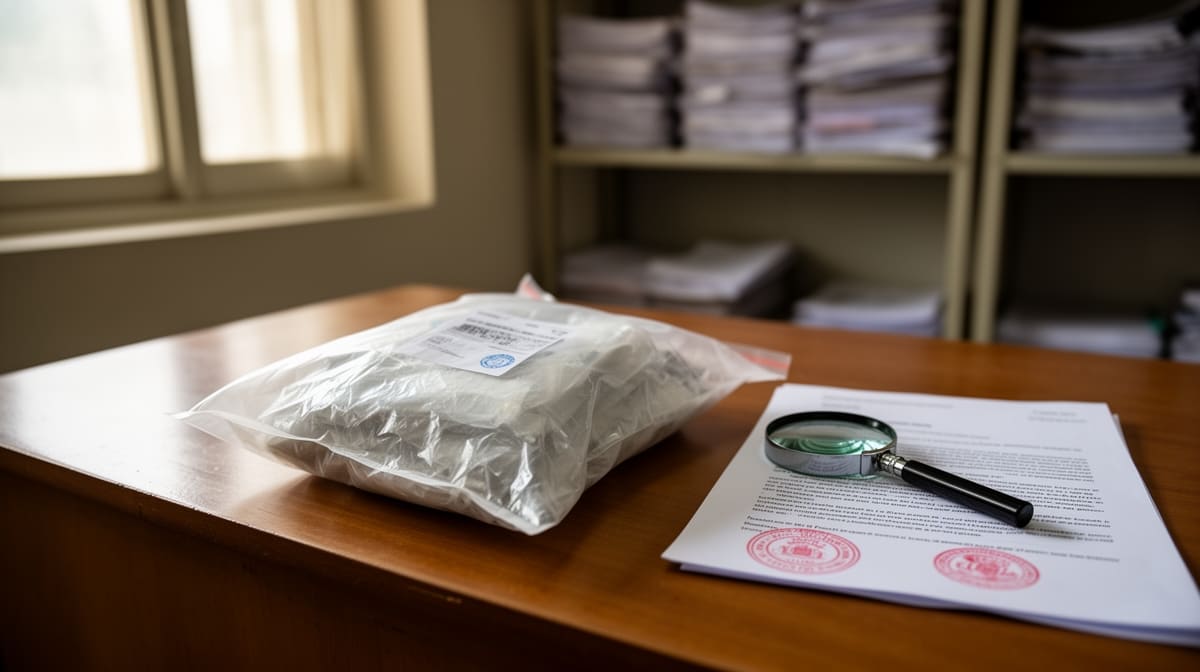
- The inventory was prepared and verified by an Executive Magistrate, with supporting documents marked as Ex.P/59, Ex.P/60, and Ex.P/61
- Samples of the seized contraband were drawn in the presence of the Magistrate
- The seized material was not produced before the trial court, but the samples and inventory were relied upon
- No allegation of tampering or substitution was substantiated by the defence
Procedural History
- Date of seizure: Not specified in judgment, but implied to precede filing of chargesheet
- Date of trial court conviction: 12.08.2025
- Date of filing of Criminal Appeal: 07.05.2026 (date of judgment)
- Date of I.A. No. 21497/2025 filing: Prior to 07.05.2026
- Date of judgment on bail/suspension application: 07.05.2026
Relief Sought
The appellants sought suspension of sentence and grant of bail during the pendency of appeal, arguing that non-compliance with Section 52-A of the NDPS Act rendered the prosecution’s case doubtful and entitled them to interim relief.
The Legal Issue
The central question was whether non-compliance with Section 52-A of the NDPS Act, specifically the failure of the investigating officer to prepare the inventory, renders the prosecution’s case legally unsustainable, thereby warranting suspension of sentence and grant of bail during appeal.
Arguments Presented
For the Appellant
Learned counsel for the appellants relied on Surepally Srinivas v. State of Andhra Pradesh (25.03.2025) and Bharat Aamble v. State of Chhattisgarh (2025 SCC OnLine SC 110) to argue that the failure to prepare the inventory by the seizing officer constituted a fundamental procedural defect. They contended that Section 52-A mandates strict compliance, and the absence of an inventory prepared by the investigating officer, even if verified by a Magistrate, vitiates the chain of custody and creates reasonable doubt about the integrity of the seized material. They asserted that the prosecution failed to discharge the burden of proving substantial compliance, and therefore, the appellants were entitled to bail pending appeal.
For the Respondent
The State countered that while the investigating officer did not personally prepare the inventory, the Executive Magistrate duly verified the seizure, drew samples, and recorded the process in official documents (Ex.P/59 - 61). The State argued that this constituted substantial compliance under Bharat Aamble, and that the prosecution’s case was supported by reliable oral and documentary evidence establishing recovery and possession. They emphasized that no evidence of tampering or substitution was adduced, and the procedural lapse did not affect the core reliability of the prosecution’s case.
The Court's Analysis
The Court undertook a detailed review of the Supreme Court’s judgment in Bharat Aamble v. State of Chhattisgarh, particularly paragraphs 50(I) - (X), which establish a nuanced framework for evaluating Section 52-A compliance. The Court noted that the Supreme Court has explicitly held that non-compliance with Section 52-A is not fatal unless it renders the prosecution’s case doubtful due to discrepancies in physical evidence.
"The procedure prescribed by the Standing Order(s) / Rules in terms of Section 52A of the NDPS Act is only intended to guide the officers and to see that a fair procedure is adopted by the officer in-charge of the investigation, and as such what is required is substantial compliance of the procedure laid therein."
The Court observed that in Surepally Srinivas, the contraband was not sealed, remained unproduced for fifteen days, and the investigating officer’s conduct raised a real possibility of substitution. In contrast, in the present case, the inventory was prepared and certified by an Executive Magistrate, samples were drawn in his presence, and no evidence of tampering or delay was established.
The Court further held that the burden under Bharat Aamble is two-tiered: first, the accused must establish a prima facie case of non-compliance on a preponderance of probabilities; second, the prosecution must prove either substantial compliance or that the lapse did not affect the case beyond reasonable doubt. Here, the appellants established a technical lapse, but the prosecution successfully demonstrated that the Magistrate’s involvement ensured procedural integrity.
The Court concluded that the prosecution’s evidence - including the Magistrate’s certified documents, the chain of custody, and the absence of any contradictory evidence - inspired confidence. Mere non-preparation of the inventory by the investigating officer, without more, could not override the reliability of the overall evidence.
The Verdict
The appellants’ application for suspension of sentence and bail under Section 430(1) of the Bharatiya Nagarik Suraksha Sanhita, 2023, was dismissed. The Court held that the conviction remains valid, and the procedural lapse under Section 52-A of the NDPS Act did not render the prosecution’s case doubtful. The appellants shall continue to serve their sentences pending the final disposal of the appeal.
What This Means For Similar Cases
Substantial Compliance Is Sufficient
- Practitioners must now argue that compliance with Section 52-A is evaluated holistically - presence of a magistrate, certified inventory, and sample drawing can substitute for the investigating officer’s direct involvement
- Technical deviations, such as non-preparation of inventory by the seizing officer, are not fatal if corroborated by independent, credible documentation
- Defence counsel must go beyond alleging non-compliance; they must demonstrate how the lapse created a real risk of tampering or substitution
Prosecution’s Burden Is Manageable
- The prosecution can rely on Magistrate-certified documents (Ex.P/59 - 61) to establish substantial compliance
- Oral testimony linking the seized material to the accused, combined with certified inventory, satisfies the standard of proof beyond reasonable doubt
- Courts will not grant bail or suspend sentence merely on procedural irregularities unless the integrity of the evidence is genuinely compromised
Strategic Implications for Bail Applications
- Applications under Section 430 CrPC for suspension of sentence must now be supported by evidence of actual prejudice - not just procedural lapses
- Courts will deny interim relief where the conviction rests on reliable, corroborated evidence despite minor procedural deviations
- Defence advocates should focus on identifying specific discrepancies in the chain of custody, not generic non-compliance