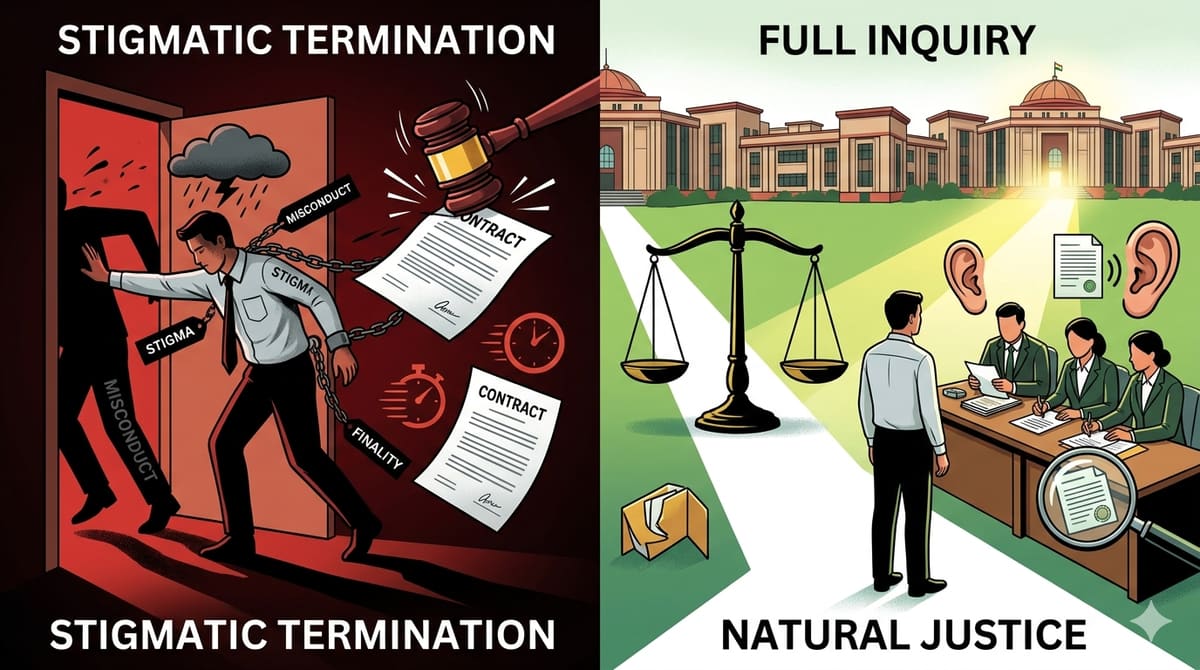
The Punjab and Haryana High Court has reaffirmed that principles of natural justice apply even to temporary government positions, holding that termination without a show cause notice or opportunity of hearing is procedurally flawed. This judgment clarifies that procedural fairness cannot be bypassed regardless of the employee's service status, setting an important precedent for service law matters.
Background & Facts
The Dispute
The petitioner, Suresh Kumar, served in the Indo-Tibetan Border Police for 22 years before retiring in 2013. He was subsequently appointed as a Special Police Officer (SPO) under Section 21 of the Haryana Police Act, 2007. In September 2020, the Haryana Police received a complaint alleging that the petitioner had illegally arranged the marriage of his maid, Manju, with Mukesh Kumar. The complaint further alleged that ₹50,000 was paid to the petitioner’s wife for facilitating the marriage.
Procedural History
The respondent, State of Haryana, conducted an inquiry into the allegations:
- Statements were recorded from Mukesh Kumar’s father and other witnesses.
- The Inquiry Officer concluded that the petitioner and his wife had illegally arranged the marriage.
- On 23.11.2020, the petitioner was terminated from his position as SPO without being issued a show cause notice or granted an opportunity of hearing.
Relief Sought
The petitioner approached the High Court under Article 226 of the Constitution of India, seeking:
- Setting aside of the termination order dated 23.11.2020.
- Reinstatement to his position as SPO with all consequential benefits.
The Legal Issue
The central question before the Court was whether the termination of a Special Police Officer under Section 21 of the Haryana Police Act, 2007 could be effected without adhering to the principles of natural justice, specifically the requirement of a show cause notice and an opportunity of hearing.
Arguments Presented
For the Petitioner
The petitioner contended that:
- The termination order was passed in violation of natural justice, as he was neither issued a show cause notice nor granted a hearing.
- The inquiry was one-sided, relying solely on statements without affording him an opportunity to defend himself.
- The punishment was disproportionately harsh, given his unblemished service record of 22 years in ITBP.
- The termination order was stigmatic, as it implied misconduct without proper adjudication.
For the Respondent
The State counsel argued that:
- The Inquiry Officer’s report sufficiently established the petitioner’s involvement in the illegal arrangement of the marriage.
- The petitioner was not a permanent employee, and thus, the principles of natural justice did not strictly apply to his termination.
- The termination was justified based on the gravity of the allegations and the findings of the inquiry.
The Court's Analysis
The Court critically examined the procedural fairness of the termination order. It observed that the respondent had conducted a one-sided inquiry, relying solely on statements from Mukesh Kumar’s father and other witnesses without affording the petitioner an opportunity to present his case.
"The respondent recorded statement of father of Mukesh Kumar to the effect that a sum of ₹50,000/- was paid to petitioner’s wife for arranging said marriage. The petitioner was neither made to join inquiry nor issued show cause notice or granted opportunity of hearing still a stigmatic order was passed."
The Court emphasized that principles of natural justice are not contingent on the nature of employment - whether permanent or temporary. It held that even for a Special Police Officer, the right to a fair hearing cannot be dispensed with. The Court further noted that the termination order was stigmatic, as it implied misconduct without proper adjudication, which could adversely affect the petitioner’s future employment prospects.
The Court also considered the proportionality of the punishment, noting that the petitioner had an unblemished service record and was nearing the age of 57 at the time of the judgment. While reinstatement was not granted due to the passage of time, the Court directed the respondent to consider the petitioner for re-appointment if he applied again, subject to availability of posts and compliance with requisite conditions.
The Verdict
The petition was disposed of with the following directions:
- The termination order dated 23.11.2020 was set aside for being procedurally flawed and in violation of natural justice.
- The respondent was directed to consider the petitioner for re-appointment as SPO if he applied again, subject to availability of posts and compliance with the requisite terms and conditions.
- The respondent was at liberty to consider the petitioner’s future conduct while making any decision regarding re-appointment.
What This Means For Similar Cases
Natural Justice Applies to All Employees, Regardless of Status
The judgment reinforces that principles of natural justice are not limited to permanent employees. Practitioners must argue that:
- Even temporary or contractual employees are entitled to a show cause notice and an opportunity of hearing before termination.
- Stigmatic orders, which imply misconduct without proper adjudication, are liable to be set aside.
Procedural Compliance Is Non-Negotiable
- One-sided inquiries without affording the employee an opportunity to defend themselves will not withstand judicial scrutiny.
- Documentary evidence alone, without proper procedural compliance, is insufficient to justify termination.
Re-employment as a Remedy
- Courts may not always order reinstatement, especially where significant time has elapsed.
- However, they may direct consideration for re-employment, subject to the employee’s future conduct and compliance with requisite conditions.
- Practitioners should highlight the age and service record of the employee to argue for leniency in such cases.