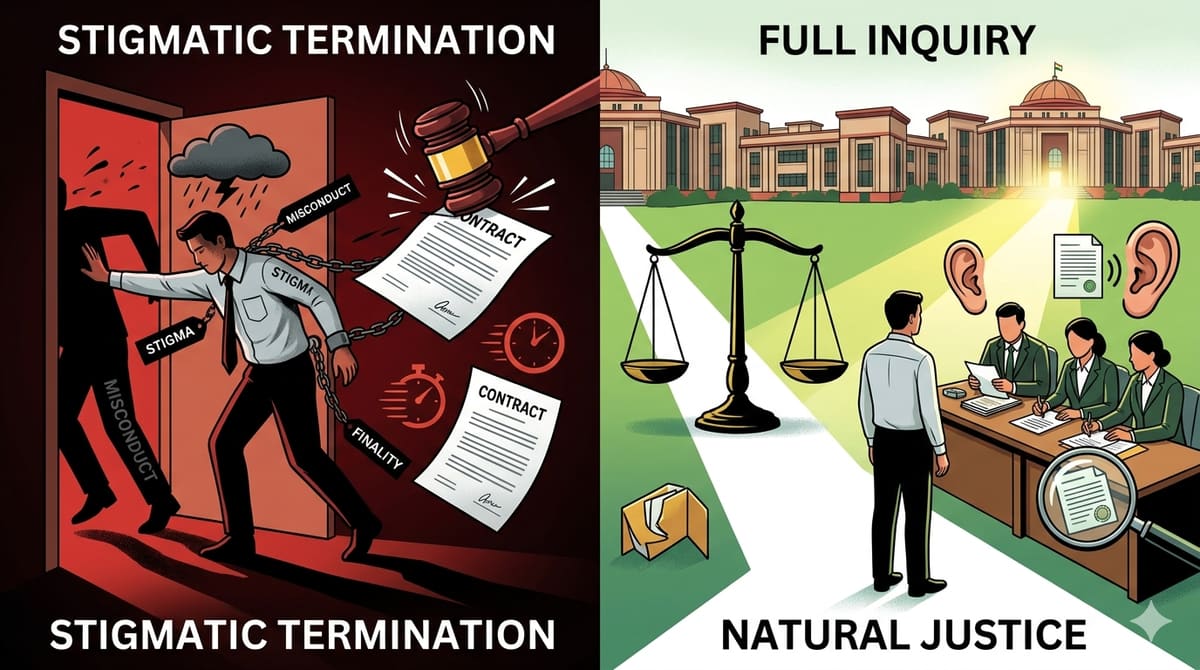
The Central Administrative Tribunal, Allahabad Bench, has delivered a significant ruling on the interplay between contractual termination clauses and principles of natural justice. The judgment clarifies that even where a contract permits termination without cause, if the action carries stigmatic implications or civil consequences, the affected party must be afforded a fair hearing. This decision reinforces the constitutional safeguards under Articles 14 and 21 and sets a precedent for scrutinizing contractual terminations in public employment.
Background & Facts
The Dispute
The applicant, Sandeep Sachan, a retired government employee with over 23 years of experience in higher education, was appointed as Campus Director, NIFT Daman, on 08.12.2022 pursuant to Advertisement No. 1/Establishment/NIFT-HQ-2022. The appointment was contractual for an initial tenure of three years, extendable up to two additional years subject to annual evaluation, and carried Pay Level-13. The applicant’s substantive post of Associate Professor (Pay Level-11) remained on lien during the contractual tenure. Despite operational challenges, including acute manpower shortages and lack of institutional support, the applicant successfully established and operationalized key departments at the newly created NIFT Daman campus.
Key Facts
-
Appointment Details:
- Date of Appointment: 08.12.2022
- Tenure: Three years (extendable by two years)
- Pay Level: Level-13 (Campus Director) with lien on substantive post of Associate Professor (Level-11)
- Contractual Clauses:
- Clause 5: Substantive post on lien
- Clause 7: Initial tenure of three years
- Clause 8: Annual performance evaluation
- Clause 9: Termination permissible by either party with one month’s notice or salary in lieu thereof
- Clause 10 & 14: Governed by NIFT Act, 2006, CCS (Conduct) Rules, 1964, and CCS (CCA) Rules, 1965
-
Incidents Leading to Termination:
- 21.03.2025: Advisory issued by Director General, NIFT, regarding improper conduct and casual remarks
- 04.06.2025: Anonymous email alleging coercion of students received by authorities
- 10.06.2025: Crime Branch arrested three campus officials under Section 75(2) (Sexual Harassment) and Section 3(5) (Common Intention) of the Bharatiya Nyaya Sanhita, 2023
- 15.06.2025: Applicant informed NIFT Head Office about the incident, five days after occurrence
- 24.06.2025: Administrator of UT of Daman and Diu directed removal of all male outsourced staff
- 25.06.2025: Fact-Finding Committee submitted report highlighting procedural lapses, misuse of authority, and institutional discipline failures
- 01.07.2025: Secretary, Education, UT Administration, issued D.O. letter requesting discontinuation of applicant’s services
-
Impugned Order:
- Date: 27.06.2025
- Action: Premature termination of contractual tenure as Campus Director and reversion to substantive post of Associate Professor
- Financial Impact: Salary reduced from Rs. 2,15,000/- per month (Level-13) to Rs. 1,69,730/- per month (Level-11)
- Process: No show cause notice, charge sheet, or opportunity of hearing afforded to the applicant
Procedural History
- 02.09.2025: Applicant submitted representation to Hon’ble Minister seeking intervention
- 25.11.2025: Respondents filed short counter affidavit before CAT
- 01.12.2025: Applicant filed rejoinder affidavit
- 24.12.2025: Respondents filed supplementary counter affidavit
- 20.01.2026: Applicant filed supplementary rejoinder affidavit
- 18.05.2026: Applicant filed written submissions
- 22.05.2026: CAT pronounced judgment dismissing the Original Application
The Parties' Positions
For the Applicant
- Violation of Natural Justice: The impugned order was passed without notice, show cause notice, or opportunity of hearing, violating Articles 14 and 21 of the Constitution and principles of natural justice.
- Stigmatic Action: The termination was punitive and stigmatic, founded on undisclosed adverse material, and amounted to demotion from Level-13 to Level-11.
- Procedural Lapses:
- No approval obtained from Board of Governors prior to termination
- Fact-Finding Committee report was prepared behind the applicant’s back, with initial report bearing signature of only one member
- No disciplinary proceedings initiated under CCS (Conduct) Rules, 1964 or CCS (CCA) Rules, 1965
- Contractual Terms: Termination required one month’s notice, which was not issued
- Judicial Precedents: Relied on A.K. Kraipak vs. Union of India, Maneka Gandhi vs. Union of India, D.K. Yadav vs. J.M.A. Industries Ltd., and State of Punjab vs. V.K. Khanna to argue that administrative actions with civil consequences must conform to natural justice.
For the Respondents
- Contractual Nature of Appointment: The post of Campus Director was purely contractual, and termination was effected under Clause 9 of the appointment letter, which permitted termination with one month’s notice or salary in lieu thereof.
- No Stigma Attached: Reversion to substantive post upon termination of contractual tenure did not amount to punishment or demotion.
- Approval Obtained: Matter was placed before Secretary (Textiles) & Chairperson, Board of Governors, and approval was obtained prior to termination.
- Fact-Finding Committee: Committee was duly constituted, and its report highlighted serious lapses, including procedural negligence and administrative incompetence.
- Alternative Remedies: Applicant failed to exhaust internal remedies of appeal and review under NIFT Statutes before approaching CAT.
- Judicial Precedents: Relied on Director, Institute of Management Development vs. Pushpa Srivastava and Parshotam Lal Dhingra vs. Union of India to argue that reversion upon contractual termination does not amount to punishment.
The Legal Issue
The central question was whether termination of a contractual appointment under a clause permitting termination without cause requires adherence to principles of natural justice when the action carries stigmatic implications or civil consequences, particularly where the affected party is reverted to a lower substantive post without procedural fairness.
Arguments Presented
For the Applicant
- The impugned order was passed in violation of natural justice, as no notice, show cause notice, or opportunity of hearing was provided.
- The termination was stigmatic and punitive, founded on undisclosed adverse material, and amounted to demotion from Level-13 to Level-11.
- The Fact-Finding Committee report was prepared behind the applicant’s back, with initial report bearing signature of only one member, rendering the inquiry non est.
- Clause 9 of the appointment letter required one month’s notice, which was not issued.
- The action violated Articles 14, 16, and 21 of the Constitution and CCS (Conduct) Rules, 1964 and CCS (CCA) Rules, 1965, which were applicable to the applicant’s service conditions.
For the Respondents
- The post of Campus Director was purely contractual, and termination was effected under Clause 9 of the appointment letter, which permitted termination with one month’s notice or salary in lieu thereof.
- Reversion to substantive post did not amount to punishment or demotion, as the applicant held lien on the substantive post.
- Approval was obtained from the Secretary (Textiles) & Chairperson, Board of Governors prior to termination.
- The Fact-Finding Committee report highlighted serious lapses, including procedural negligence and administrative incompetence.
- The applicant failed to exhaust internal remedies of appeal and review under NIFT Statutes before approaching CAT.
The Court's Analysis
The Tribunal examined the contractual terms, statutory provisions, and judicial precedents to determine whether the impugned order violated principles of natural justice. The key observations were:
-
Contractual vs. Stigmatic Termination:
"The termination here is not the termination as envisaged under the CCS(CCA) rules but a termination of the „contractual appointment‟."
However, the Tribunal noted that the Fact-Finding Committee report contained serious allegations, including procedural negligence, misuse of authority, and administrative incompetence, which carried stigmatic implications. The report concluded that the applicant’s conduct had "severely eroded trust across all levels in the institution" and "undermined the institution’s credibility."
-
Natural Justice and Civil Consequences: The Tribunal relied on judgments such as A.K. Kraipak vs. Union of India and Maneka Gandhi vs. Union of India to hold that even administrative or contractual actions having civil consequences must conform to principles of fairness, transparency, and audi alteram partem. The impugned order, being stigmatic and punitive, could not be sustained without affording the applicant an opportunity of hearing.
-
Procedural Fairness: The Tribunal observed that the Fact-Finding Committee conducted its proceedings behind the applicant’s back, without recording his statement or affording an opportunity to rebut allegations. The initial report bore the signature of only one member, raising doubts about its authenticity and legality. The Tribunal noted:
"The applicant was never informed about the constitution, purpose or scope of the Fact-Finding Committee, no statement of the applicant was ever recorded, no opportunity to rebut the allegations was provided, and the alleged report was never supplied prior to passing of the impugned order dated 27.06.2025."
-
Approval of Board of Governors: The respondents contended that approval was obtained from the Secretary (Textiles) & Chairperson, Board of Governors prior to termination. However, the Tribunal noted that the Board of Governors was informed only after the impugned order was passed, rendering the approval ex post facto and insufficient to cure the illegality.
-
Distinction from Precedents: The Tribunal distinguished the judgments relied upon by the respondents (Director, Institute of Management Development vs. Pushpa Srivastava and Parshotam Lal Dhingra vs. Union of India) on the ground that those cases involved simpliciter contractual terminations without stigmatic implications. In contrast, the present case involved premature termination founded on undisclosed adverse material, rendering the action punitive in nature.
The Verdict
The Tribunal dismissed the Original Application, holding that:
- The impugned order dated 27.06.2025 was passed in accordance with Clause 9 of the appointment letter, which permitted termination with one month’s notice or salary in lieu thereof.
- The applicant was paid one month’s salary in lieu of notice on 20.11.2025, satisfying the contractual requirement.
- The post of Campus Director was purely contractual, and reversion to the substantive post of Associate Professor did not amount to punishment or demotion.
- The Fact-Finding Committee report, though procedurally flawed, provided sufficient basis for the respondents’ decision.
- The Board of Governors’ approval, though obtained post facto, was sufficient to validate the impugned order.
However, the Tribunal’s analysis underscored that stigmatic actions require adherence to natural justice, even in contractual terminations. The dismissal of the application does not detract from the legal principle that actions with civil consequences must afford procedural fairness.
What This Means For Similar Cases
Stigmatic Actions Require Natural Justice
- Contractual clauses permitting termination without cause do not absolve authorities from adhering to principles of natural justice where the action carries stigmatic implications or civil consequences.
- Practitioners must argue that even administrative or contractual terminations founded on adverse material require notice, opportunity of hearing, and procedural fairness.
- Judicial scrutiny will apply where the impugned action affects reputation, livelihood, or future service prospects.
Fact-Finding Committees Must Follow Due Process
- Committees constituted to inquire into allegations must afford the affected party an opportunity to present their case, rebut allegations, and access the report before any adverse action is taken.
- Procedural lapses, such as reports prepared behind the back of the affected party or bearing signatures of only select members, will vitiate the inquiry and render the subsequent action illegal.
- Transparency in inquiry proceedings is non-negotiable, particularly where the findings carry stigmatic implications.
Board Approval Must Be Obtained Prior to Action
- Ex post facto approval by the competent authority is insufficient to cure an illegal order at its inception.
- Authorities must ensure that prior approval is obtained from the Board of Governors or equivalent body before passing orders with civil consequences.
- Practitioners should challenge actions taken without prior sanction, as such orders are void ab initio.