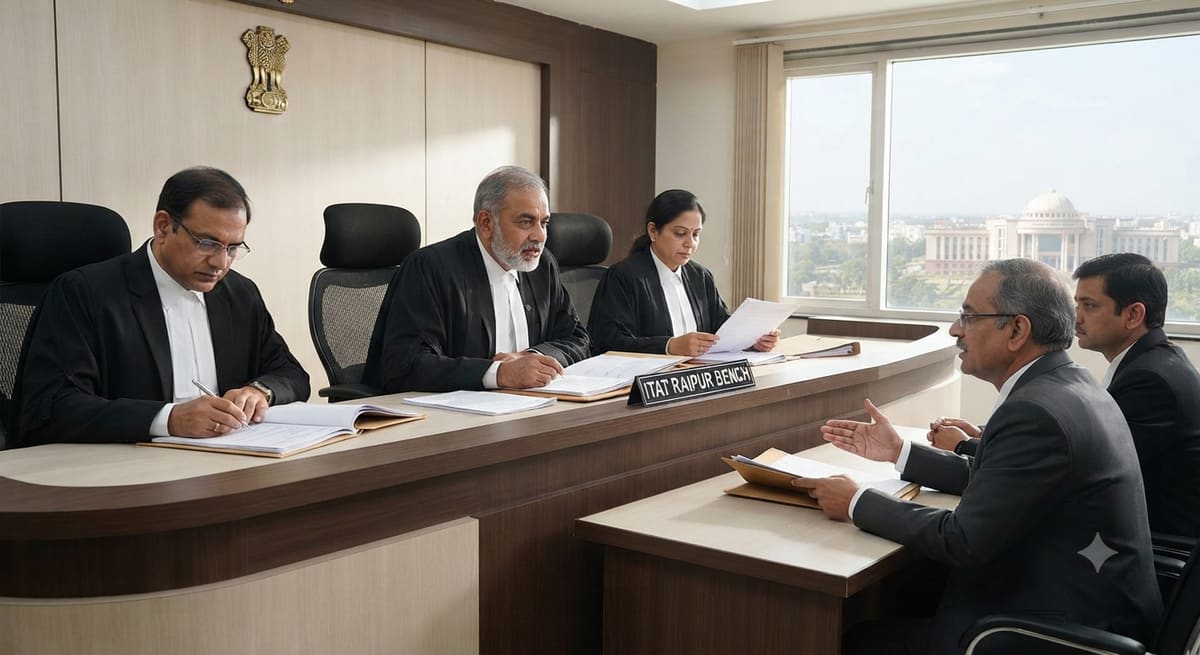
The ITAT Raipur has reaffirmed that procedural delays in filing appeals must not override the principles of substantial justice, particularly when the merits of a case remain unexamined. In a significant ruling, the Tribunal restored an appeal dismissed solely on technical grounds, directing the CIT(A) to reconsider the matter on its merits after condoning the delay.
Background & Facts
The Dispute
The appellant, Devguru Education, a partnership firm, filed its income tax return for Assessment Year 2018-19 on 31.10.2018 declaring NIL income. The case was subsequently reopened under Section 147 of the Income Tax Act, 1961, and a notice under Section 148 was issued. The firm failed to file a return in response. The Assessing Officer, relying on Section 56(2)(x), added Rs. 1,28,37,700 to the firm’s income, treating the purchase of immovable property on 30.01.2018 as an unexplained receipt. The firm challenged this addition through an appeal before the Commissioner of Income Tax (Appeals).
Key Facts
The firm filed its original return on 31.10.2018.
The notice under Section 148 was issued and served on the firm.
The firm did not file a return in response to the notice.
The Assessing Officer passed an order under Section 147 read with Sections 144 and 144B on 15.12.2024, adding Rs. 1,28,37,700 under "Income from Other Sources".
The firm filed its appeal before the CIT(A) on 04.03.2025, which was 54 days beyond the statutory 30-day limit under Section 249(1).
The CIT(A) dismissed the appeal on 12.01.2026 solely on the ground of delay, without considering the reasons for the delay or granting a hearing.
The firm claimed it was unaware of the CIT(A)’s order because notices were sent to a defunct email address.
Representations were made to the CIT(A) prior to dismissal, but no opportunity to explain the delay was granted.
Procedural History
31.10.2018: Original return filed declaring NIL income.
15.12.2024: Assessing Officer passed order under Section 147/144/144B adding Rs. 1,28,37,700.
04.03.2025: Appeal filed before CIT(A) - 54 days late.
12.01.2026: CIT(A) dismissed appeal for delay without hearing or condonation.
29.06.2026: Hearing held before ITAT Raipur.
15.07.2026: ITAT Raipur pronounced order.
Relief Sought
The appellant sought restoration of the appeal before the CIT(A) with direction to condone the delay and decide the matter on merit, including reconsideration of the addition under Section 56(2)(x) and the validity of the notice under Section 148.
The Legal Issue
The central question was whether the CIT(A) was justified in dismissing an appeal solely on the ground of delay without considering the reasons for the delay or granting an opportunity to explain it, particularly when the merits of the case remain unadjudicated.
Arguments Presented
For the Appellant
The learned Counsel for the assessee argued that the CIT(A) violated principles of natural justice by dismissing the appeal without hearing the appellant on the reasons for delay. He cited Clause 15 of Form No. 35, which permits explanation of delay, and emphasized that the delay was not deliberate - the notices were sent to a defunct email address. He relied on Collector, Land Acquisition v. Mst. Katiji & Ors. (167 ITR 471 SC) and Inder Singh v. State of Madhya Pradesh (2025 LiveLaw (SC) 339) to argue that substantial justice must prevail over technicalities. He requested that the matter be remanded to the CIT(A) for adjudication on merits after condoning the delay.
For the Respondent
The Senior DR contended that the delay of 54 days was unexplained and that the CIT(A)’s order, which was well-reasoned, should be upheld. He argued that the appellant had ample opportunity to file the appeal within time and that the dismissal was in accordance with statutory procedure. He submitted that the merits of the case were not relevant at the threshold stage of delay.
The Court's Analysis
The Tribunal acknowledged that while statutory timelines are mandatory, they are not absolute when their rigid application defeats the ends of justice. It emphasized that the CIT(A) failed to consider the explanation offered by the assessee regarding the defunct email address, which constituted a plausible, non-malicious reason for the delay.
"When substantial justice and technical considerations are pitted against each other, cause of substantial justice deserves to be preferred for the other side cannot claim to have vested right in injustice being done because of a non-deliberate delay."
The Tribunal further cited Inder Singh v. State of Madhya Pradesh, noting that "if in a particular case, the merits have to be examined, it should not be scuttled merely on the basis of limitation." The Tribunal held that dismissal at the threshold without hearing violates the principles of audi alteram partem and renders the appellate remedy illusory.
It observed that the addition under Section 56(2)(x) involved complex questions of fact and law - including whether the property purchase triggered taxable income and whether the notice under Section 148 was validly served. These issues could not be decided on the basis of procedural default alone.
The Tribunal concluded that the only fair course was to restore the appeal to the CIT(A) with a direction to condone the delay and decide the matter on its merits after affording a proper hearing.
The Verdict
The appeal was allowed for statistical purposes. The ITAT Raipur set aside the CIT(A)’s order dated 12.01.2026, directed condonation of the 54-day delay in filing the appeal, and restored the matter to the CIT(A) for fresh adjudication on merit. The CIT(A) was directed to afford the assessee a full opportunity of hearing and decide the appeal within 8 weeks from the date of receipt of the order. No costs were awarded.
What This Means For Similar Cases
Delay Cannot Be a Blanket Ground for Dismissal
Practitioners must now argue that any dismissal of appeal solely on delay, without examining the explanation or granting a hearing, is violative of natural justice.
The burden shifts to the revenue to prove mala fide or deliberate delay; mere lapse of time is insufficient.
Opportunity to Explain Delay Is Mandatory
Form No. 35, Clause 15, is not a formality - it is a statutory right to explain delay.
Failure to consider such explanations renders the order voidable.
All CIT(A)s and appellate authorities must record reasons for rejecting delay explanations, not merely state "delay not condoned."
Merits Must Be Examined Before Dismissal
Cases involving substantial tax liability, such as additions under Section 56(2)(x), require adjudication on facts.
Courts and tribunals must apply the "substantial justice over technicality" doctrine more rigorously in tax appeals.
This precedent empowers taxpayers to challenge dismissals on delay grounds in writ petitions before High Courts if the appellate authority refuses to condone delay without hearing.