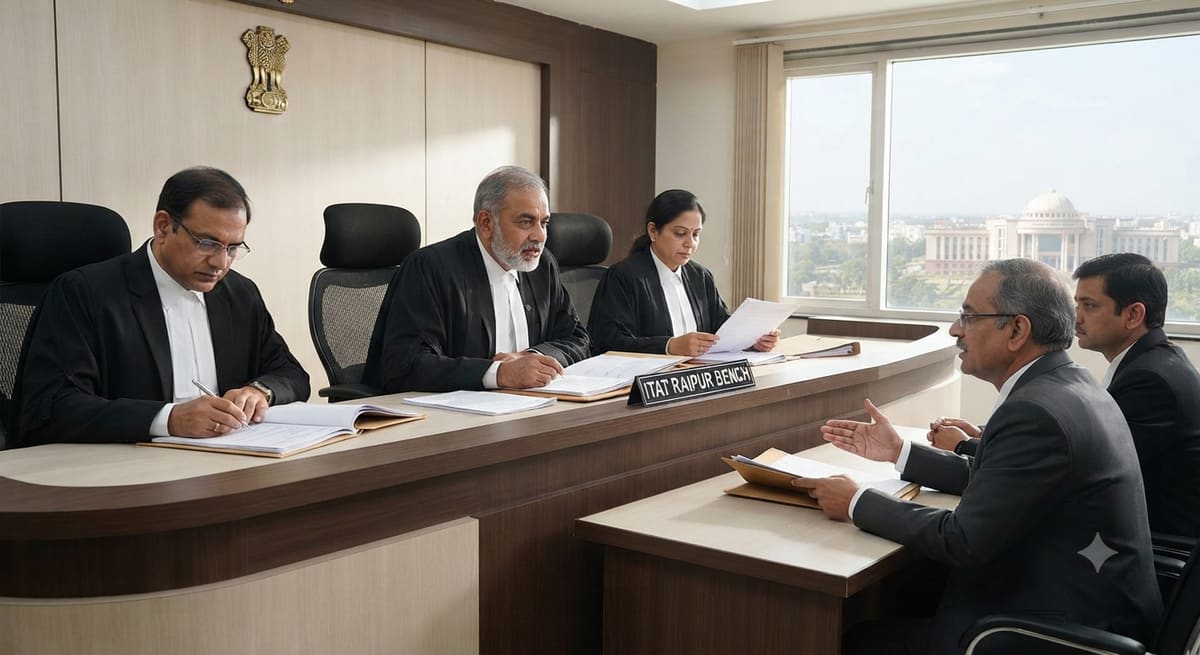
The Income Tax Appellate Tribunal, Kolkata, has reaffirmed a foundational principle of administrative law: that no taxpayer may be deprived of a fair hearing, even in the absence of representation. In a significant ruling, the Tribunal set aside an order dismissing an appeal in limine, holding that the Commissioner of Income Tax (Appeals) cannot bypass statutory obligations under Section 250 by treating the Assessing Officer’s order as self-speaking. This judgment reinforces procedural fairness as non-negotiable in tax adjudication.
Background & Facts
The Dispute
The appellant, Uttar Pradesh Safety Glass Works Private Limited, filed its return of income for Assessment Year 2016-17 on 27.09.2016, declaring a total income of ₹11,01,130. The case was reopened to examine a large transaction of ₹1,05,00,000 for the purchase of immovable property during FY 2015-16. The Assessing Officer (AO) questioned the source of funds used for this purchase and identified two claimed sources: a recovery of advances amounting to ₹81,60,000 from M/s Triveni Glass Ltd. and a loan of ₹40,00,000 from director Mrs. Meeta Agarwal.
Key Facts
- The AO found no documentary evidence supporting the advance given to M/s Triveni Glass Ltd. in prior years
- The closing balances of loans to M/s Triveni Glass Ltd. as per the balance sheet were ₹1,42,37,800 as of 31.03.2015 and ₹59,53,090 as of 31.03.2016
- These figures were disclosed under "Other Current Assets" in Schedule 14 of the balance sheet but were shown as ₹NIL in the respective income tax returns for AY 2015-16 and 2016-17
- The AO concluded that the ₹81,60,000 was an unexplained investment under Section 69 of the Income Tax Act, 1961 and added it to the income
- The total assessed income was raised to ₹92,61,130
- The appellant did not appear before the AO or the CIT(A) and submitted no documents or arguments
Procedural History
- 27.09.2016: Assessee filed return for AY 2016-17
- 2016-17: Assessment proceedings initiated; reopening for scrutiny of property purchase
- 30.01.2026: Order of Ld. CIT(A), NFAC, Delhi, passed dismissing appeal
- 15.11.2025: Last date of hearing fixed before CIT(A); assessee filed application for adjournment
- 30.01.2026: CIT(A) dismissed appeal in limine, holding that the assessee had not pressed any grounds due to non-submission of material
- 07.07.2026: Hearing concluded before ITAT Kolkata
- 15.07.2026: ITAT pronounced order
The Parties' Positions
The assessee, through its filed grounds of appeal, contended that:
- The CIT(A) dismissed the appeal without considering its application for adjournment filed on 15.11.2025
- The CIT(A) failed to provide an opportunity of being heard, violating principles of natural justice
- The addition under Section 69 was erroneous as the loan advances were verifiable through audited financial statements and prior returns
- The discrepancy in balance sheet disclosures and return filings was due to technical misclassification, not concealment
The Department, represented by Sr. DR Praveen Das Chowdhury, relied entirely on the CIT(A)’s order and urged the Tribunal to uphold it.
Relief Sought
The assessee sought:
- Setting aside of the CIT(A)’s order dated 30.01.2026
- Restoration of the appeal for fresh hearing with opportunity to present evidence and arguments
- Reconsideration of the addition under Section 69 on merits
- Cancellation of interest levied under Sections 234A, 234B, and 234C
The Legal Issue
The central question was whether the Commissioner of Income Tax (Appeals) can lawfully dismiss an appeal under Section 250 of the Income Tax Act, 1961 without affording the assessee an opportunity to be heard, particularly when an adjournment application has been filed, and whether the absence of representation justifies a non-speaking order.
Arguments Presented
For the Appellant/Petitioner
Although no advocate appeared for the assessee, the grounds of appeal filed before the Tribunal raised two critical legal contentions:
- The CIT(A) violated principles of natural justice by dismissing the appeal without considering the adjournment application filed on the last date of hearing
- The CIT(A) failed to pass a speaking order as mandated by Section 250(6), which requires the appellate authority to state the points for determination and the reasons for its decision
- The CIT(A) improperly treated the AO’s order as self-speaking, contrary to binding precedents in Ajji Basha v. CIT and Commissioner of Income-tax (Central) Nagpur v. Premkumar Arjundas Luthra (HUF)
For the Respondent/State
The Department, through its representative, did not advance independent arguments but relied solely on the CIT(A)’s reasoning that:
- The assessee had not submitted any material or arguments in support of its grounds
- In the absence of any representation, the CIT(A) was justified in upholding the AO’s order
- The appeal was effectively abandoned and could be dismissed for non-prosecution
The Court's Analysis
The Tribunal undertook a rigorous analysis of the statutory framework under Section 250 and the jurisprudence on natural justice in tax appeals. It emphasized that Section 250(6) mandates that every order passed by the CIT(A) must be a speaking order - one that articulates the points for determination and the reasons for the decision.
"The law does not empower the CIT(A) to dismiss the appeal for non-prosecution as is evident from the provisions of the Act."
The Tribunal cited Ajji Basha v. CIT (2019) and Premkumar Arjundas Luthra (HUF) (2016) to underscore that the CIT(A) cannot abdicate its duty by merely endorsing the AO’s order as self-speaking. The absence of representation by the assessee does not absolve the appellate authority of its statutory obligation to examine the merits of the appeal on the basis of the record.
The Tribunal further noted that the assessee had filed an application for adjournment on the last date of hearing - a fact that the CIT(A) entirely ignored. This omission was not merely procedural; it was a substantive violation of the right to be heard. The Tribunal held that even if the assessee was unrepresented, the appellate authority was duty-bound to ensure that the appeal was disposed of fairly and in accordance with law.
The Tribunal rejected the notion that non-appearance equates to abandonment. It observed that the assessee had filed a detailed appeal with eight grounds, indicating a clear intention to contest the assessment. The failure to appear may be due to inadvertence, lack of resources, or administrative oversight - none of which justify a summary dismissal without due process.
The Verdict
The appeal was partly allowed for statistical purposes. The Tribunal set aside the order of the CIT(A) dated 30.01.2026 and restored the appeal to the CIT(A) for fresh disposal. The CIT(A) was directed to afford the assessee a full opportunity to present its case, including submission of documents and arguments, and to also grant the AO an opportunity to respond under Rule 46A of the Income Tax Rules, 1962, if necessary. The CIT(A) must pass a speaking order addressing each ground of appeal on merits, in compliance with Section 250(6), within 8 weeks from the date of receipt of this order.
What This Means For Similar Cases
Speaking Orders Are Mandatory, Not Optional
- Practitioners must now insist that CIT(A) orders explicitly address each ground of appeal with reasoning
- Any order that merely states "no submissions received, hence AO’s order confirmed" is legally defective
- Appeals cannot be dismissed on technical grounds of non-appearance without examining whether the right to be heard was genuinely denied
Adjournment Applications Cannot Be Ignored
- Filing an adjournment request on the last date of hearing triggers a duty to consider it
- Courts and tribunals must record reasons for rejecting adjournment applications
- Failure to do so renders the final order vulnerable to being set aside on grounds of natural justice
Representation Is Not a Prerequisite for Fair Hearing
- The absence of an advocate does not negate the taxpayer’s right to a fair hearing
- Tax authorities must proactively ensure procedural compliance, even when the assessee is unrepresented
- This judgment empowers taxpayers to challenge summary dismissals in higher forums