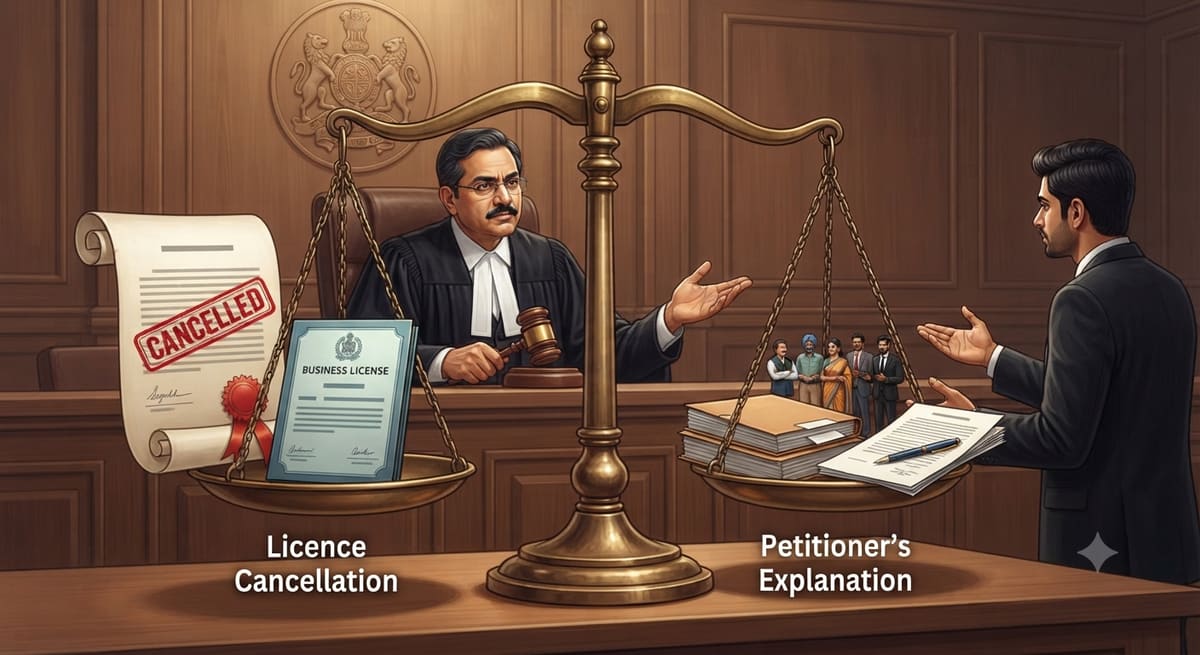
The Bombay High Court has held that refusal of a live music performance license based solely on public objections - without procedural fairness or objective legal grounds - violates both the principles of natural justice and the fundamental right to carry on business under Article 19(1)(g) of the Constitution. This judgment reinforces that administrative discretion must be exercised within statutory limits and cannot be substituted by public sentiment.
Background & Facts
The Dispute
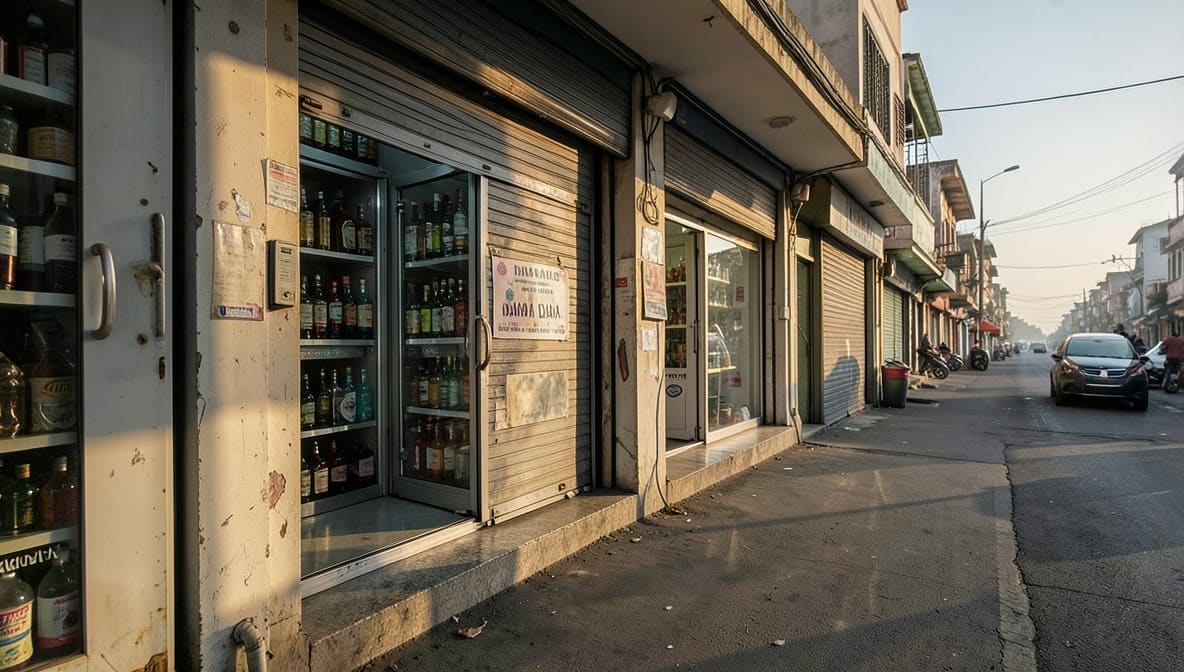
The petitioner, Shivaji Sambu Waghralkar, sole proprietor of M/s Hausa Restaurant & Bar, sought an Entertainment License to operate a live orchestra at his premises in The Affaire, Sector 17, Sanpada, Navi Mumbai. The establishment already held a valid Eating House License from the Municipal Corporation and a Foreign Liquor License-III (FL-III) under the Foreign Liquor Rules, 1953. The petitioner explicitly stated that he did not intend to host dance performances or a ladies bar. He applied for a Live Music Orchestra License under the Maharashtra Police Act, 1951 and the Public Amusement Rules, 1999, fulfilling all procedural requirements including obtaining a No Objection Certificate from the Vashi Police Station.
Key Facts
- The petitioner submitted his application for an Orchestra License on or before 15.01.2025.
- The Licensing Authority, Commissioner of Police, Navi Mumbai, issued a public notice under Rule 4 of the Public Amusement Rules, 1999 on 05.02.2025.
- In response, 23 Co-operative Housing Societies, 232 citizens/local public representatives, and one business association submitted objections.
- The objections primarily alleged that the petitioner would operate a dance bar or ladies bar, despite his categorical undertaking to the contrary.
- Media reports amplified these concerns, creating public pressure.
- On 24.02.2025, the Licensing Authority refused the license, citing apprehension of a serious law and order situation.
- The petitioner was not granted any personal hearing before this refusal.
- The petitioner filed an appeal under Section 33 of the Police Act, 1951 on 05.03.2025.
- On 14.08.2025, the Divisional Commissioner, Konkan Division, dismissed the appeal with a one-line reasoning: "The Licensing Authority rightly refused the license on law and order grounds."
- The petitioner filed the present writ petition under Articles 226 and 227 on 20.09.2025.
- The spot inspection report submitted by the Deputy Collector-cum-Special Executive Officer revealed that two other bars (91 Palm Lounge Bar and Rosewood Bar) in the same building already operated pre-recorded music.
- In the Navi Mumbai Commissionerate, 43 other establishments had been granted live orchestra licenses.
- The petitioner had previously operated a bar at Vashi, where five orchestra licenses had been suspended due to violations - facts not disclosed to the Licensing Authority but raised by the State in its affidavit-in-reply.
Procedural History
- 15.01.2025: Petitioner submits application for Orchestra License.
- 05.02.2025: Public notice issued under Rule 4 of Public Amusement Rules, 1999.
- 24.02.2025: Licensing Authority refuses license without hearing.
- 05.03.2025: Petitioner files appeal before Divisional Commissioner.
- 14.08.2025: Divisional Commissioner dismisses appeal with no substantive reasoning.
- 20.09.2025: Writ Petition No. 12910 of 2025 filed before Bombay High Court.
- 06.01.2026: Judgment reserved.
- 02.04.2026: Judgment pronounced.
The Parties' Positions
Petitioner: Argued that the refusal was arbitrary, violative of natural justice, and based on unsubstantiated fears of misuse. He emphasized that live music was not inherently objectionable and that 43 similar licenses had been granted in Navi Mumbai. He cited Hotel Priya v. State of Maharashtra and Indian Hotel and Restaurant Association v. State of Maharashtra to show that societal morality cannot override statutory rights.
Respondents: Contended that the Licensing Authority had a duty to prevent law and order disruption. They relied on the volume of objections and past violations at the petitioner’s Vashi establishment to justify refusal. They argued that discretion under Rule 104(g) was broad and that public interest outweighed individual rights.
Relief Sought
The petitioner sought quashing of the orders dated 24.02.2025 and 14.08.2025, and a direction to the Licensing Authority to grant the orchestra license within a stipulated time, subject to compliance with all other conditions.
The Legal Issue
Can a Licensing Authority refuse a performance license under Rule 104(g) of the Public Amusement Rules, 1999 solely on the basis of public objections alleging potential misuse, without providing a hearing or demonstrating a direct nexus to any of the statutory grounds for refusal?
Arguments Presented
For the Petitioner
The petitioner’s counsel argued that Rule 104(g) is not a catch-all provision for subjective public sentiment. The refusal was procedurally flawed as no hearing was granted, violating the foundational principle of audi alteram partem. He cited UMC Technologies v. FCI and CORE v. ECL SPIC SMO MCML to establish that administrative actions affecting livelihood require procedural fairness. He further relied on Hotel Priya and Indian Hotel and Restaurant Association to show that courts have consistently rejected moral policing under the guise of public order. The fact that 43 similar licenses had been issued rendered the refusal discriminatory and irrational.
For the Respondent
The State, through the AGP, contended that the Licensing Authority, being best placed to assess local law and order conditions, had exercised its discretion reasonably. The volume of objections from residents and local representatives justified the refusal. The AGP argued that the petitioner’s past violations at Vashi demonstrated a pattern of non-compliance, and that the right to carry on business under Article 19(1)(g) is subject to reasonable restrictions under Article 19(6). He further claimed that the appellate hearing cured any procedural defect.
The Court's Analysis
The Court undertook a rigorous analysis of Rule 104 of the Public Amusement Rules, 1999. It observed that Clauses (a) to (f) enumerate specific grounds for refusal - indecent content, sedition, religious offense, breach of peace, etc. - while Clause (g) is a residuary provision. Crucially, the Court held that Clause (g) cannot be invoked to bypass the specificity of (a) to (f). To permit refusal on vague grounds like "public opposition" would render the rule arbitrary and ultra vires.
"The Licensing Authority cannot substitute its own notion of public morality or succumb to public pressure under the guise of Clause (g). The legislature, not the public or the executive, is the final arbiter of what constitutes a lawful trade."
The Court emphasized that the petitioner’s proposed activity - live orchestra music - was not inherently noxious or illegal. The Supreme Court in State of Punjab v. Devans Modern Breweries had held that regulated activities, even those involving liquor, cannot be deemed criminal merely because of societal disapproval. Similarly, in Indian Hotel and Restaurant Association, the Court rejected the notion that dance performances are per se immoral.
The Court also rejected the State’s argument that the appellate hearing cured the initial denial of natural justice. Citing Krishnadatt Awasthy v. State of Madhya Pradesh, it held that a defective first-stage proceeding cannot be remedied by a subsequent appeal. The prejudice caused by the absence of a hearing at the initial stage - where the petitioner could have rebutted the allegations of intent to run a dance bar - was irreparable.
The Court further noted the inconsistency in the Licensing Authority’s conduct: granting licenses to 43 other establishments while denying one to the petitioner on identical premises, with no discernible distinction in risk profile. The presence of two other bars in the same building playing pre-recorded music further undermined the claim of unique law and order risk.
The Court concluded that the refusal was not based on any objective assessment of the proposed performance but on speculative fears rooted in misinformation. The petitioner’s undertaking not to host dance performances was binding and credible.
The Verdict
The petition was allowed. The orders dated 24.02.2025 and 14.08.2025 were quashed and set aside. The Licensing Authority was directed to grant the performance license for live orchestra music within four weeks from the date of communication of this order, subject to the petitioner fulfilling all other statutory conditions. No monetary compensation was awarded, as the relief sought was injunctive and declaratory.
What This Means For Similar Cases
Procedural Fairness Is Non-Negotiable in Licensing Decisions
- Practitioners must insist on a personal hearing before any adverse licensing decision, even if the statute does not explicitly mandate it.
- Administrative bodies cannot rely on anonymous or unverified public objections as a substitute for due process.
- Failure to provide a hearing at the first stage cannot be cured by appellate review.
Statutory Discretion Must Be Grounded in Objective Criteria
- Licensing authorities must tie refusals to specific grounds enumerated in the statute, not vague "public interest" or "morality" claims.
- Past conduct of the applicant may be relevant only if directly linked to the current application and disclosed in the proceedings.
- Consistency in granting similar licenses across comparable premises is a strong indicator of arbitrariness when one application is denied.
Public Morality Cannot Override Statutory Rights
-
Courts will not permit executive authorities to act as moral arbiters under the guise of public order.
-
Societal norms evolve; statutory frameworks must govern, not public sentiment.
-
The res extra commercium doctrine does not apply to regulated activities like live music in licensed premises.
-
Practitioners should cite Hotel Priya and Indian Hotel and Restaurant Association to challenge subjective licensing refusals.
-
Applications for entertainment licenses should include clear, written undertakings regarding scope of performance to preempt misuse allegations.
-
Where 40+ similar licenses exist in a jurisdiction, refusal of one without objective distinction invites judicial intervention under Article 14.