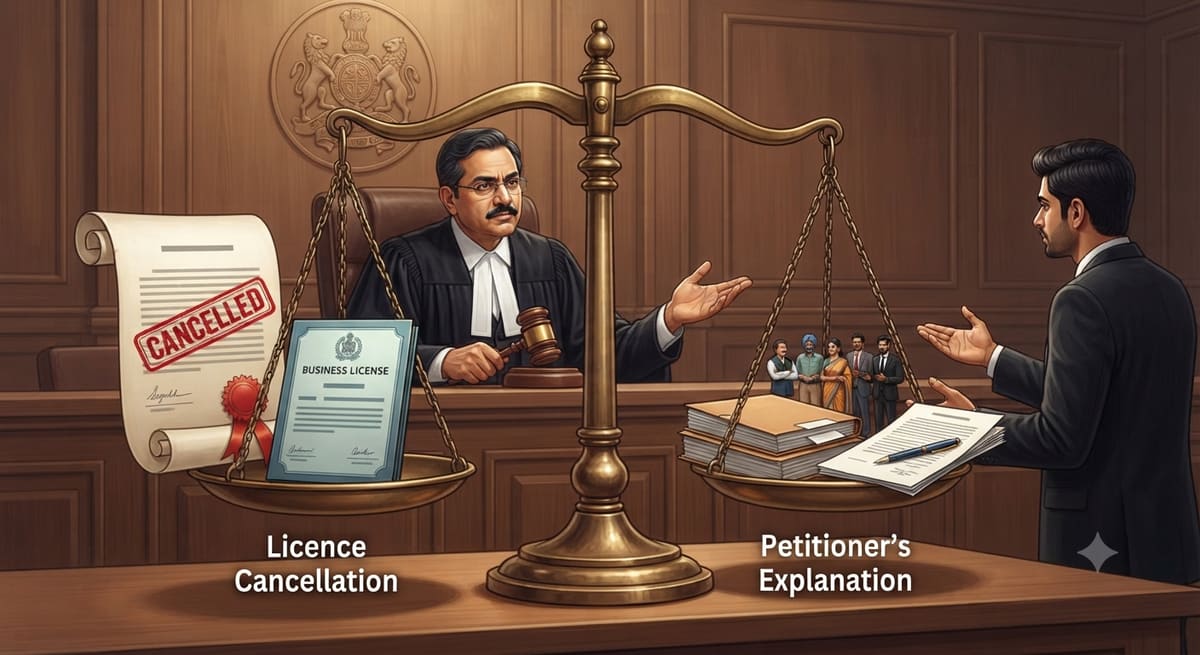
The Bombay High Court has reaffirmed that administrative penalties, particularly licence cancellations, must be proportionate and grounded in reasoned consideration of the accused’s explanation. In this case, the court set aside orders cancelling a liquor licence without evaluating the petitioner’s rebuttal or assessing whether such a severe penalty matched the nature of the alleged violation.
Background & Facts
The Dispute
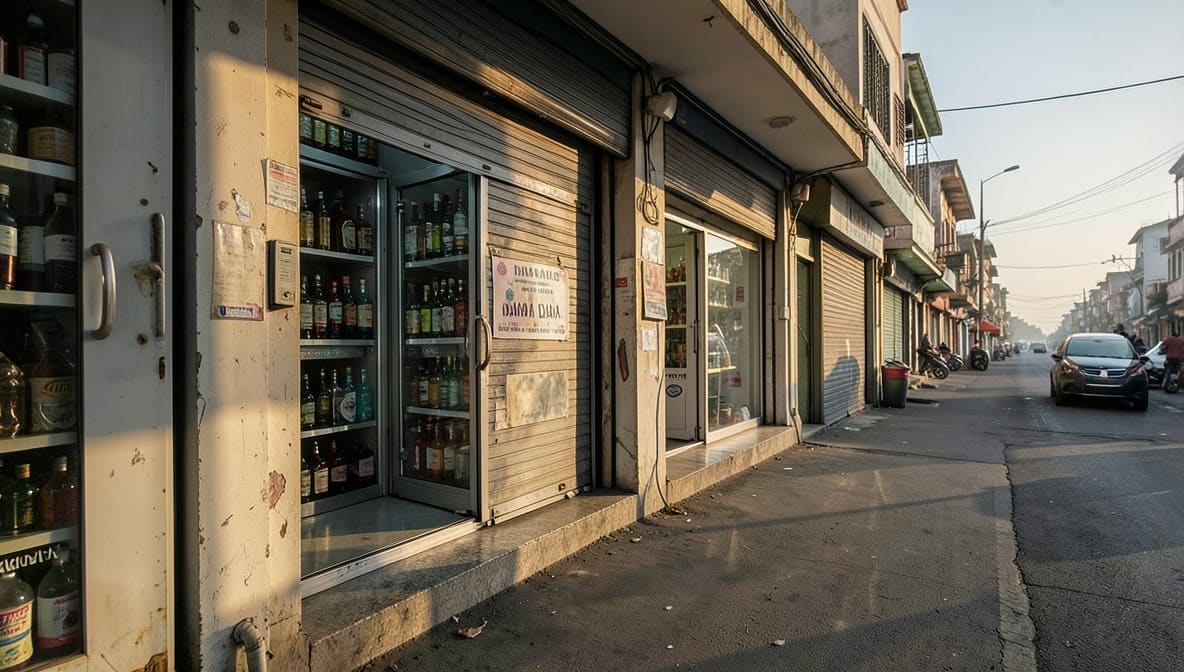
The petitioner, Shabnoor Ayub Pathan, held a valid liquor retail licence under the Goa, Daman and Diu Excise Duty Act, 1964. On 3 January 2018, she received a show cause notice alleging two violations: (1) operating the licensed premises beyond the legally prescribed closing time of 23:00 hours on the night of 31 December 2017 to 1 January 2018, and (2) permitting the licence to be operated through an appointed manager, which the authorities deemed an unlawful transfer under Rule 104(1) of the Excise Rules.
Key Facts
- The licensed premises were allegedly found open past 23:00 hours on the night of 31 December 2017 into 1 January 2018
- The show cause notice was issued on 03.01.2018
- The petitioner submitted a written reply on 06.01.2018, explaining that the lapse occurred during a public holiday period and was inadvertent
- The reply specifically denied any intentional transfer of the licence and clarified that the manager was duly appointed under the rules
- No independent evidence, such as surveillance footage or witness statements, was recorded to substantiate the allegations
- The penalty imposed was cancellation of the licence, a permanent and severe sanction
Procedural History
- 03.01.2018: Show cause notice issued by Respondent No.1 (Commissioner of Excise, Daman & Diu)
- 06.01.2018: Petitioner submitted written reply explaining circumstances of the alleged violation
- 05.07.2018: Respondent No.1 passed order cancelling the licence without addressing the petitioner’s reply or considering proportionality
- 10.04.2019: Respondent No.2 (Appellate Authority) confirmed the cancellation order without independent review
- 15.06.2020: Writ Petition No. 1463 of 2020 filed before the Bombay High Court
- 15.06.2026: Judgment delivered by Justice Amit Borkar
Relief Sought
The petitioner sought quashing of the orders dated 05.07.2018 and 10.04.2019, restoration of her liquor licence, and a direction to reconsider the matter with proper application of mind and adherence to principles of natural justice.
The Legal Issue
The central question was whether an administrative authority may impose the drastic penalty of licence cancellation without considering the licensee’s explanation or evaluating whether the punishment is proportionate to the alleged violation.
Arguments Presented
For the Petitioner
Mr. Vikram Sutaria argued that the authorities failed to apply their mind to the petitioner’s reply dated 06.01.2018, which offered a plausible explanation for the timing of the alleged breach - occurring during New Year’s Eve celebrations. He contended that cancellation of a licence, which effectively terminates a livelihood, is a disproportionate penalty for a single, non-recurring lapse, especially where no prior violations were recorded. He relied on State of Haryana v. Bhajan Lal and K. S. Puttaswamy v. Union of India to assert that administrative action must be reasonable and proportionate.
For the Respondent
Mr. Harsh Dedia submitted that the violation of Rule 19 (operating beyond hours) and Rule 104(1) (unauthorized transfer) were serious breaches warranting cancellation under the statutory framework. He argued that the licensing regime is regulatory in nature and strict compliance is necessary to prevent misuse. He did not dispute the absence of consideration of the reply but maintained that the facts themselves justified the penalty.
The Court's Analysis
Justice Amit Borkar observed that the impugned orders were devoid of any reasoning on the petitioner’s explanation. The authorities did not address whether the incident was isolated, whether the manager’s role was lawful, or whether the violation was intentional. The court emphasized that the right to carry on a lawful business is protected under Article 19(1)(g) of the Constitution, and any restriction must satisfy the test of proportionality.
"The authorities have not examined whether the penalty of cancellation of licence was proportionate to the nature of the alleged violations."
The court noted that the petitioner had not been given a personal hearing, and the appellate authority merely affirmed the original order without independent scrutiny. The failure to consider the reply dated 06.01.2018 amounted to a violation of natural justice. The court further held that cancellation of a licence is not an automatic consequence of a single breach, especially where the violation is not repeated or malicious. The principle of proportionality requires that the punishment fit the gravity of the offence, and the authorities must record reasons for choosing the most severe sanction.
The Verdict
The writ petition was allowed. The orders dated 05.07.2018 and 10.04.2019 were quashed and set aside. Respondent No.1 shall reconsider the matter afresh, after granting the petitioner a reasonable opportunity of being heard, and shall pass a reasoned order in accordance with law. There shall be no order as to costs.
What This Means For Similar Cases
Proportionality Is Mandatory in Licensing Sanctions
- Practitioners must now insist that authorities record explicit reasoning for imposing cancellation, suspension, or heavy fines
- A single, non-recurring breach without evidence of intent or harm cannot justify permanent licence cancellation
- The burden shifts to the authority to demonstrate why lesser penalties (fine, suspension, warning) are inadequate
Failure to Consider Reply Violates Natural Justice
- Written replies submitted in response to show cause notices are not formalities - they are substantive rights
- Administrative orders that ignore or gloss over a petitioner’s explanation are vulnerable to judicial review
- Courts will intervene where the record shows no evidence of application of mind to the defence offered
Licensing Authorities Must Distinguish Between Minor and Grave Violations
- Operating beyond hours on a public holiday is materially different from repeated trafficking or sale to minors
- Authorities must classify violations by severity and tailor penalties accordingly
- Blanket cancellation policies without individualized assessment are legally unsustainable